
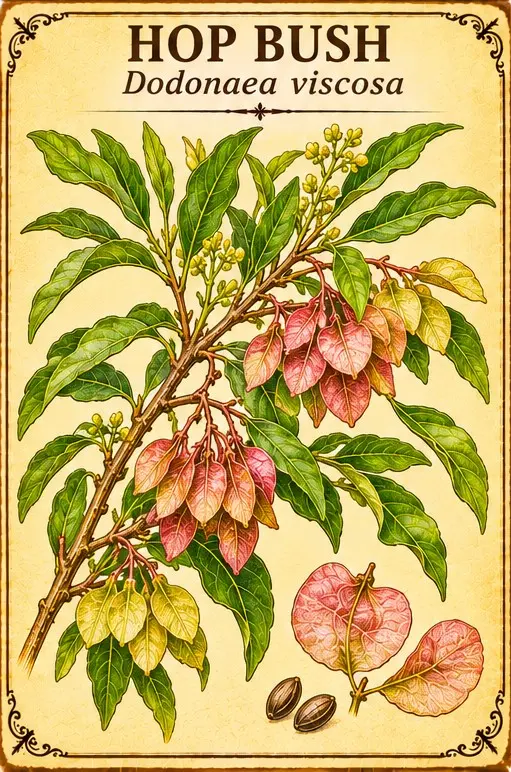
Hop Bush
Dodonaea viscosa
A hardy shrub used in traditional medicine on several continents, mainly on skin rashes, infections and wounds. Leaf extracts sped wound healing in rats.
Safety at a glance
- Pregnancy1 note →
- BreastfeedingNothing recorded
- MedicinesNothing recorded
- Who should avoid itNothing recorded
- AllergiesNothing recorded
- ToxicityNothing recorded
Tap a box to read the safety notes below. “Nothing recorded” means our sources don't cover it, not that it's safe.
What is Hop Bush?
- Plant family
- Sapindaceae, the soapberry family
- Parts used
- The leaves, and also roots
- Where it grows
- Tropical and subtropical regions worldwide
- Genus
- Dodonaea
- Species
- viscosa
Also called
Hopbush, Florida Hopbush
Traditionally used for
- Wounds
- Skin rashes
- Diarrhea (traditional)
Traditionally described as
- Leaves contain flavonoids
- saponins and phenols
Health topics
Where Hop Bush appears in symptom search, and why. Being listed doesn't mean it's a proven treatment.
- Cancer Research
Lab and animal studies only: listed among many effects, it slowed or killed some cancer cells. Not tested against cancer in people.
- Cuts, Wounds, Burns and Skin Ulcers
The leaves are a traditional wound remedy; sped healing in rats. Not tested in people.
- Diarrhea
Root extracts reduced diarrhea in mice. Not tested in people.
Safety
Pregnancy
A leaf extract was toxic to developing zebrafish embryos. Researchers advise caution with its use in pregnancy.[1]Study
What does the research say?
Traditional use
These are traditional uses, not proven treatments.
A hardy evergreen shrub with papery, winged seed pods, used in traditional medicine in more than 20 countries, from Australia and the Pacific to Africa, the Middle East, Asia and the Americas. The leaves are applied to skin rashes, infections and wounds.[2]Study
Laboratory & animal research
Lab and animal results show what might be worth studying in people. They don't show that the herb has these effects in humans.
In short
Toxic to zebrafish embryos; use caution in pregnancy.
Sources
- [1] The Reproductive Toxicity Associated with Dodonaea viscosa, a Folk Medicinal Plant in Saudi Arabia · DOI: 10.1155/2021/6689110Peer-reviewed study
- [2] Pharmacological properties of the ethnomedicinal plant Dodonaea viscosa: Anticancer potential and beyond (Review) · DOI: 10.3892/br.2026.2115Peer-reviewed study
This information is educational and traditional in nature, and is not a substitute for professional medical advice. Unfamiliar word? See what these words mean.