
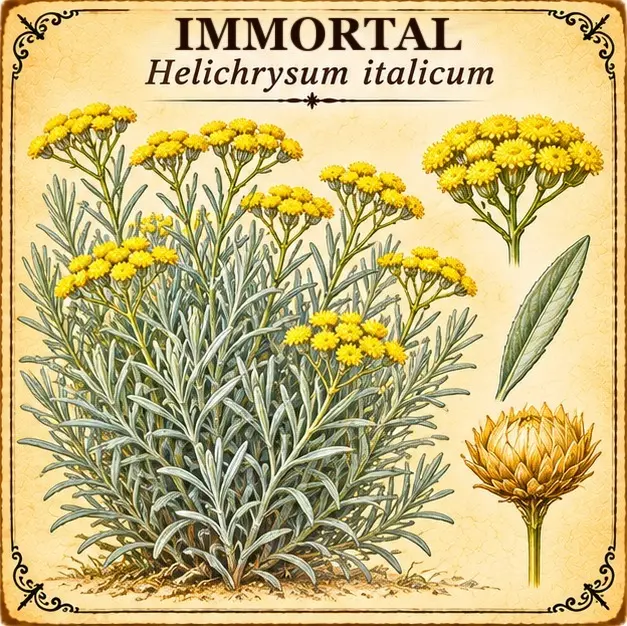
Immortal
Helichrysum italicum
A Mediterranean everlasting flower used for colds, cough, allergies, skin and liver complaints. No side effects were reported in clinical trials.
Safety at a glance
- PregnancyNothing recorded
- BreastfeedingNothing recorded
- Medicines1 note →
- Who should avoid itNothing recorded
- Allergies1 note →
- ToxicityNothing recorded
Tap a box to read the safety notes below. “Nothing recorded” means our sources don't cover it, not that it's safe.
Immortal may interact with some medicines. If you take any medicine, read Interactions with medicines below and talk to your doctor or pharmacist before using it.
What is Immortal?
- Plant family
- Asteraceae, the daisy family
- Parts used
- The flowers and leaves
- Where it grows
- The Mediterranean
- Genus
- Helichrysum
- Species
- italicum
Traditionally used for
- Cough
- Colds
- Skin
- Inflammation
Traditionally described as
- Rich in flavonoids and terpenes
Health topics
Where Immortal appears in symptom search, and why. Being listed doesn't mean it's a proven treatment.
- Cough
Used traditionally for cough and studied in mixed cough products.
Safety
Interactions with medicines
One of its flavonoids blocked some CYP enzymes, the liver enzymes that break down many drugs.[1]Study
Allergies
One allergic reaction to its extracts has been reported.[1]Study
Side effects
No side effects were reported in the clinical trials.[2]Study
What does the research say?
Traditional use
These are traditional uses, not proven treatments.
A Mediterranean plant whose yellow flowers keep their shape and color when dried, which is why the group is called "everlasting" or "immortal." It is used in Italy, Spain, Portugal and Bosnia and Herzegovina. The flowers and leaves are taken for allergies, colds, cough, skin problems, liver and gallbladder complaints, inflammation, infections and trouble sleeping.[1]Study
Laboratory & animal research
Lab and animal results show what might be worth studying in people. They don't show that the herb has these effects in humans.
In lab tests, its compounds fought bacteria such as Staph and the yeast Candida, and eased inflammation. Its flavonoids protected skin from sun redness in animals and people.[1]Study
Research in people
Six clinical trials looked at it for pain, cough and mental exhaustion, but it was usually mixed with other ingredients, so its own effect isn't clear.[2]Study
In short
Rare allergy; may affect drug-processing enzymes.
Sources
- [1] Helichrysum italicum: from traditional use to scientific data · DOI: 10.1016/j.jep.2013.11.005Peer-reviewed study
- [2] A Review and Evaluation of the Data Supporting Internal Use of Helichrysum italicum · DOI: 10.3390/plants10081738Peer-reviewed study
This information is educational and traditional in nature, and is not a substitute for professional medical advice. Unfamiliar word? See what these words mean.