
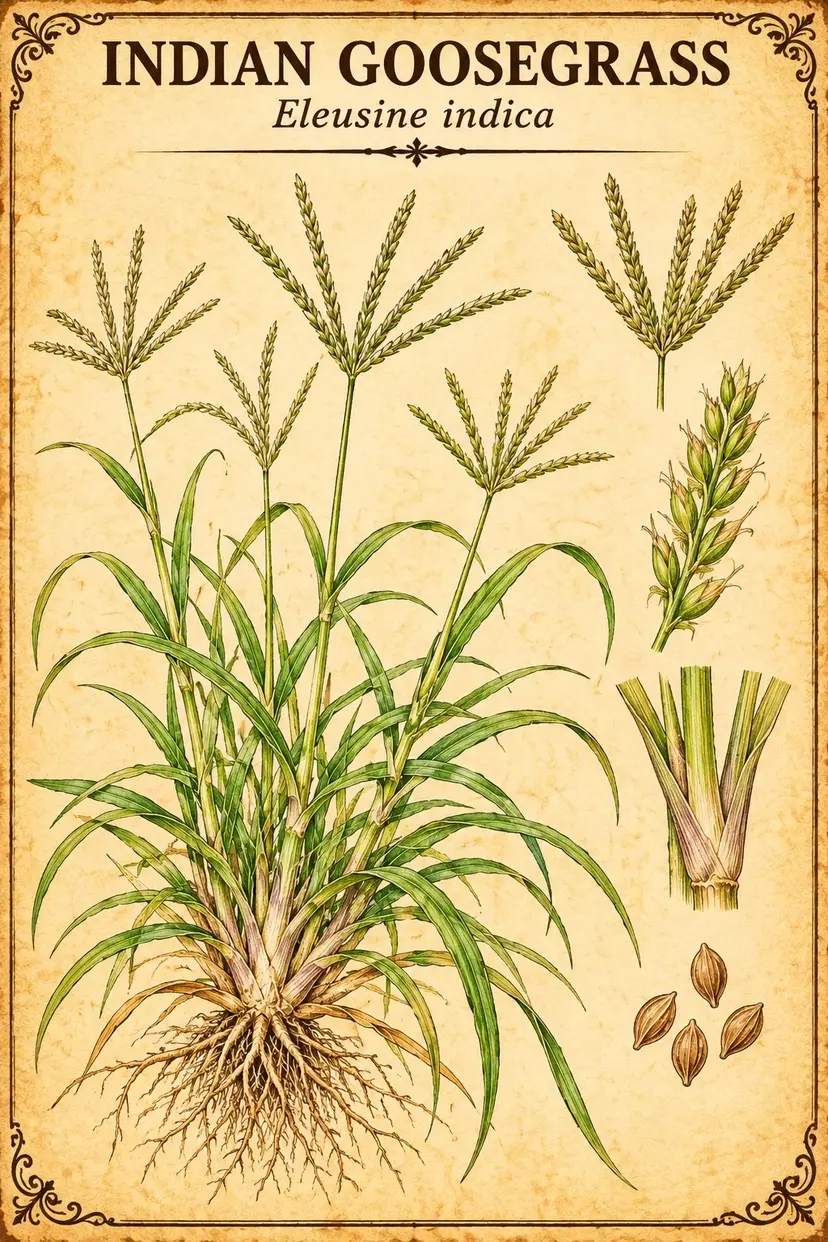
Indian Goosegrass
Eleusine indica
A common tropical weed grass, also called wiregrass, whose root and whole plant are boiled for fever, cough and worms. An extract lowered cholesterol in rats and protected their livers.
Safety at a glance
- PregnancyNothing recorded
- BreastfeedingNothing recorded
- MedicinesNothing recorded
- Who should avoid itNothing recorded
- AllergiesNothing recorded
- Toxicity1 note →
Tap a box to read the safety notes below. “Nothing recorded” means our sources don't cover it, not that it's safe.
What is Indian Goosegrass?
- Plant family
- Poaceae, the grass family
- Parts used
- The whole plant, especially the root, and the leaves
- Where it grows
- Tropical and subtropical Asia and Africa
- Genus
- Eleusine
- Species
- indica
Also called
Wiregrass
Regional names
Rumput Sambau, Sohinatad
Traditionally used for
- Fever
- Cough
- Worms
- Asthma (traditional)
Traditionally described as
- Contains lutein
- beta-sitosterol and stigmasterol
Health topics
Where Indian Goosegrass appears in symptom search, and why. Being listed doesn't mean it's a proven treatment.
- Asthma and Wheezing
A root decoction is a Malaysian remedy for asthma. Not studied in people.
- Cough
Traditionally used for cough. Not studied in people.
- Fever
A traditional fever remedy. Not studied in people.
- High Cholesterol
An extract lowered cholesterol in rats on a high-fat diet. Not tested in people.
Safety
Toxicity testing
In a rat safety test, a single large dose of an extract caused no deaths, toxic signs or tissue damage. No human safety studies were found.[1]Study
What does the research say?
Traditional use
These are traditional uses, not proven treatments.
A common tropical weed grass. In traditional medicine the whole plant, especially the root, is boiled and drunk for fever, cough and worms, and to increase urine. The seed has been eaten in famine and used for liver complaints.[2]Study
In Malaysia, leaf juice is used after childbirth to help deliver the placenta and ease pain from vaginal bleeding. A root decoction is used for asthma, and a whole-plant decoction for urinary infections.[3]Study
Laboratory & animal research
Lab and animal results show what might be worth studying in people. They don't show that the herb has these effects in humans.
In rats, a water extract protected the liver from chemical damage.[2]Study
In rats on a high-fat diet, an extract lowered body weight, cholesterol, triglycerides and LDL cholesterol, and raised HDL cholesterol. Its lutein blocked a fat-digesting enzyme in lab tests.[1]Study
In lab tests, a leaf extract from Cameroon protected cells from damage and may help reduce inflammation.[4]Study
In goats with gut worms, an extract cut worm eggs by up to 56%, less than the standard worming drug levamisole (97%).[5]Study
In short
No human safety studies were found.
Sources
- [1] Potential Lipid-Lowering Effects of Eleusine indica (L) Gaertn. Extract on High-Fat-Diet-Induced Hyperlipidemic Rats · DOI: 10.4103/0973-1296.203986Peer-reviewed study
- [2] Eleusine indica L. possesses antioxidant activity and precludes carbon tetrachloride (CCl₄)-mediated oxidative hepatic damage in rats · DOI: 10.1007/s12199-011-0255-5Peer-reviewed study
- [3] Annotation and Identification of Phytochemicals from Eleusine indica Using High-Performance Liquid Chromatography Tandem Mass Spectrometry: Databases-Driven Approach · DOI: 10.3390/molecules28073111Peer-reviewed study
- [4] Antioxidant and anti-inflammatory activities of extracts from Cassia alata, Eleusine indica, Eremomastax speciosa, Carica papaya and Polyscias fulva medicinal plants collected in Cameroon · DOI: 10.1371/journal.pone.0103999Peer-reviewed study
- [5] In vivo anthelmintic activity of Eleusine indica extracts against gastrointestinal nematodes of goats · DOI: 10.5455/javar.2023.j686Peer-reviewed study
This information is educational and traditional in nature, and is not a substitute for professional medical advice. Unfamiliar word? See what these words mean.