
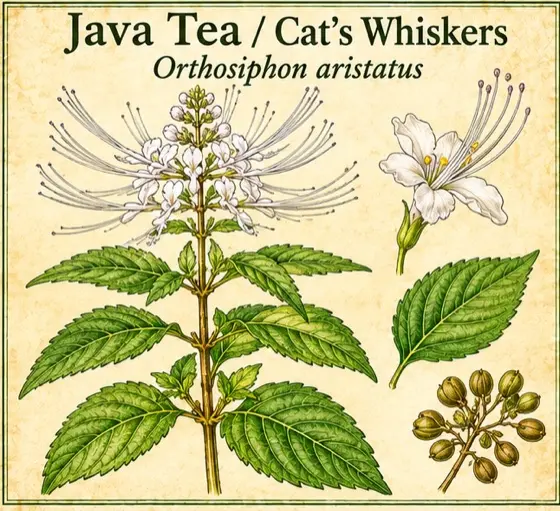
Java Tea
Orthosiphon aristatus
A Southeast Asian mint-family herb nicknamed cat's whiskers. Europe accepts its leaf as a traditional tea to increase urine and flush the urinary tract in minor urinary complaints.
Safety at a glance
- Pregnancy1 note →
- BreastfeedingNothing recorded
- MedicinesNothing recorded
- Who should avoid it1 note →
- AllergiesNothing recorded
- ToxicityNothing recorded
Tap a box to read the safety notes below. “Nothing recorded” means our sources don't cover it, not that it's safe.
What is Java Tea?
- Plant family
- Lamiaceae, the mint family
- Parts used
- The dried leaves and stem tips
- Where it grows
- Southeast Asia and tropical Australia
- Genus
- Orthosiphon
- Species
- aristatus
Also called
Cat's Whiskers, Kidney Tea
Traditional names
Misai Kucing, Orthosiphonis Folium
Older scientific names
Orthosiphon stamineus
Traditionally used for
- Flushing the urinary tract (traditional)
- Diabetic kidney disease (animal research)
Traditionally described as
- Leaves rich in polyphenols
Health topics
Where Java Tea appears in symptom search, and why. Being listed doesn't mean it's a proven treatment.
- Bladder and Urinary Tract Infections (UTIs)
Accepted in Europe as a traditional tea to flush the urinary tract in minor urinary complaints.
- High Blood Sugar
Lowered blood sugar and protected the kidneys in diabetic mice.
Natural compounds
How it's prepared
Common ways Java Tea is prepared or sold. This isn't advice on how to take it; see Safety below.
- Extract
Liquid and dry extracts are also used in Europe.[1]Health agency
- Tea / Infusion
2 to 3 g of dried leaf in 150 mL of boiling water, up to 12 g a day.[1]Health agency
Safety
Who should avoid it
Don't use Java tea if you've been told to limit fluids, for example because of severe heart or kidney disease. See a doctor if you get a fever, pain when urinating, spasms or blood in the urine.[1]Health agency
Side effects
No side effects or medicine interactions are known. Don't use it if you're allergic to it.[1]Health agency
Pregnancy
Its safety in pregnancy and breastfeeding hasn't been established, so it isn't recommended at these times. It isn't recommended for children and teenagers under 18 either, because of a lack of data.[1]Health agency
What does the research say?
Traditional use
These are traditional uses, not proven treatments.
Java tea is a Southeast Asian herb of the mint family, nicknamed "cat's whiskers" for the long white stamens that stick out of its flowers. Based on long-standing use, European regulators accept the leaf as a traditional herbal medicine. It increases urine to flush the urinary tract, alongside other care for minor urinary complaints.
This is based on long use, not on clinical trials.[1]Health agency
Technical detail: traditional-use indication as an adjuvant in minor urinary tract complaints.
The European guidance for adults is 2 to 3 g of cut dried leaf in 150 mL of boiling water as a tea, up to 12 g a day. Drink plenty of fluids while using it. See a doctor if symptoms last more than 2 weeks.[1]Health agency
Technical detail: powdered leaf, liquid extracts and several dry extracts are also covered.
Laboratory & animal research
Lab and animal results show what might be worth studying in people. They don't show that the herb has these effects in humans.
In China, Java tea ("kidney tea") is widely used for diabetic kidney disease. In diabetic mice, its extract lowered fasting blood sugar, reduced inflammation and kidney damage, and shifted gut bacteria. This is an animal study only.[2]Study
Technical detail: db/db mice; 12 polyphenols identified; inhibited ferroptosis (GPX4 and FTH1 up, ACSL4 and NCOA4 down); SOD increased, MDA and 4-HNE decreased.
In short
Avoid if you must limit fluids, such as with severe heart or kidney disease. Not recommended in pregnancy or under 18.
Sources
- [1] European Union herbal monograph on Orthosiphon aristatus (Blume) Miq. var. aristatus, folium, Revision 1 (EMA/HMPC/486551/2020) — European Medicines Agency, Committee on Herbal Medicinal Products (HMPC)Government health agency
- [2] Kidney tea [Orthosiphon aristatus (Blume) Miq.] improves diabetic nephropathy via regulating gut microbiota and ferroptosis · DOI: 10.3389/fphar.2024.1392123Peer-reviewed study
This information is educational and traditional in nature, and is not a substitute for professional medical advice. Unfamiliar word? See what these words mean.