
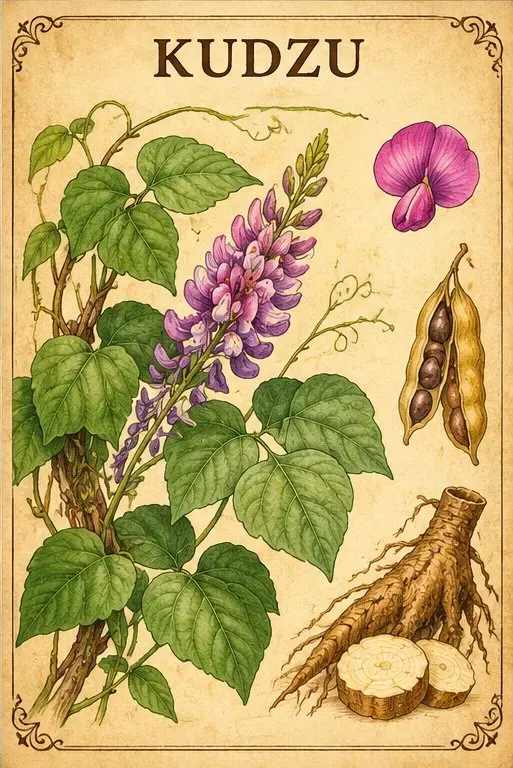
Kudzu
Pueraria montana var. lobata
A Chinese medicinal root. Small studies found its extract helped heavy drinkers drink less, but not people already in treatment.
Safety at a glance
- PregnancyNothing recorded
- BreastfeedingNothing recorded
- MedicinesNothing recorded
- Who should avoid itNothing recorded
- AllergiesNothing recorded
- ToxicityNothing recorded
Tap a box to read the safety notes below. “Nothing recorded” means our sources don't cover it, not that it's safe.
What is Kudzu?
- Plant family
- Fabaceae, the pea and bean family
- Parts used
- The root
- Genus
- Pueraria
- Species
- montana var. lobata
Traditional names
Puerariae Lobatae Radix
Older scientific names
Pueraria lobata
Traditionally used for
- Fever
- Thirst
- Diarrhea
- Rashes
- Effects of alcohol
Traditionally described as
- Isoflavone-rich root
Traditions that use it
- Traditional Chinese Medicine
A classic Chinese medicinal herb, traditionally used to relieve fever and thirst, stop diarrhea, help rashes come out and counter the effects of alcohol.
Safety
Side effects
No side effects, and no changes in liver or kidney blood tests, were seen in a 4-week study of kudzu extract in 17 men. The studies so far have been small.[1]Study
What does the research say?
Traditional use
These are traditional uses, not proven treatments.
Kudzu root has a long history in China as both a food and a medicine. Traditionally it has been used to:
- relieve fever
- ease thirst
- stop diarrhea
- help rashes come out
- counter the effects of alcohol
Research in people
In a 2013 study, 17 young men who drank heavily but were not seeking treatment took either a kudzu extract or a placebo every day for 4 weeks. Those on kudzu drank fewer drinks each week, had fewer heavy drinking days and more days without alcohol. It did not reduce their craving for alcohol. There were no side effects and no changes in liver or kidney tests.[1]Study
Technical detail: NPI-031, 250 mg isoflavones three times daily; randomized, double-blind, between-subject; weekly drinks fell by 34–57%.
In a 2015 study, 20 men took a single dose of kudzu extract or a placebo before a 90-minute session where they could drink up to 6 beers. The kudzu group cut down from about 3 beers to about 2 and drank more slowly, while the placebo group drank slightly more.[3]Study
Technical detail: single 2 g dose (520 mg isoflavones) 2.5 hours before; kudzu 3.0 to 1.9 beers; placebo 2.7 to 3.4 beers.
A 2011 study in 12 adults who drank moderately found that taking kudzu extract for 9 days did not make them feel more drunk, or affect their balance or reaction time, when they drank alcohol. Blood alcohol rose slightly faster for 10 to 15 minutes after the larger alcohol dose.[4]Study
Technical detail: 750 mg/day isoflavones; double-blind crossover; alcohol challenge 0.35 or 0.7 g/kg.
A 2026 trial gave 19 men and women in treatment for alcohol use disorder kudzu extract or a placebo for 8 weeks, along with weekly counseling. Kudzu worked no better than placebo for cutting down heavy drinking days. No safety problems were seen. The authors suggest kudzu may help reduce binge drinking but may not add anything for people already in a good treatment program.[5]Study
Technical detail: 750 mg/day isoflavones; heavy drinking days fell 30% with kudzu vs 44% with placebo.
In short
Research is small and limited.
Sources
- [1] A standardized kudzu extract (NPI-031) reduces alcohol consumption in nontreatment-seeking male heavy drinkers · DOI: 10.1007/s00213-012-2884-9Peer-reviewed study
- [2] Molecular Mechanisms and Therapeutic Potential of Puerariae Lobatae Radix in Bone Metabolism: A Comprehensive Review · DOI: 10.2147/DDDT.S620698Peer-reviewed study
- [3] A single dose of kudzu extract reduces alcohol consumption in a binge drinking paradigm · DOI: 10.1016/j.drugalcdep.2015.05.025Peer-reviewed study
- [4] Kudzu extract treatment does not increase the intoxicating effects of acute alcohol in human volunteers · DOI: 10.1111/j.1530-0277.2010.01390.xPeer-reviewed study
- [5] Effects of kudzu extract on alcohol consumption among men and women seeking treatment for alcohol use disorder · DOI: 10.1016/j.dadr.2026.100473Peer-reviewed study
This information is educational and traditional in nature, and is not a substitute for professional medical advice. Unfamiliar word? See what these words mean.