
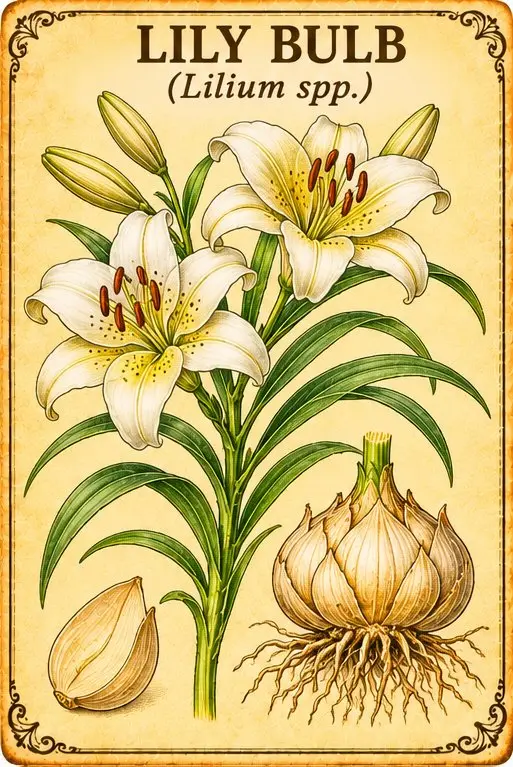
Lily Bulb
Lilium spp.
Baihe, lily bulbs eaten as food and used in Chinese medicine for breathing problems.
Safety at a glance
- PregnancyNothing recorded
- BreastfeedingNothing recorded
- MedicinesNothing recorded
- Who should avoid itNothing recorded
- AllergiesNothing recorded
- ToxicityNothing recorded
Tap a box to read the safety notes below. “Nothing recorded” means our sources don't cover it, not that it's safe.
What is Lily Bulb?
- Plant family
- Liliaceae, the lily family
- Parts used
- The bulb scales
- Genus
- Lilium
- Species
- brownii
Also called
Baihe, Lilii Bulbus
Traditionally used for
- Breathing problems (traditional)
- Food
Traditionally described as
- Bulb polysaccharides
Traditions that use it
- Traditional Chinese Medicine
Baihe preparations have been used for breathing problems.
What does the research say?
Traditional use
These are traditional uses, not proven treatments.
Lily bulb, known in China as Baihe, has a long history as both food and medicine. Preparations based on it have been used for breathing problems in traditional Chinese medicine, and Lanzhou lily is eaten as a vegetable.[1]Study
Laboratory & animal research
Lab and animal results show what might be worth studying in people. They don't show that the herb has these effects in humans.
Sugars (polysaccharides) from tiger lily bulbs (Lilium lancifolium) made immune cells more active in a 2017 lab study.[2]Study
In short
No safety data.
Sources
- [1] Lilium brownii/Baihe as Nutraceuticals: Insights into Its Composition and Therapeutic Properties · DOI: 10.3390/ph17091242Peer-reviewed study
- [2] Immune-enhancing effects of polysaccharides extracted from Lilium lancifolium Thunb. · DOI: 10.1016/j.intimp.2017.08.030Peer-reviewed study
This information is educational and traditional in nature, and is not a substitute for professional medical advice. Unfamiliar word? See what these words mean.