
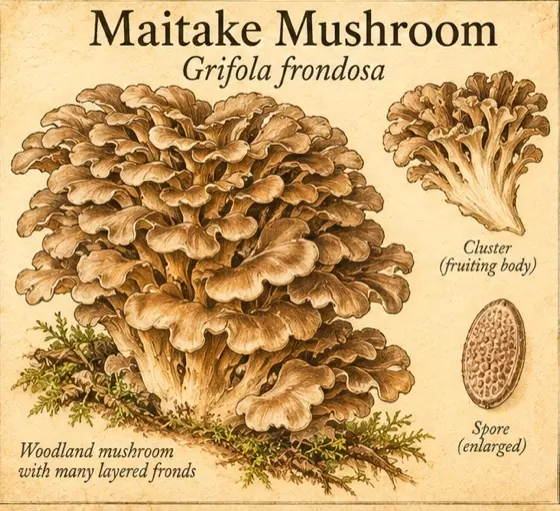
Maitake Mushroom
Grifola frondosa
A large, frilly edible mushroom known as hen of the woods. Small Japanese trials found one maitake strain eaten in bread eased cold symptoms and improved memory scores in older adults.
Safety at a glance
- PregnancyNothing recorded
- BreastfeedingNothing recorded
- MedicinesNothing recorded
- Who should avoid itNothing recorded
- AllergiesNothing recorded
- ToxicityNothing recorded
Tap a box to read the safety notes below. “Nothing recorded” means our sources don't cover it, not that it's safe.
What is Maitake Mushroom?
- Plant family
- Meripilaceae
- Parts used
- The fruiting body (eaten as food, or as extracts)
- Where it grows
- Temperate forests of Japan, China, Europe and North America
- Genus
- Grifola
- Species
- frondosa
Also called
Maitake, Hen of the Woods, Dancing Mushroom
Traditionally used for
- Food
- Immune support (studied)
- Memory (early research)
- Cancer research
Traditionally described as
- Rich in beta-glucan polysaccharides
Health topics
Where Maitake Mushroom appears in symptom search, and why. Being listed doesn't mean it's a proven treatment.
- Cancer Research
A small trial in breast cancer survivors found a maitake extract both boosted and dampened immune measures.
- Colds and Nasal Congestion
One maitake strain eaten in bread was linked to fewer days of fever and runny nose, though not fewer colds.
- Memory and Thinking
One maitake strain improved memory test scores in older adults in an 18-week trial.
Natural compounds
Safety
Side effects
In a trial of maitake extract, two people stopped because of mild side effects that may have been caused by it: nausea and joint swelling in one, and rash and itching in the other.[1]Study
What does the research say?
Laboratory & animal research
Lab and animal results show what might be worth studying in people. They don't show that the herb has these effects in humans.
In lab and animal studies, a polysaccharide (complex carbohydrate) extract of maitake affected the immune system.[1]Study
Research in people
In a 3-week trial, 34 women who'd finished breast cancer treatment took a maitake extract at different doses. No dose caused serious side effects. Blood tests showed the extract could both boost and dampen different parts of the immune system. The authors say cancer patients should know that herbs can have more complex effects than expected.[1]Study
Technical detail: phase I/II dose escalation, 0.1–5 mg/kg twice daily; no dose-limiting toxicity.
In a Japanese trial, healthy adults ate bread containing one of two maitake strains, or plain bread, for 11 to 18 weeks. Maitake didn't reduce how often people caught colds. But one strain (Y10M) was linked to fewer days of fever and runny nose, and to changes in immune cells.[2]Study
Technical detail: randomized, double-blind, placebo-controlled; young adults (18–20) and middle-aged/older adults (40–85). Y10M increased plasmacytoid dendritic cells and type I interferon-related gene expression; strain C5304 showed limited effects.
In an 18-week trial with 47 healthy Japanese adults aged 60 or older, eating bread containing 50 g of one maitake strain (Y10M) improved scores on a memory and thinking test compared with plain bread. Natural killer (immune) cell activity also rose. The other strain had no effect. No one stopped because of side effects.[3]Study
Technical detail: randomized, double-blind, placebo-controlled; outcome was the Japanese Montreal Cognitive Assessment (MoCA-J).
In short
A maitake extract both boosted and dampened immune measures in cancer survivors.
Sources
- [1] A phase I/II trial of a polysaccharide extract from Grifola frondosa (Maitake mushroom) in breast cancer patients: immunological effects · DOI: 10.1007/s00432-009-0562-zPeer-reviewed study
- [2] Maitake mushroom supplementation modulates upper respiratory symptoms and immune responses in healthy adults: a randomized, double-blind, placebo-controlled trial · DOI: 10.1039/d6fo01593jPeer-reviewed study
- [3] Maitake Mushroom (Grifola frondosa) Enhances Cognitive Function in Healthy Older Japanese: A Randomized, Double-Blind, Placebo-Controlled Trial · DOI: 10.3177/jnsv.72.163Peer-reviewed study
This information is educational and traditional in nature, and is not a substitute for professional medical advice. Unfamiliar word? See what these words mean.