
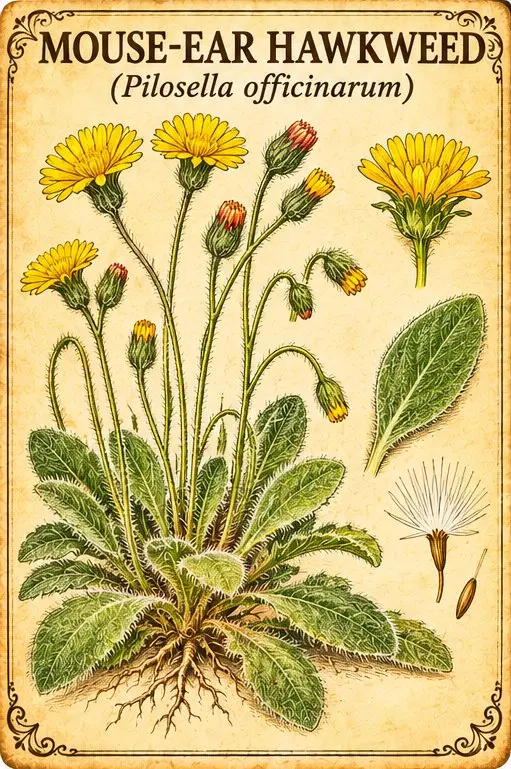
Mouse-Ear Hawkweed
Pilosella officinarum
A plant recognized in Europe as a traditional medicine for minor urinary complaints.
Safety at a glance
- Pregnancy1 note →
- BreastfeedingNothing recorded
- MedicinesNothing recorded
- Who should avoid it1 note →
- Allergies1 note →
- ToxicityNothing recorded
Tap a box to read the safety notes below. “Nothing recorded” means our sources don't cover it, not that it's safe.
What is Mouse-Ear Hawkweed?
- Plant family
- Asteraceae, the daisy family
- Parts used
- The whole plant, above and below ground, as a tea or powder
- Genus
- Pilosella
- Species
- officinarum
Older scientific names
Hieracium pilosella
Traditionally used for
- Minor urinary complaints
Traditionally described as
- Whole plant
Health topics
Where Mouse-Ear Hawkweed appears in symptom search, and why. Being listed doesn't mean it's a proven treatment.
- Bladder and Urinary Tract Infections (UTIs)
Recognized in Europe as a traditional medicine for minor urinary complaints, alongside plenty of fluids. See a doctor for fever, pain or blood in the urine.
Traditions that use it
- European Folk Medicine
Recognized in the European Union as a traditional herbal medicine to relieve minor urinary complaints, alongside drinking plenty of fluids.
Safety
Who should avoid it
Not for anyone under 18. Don't use it if a doctor has told you to drink less fluid. See a doctor if you get a fever, pain when urinating, cramps or blood in the urine, or if symptoms last longer than 2 weeks.[1]Health agency
Allergies
Don't use it if you are allergic to mouse-ear hawkweed or other plants in the daisy family (Asteraceae).[1]Health agency
Side effects
No side effects have been reported. No interactions with medicines have been described.[1]Health agency
Pregnancy
Don't use it if you are pregnant or breastfeeding.[1]Health agency
How much to use
For adults: a tea made with 2 to 4 g of the dried herb in 250 ml of boiling water, 3 times a day, or 200 to 520 mg of the powdered herb 2 to 4 times a day (560 to 1,300 mg a day).[2]Health agency
What does the research say?
Traditional use
These are traditional uses, not proven treatments.
The European Medicines Agency recognizes mouse-ear hawkweed as a traditional herbal medicine for adults, to relieve the symptoms of minor urinary tract complaints, alongside drinking plenty of fluids to pass more urine. This is based on long-standing use, not on clinical studies.[1]Health agency
In short
Adults only; not in pregnancy; avoid if allergic to daisy-family plants.
Sources
- [1] Assessment report summary for the public: Mouse-ear hawkweed (EMA/HMPC/387725/2025) — European Medicines Agency, Committee on Herbal Medicinal Products (HMPC)Government health agency
- [2] European Union herbal monograph on Pilosella officinarum Vall. (syn Hieracium pilosella L.), herba cum radice, revision 1 (EMA/HMPC/493453/2023) — European Medicines Agency, Committee on Herbal Medicinal Products (HMPC)Government health agency
This information is educational and traditional in nature, and is not a substitute for professional medical advice. Unfamiliar word? See what these words mean.