
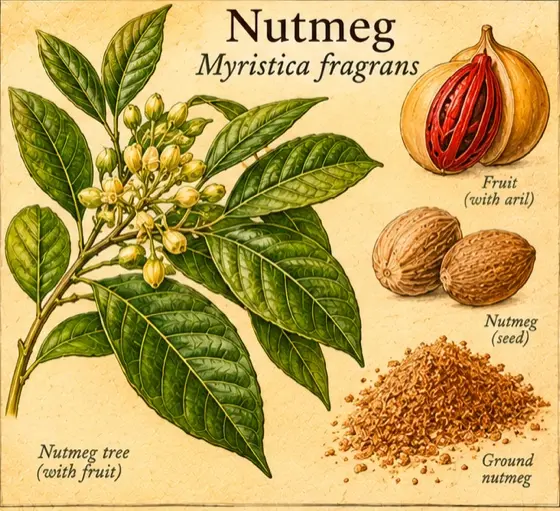
Nutmeg
Myristica fragrans
A familiar kitchen spice and a traditional Chinese remedy for diarrhea. In large amounts, nutmeg causes poisoning, with a racing heart, hallucinations and drowsiness.
Safety at a glance
- PregnancyNothing recorded
- BreastfeedingNothing recorded
- MedicinesNothing recorded
- Who should avoid itNothing recorded
- AllergiesNothing recorded
- Toxicity2 notes →
Tap a box to read the safety notes below. “Nothing recorded” means our sources don't cover it, not that it's safe.
What is Nutmeg?
- Plant family
- Myristicaceae, the nutmeg family
- Parts used
- The seed (nutmeg); its red seed covering is sold as mace
- Where it grows
- The Banda Islands (Maluku) of Indonesia; now grown across the tropics
- Genus
- Myristica
- Species
- fragrans
Also called
Mace
Traditional names
Rou Dou Kou, Jaiphal
Traditionally used for
- Spice
- Diarrhea (traditional Chinese)
Traditionally described as
- Seed rich in lignans and terpenoids
Health topics
Where Nutmeg appears in symptom search, and why. Being listed doesn't mean it's a proven treatment.
- Diarrhea
Traditionally used in Chinese medicine to stop diarrhea.
- Poisonous Plants
Large amounts of nutmeg cause poisoning, with a racing heart, hallucinations and drowsiness.
Traditions that use it
- Traditional Chinese Medicine
Introduced to China around the 3rd to 4th centuries CE; classical texts describe it as warming the digestion and stopping diarrhea.
Natural compounds
How it's prepared
Common ways Nutmeg is prepared or sold. This isn't advice on how to take it; see Safety below.
- Culinary Preparation
Grated or ground as a spice, in small amounts.[1]Study
Safety
Toxicity testing
Nutmeg is a common kitchen spice, but in large amounts it can make you high and cause hallucinations, and it can poison you. Over 10 years, the Swiss poison center was asked about 236 people (aged 0 to 85) who may have been poisoned by nutmeg. Enquiries peaked in 2020 and 2021, when a TikTok "nutmeg challenge" was popular.[1]Study
A 23-year-old man who ate 75 g of nutmeg developed a racing heart and wide pupils 4 hours later. He became very drowsy after about 14 hours. All symptoms went away by themselves within 26 hours. Most nutmeg poisonings are mild.[1]Study
Technical detail: tachycardia and mydriasis; monitored in intensive care; he was taking fluoxetine and quetiapine long term.
What does the research say?
Traditional use
These are traditional uses, not proven treatments.
Nutmeg is the seed of a tropical evergreen tree and a familiar kitchen spice. It's also a long-standing medicine in Asia. It reached China around the 3rd to 4th centuries CE. Classical Chinese medical texts say it warms the digestion, helps energy (qi) flow and stops diarrhea.[2]Study
Technical detail: "warming the middle jiao to promote qi flow, and astringing the intestines to relieve diarrhea."
Laboratory & animal research
Lab and animal results show what might be worth studying in people. They don't show that the herb has these effects in humans.
Nutmeg's main active compounds are lignans and terpenoids. In lab and animal research, they affected the digestive system and protected nerve cells, which may help explain its traditional uses. These effects haven't been tested in people.[2]Study
In short
Large amounts are toxic and psychoactive; poisonings rose with a TikTok challenge.
Sources
- [1] Intoxication with nutmeg: A case presentation and analysis of Swiss poisons information center (Tox Info Suisse) enquiries 2014-2023 · DOI: 10.1016/j.toxrep.2026.102274Peer-reviewed study
- [2] Myristica fragrans: A comprehensive review of its botanical characterization, traditional uses, phytochemistry, and pharmacological properties · DOI: 10.1016/j.jep.2025.120916Peer-reviewed study
This information is educational and traditional in nature, and is not a substitute for professional medical advice. Unfamiliar word? See what these words mean.