
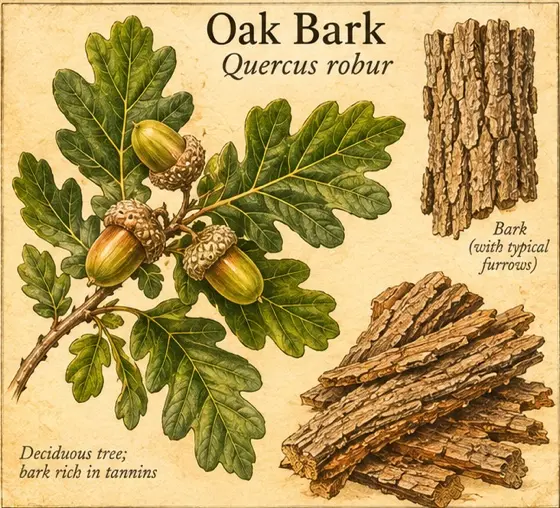
Oak Bark
Quercus robur
The tannin-rich bark of the European oak, accepted in Europe as a traditional remedy for mild diarrhea, minor mouth and skin inflammation, and itchy piles.
Safety at a glance
- Pregnancy1 note →
- BreastfeedingNothing recorded
- Medicines1 note →
- Who should avoid it1 note →
- AllergiesNothing recorded
- ToxicityNothing recorded
Tap a box to read the safety notes below. “Nothing recorded” means our sources don't cover it, not that it's safe.
Oak Bark may interact with some medicines. If you take any medicine, read Interactions with medicines below and talk to your doctor or pharmacist before using it.
What is Oak Bark?
- Plant family
- Fagaceae
- Parts used
- The dried bark of young branches
- Where it grows
- Europe and western Asia
- Genus
- Quercus
- Species
- robur
Also called
English Oak, Pedunculate Oak
Traditional names
Quercus Cortex
Traditionally used for
- Mild diarrhea (traditional)
- Mouth and skin inflammation (traditional)
- Hemorrhoids (traditional)
Traditionally described as
- Very rich in tannins; astringent
Health topics
Where Oak Bark appears in symptom search, and why. Being listed doesn't mean it's a proven treatment.
- Diarrhea
Accepted in Europe as a traditional remedy for mild diarrhea, for up to 3 days.
- Skin Irritation, Rashes and Itching
Used in Europe as a traditional rinse, poultice or bath for minor skin and mouth inflammation.
Traditions that use it
- European Folk Medicine
Oak bark is a long-established European remedy for mild diarrhea, sore mouth and gums, skin inflammation and itchy piles.
Natural compounds
Safety
Interactions with medicines
Oak bark taken by mouth may slow the absorption of other medicines. Take it at least 1 hour before or after other medicines.[1]Health agency
Who should avoid it
Don't use oak bark baths on open wounds, large areas of damaged skin, or skin infections. Hot baths aren't advised if you have a fever or an infection, heart failure or high blood pressure.[1]Health agency
Side effects
Allergic reactions have been reported. See a doctor if diarrhea keeps coming back or there's blood in the stool, or if you have rectal bleeding while using it for piles.[1]Health agency
Pregnancy
Its safety in pregnancy and breastfeeding hasn't been established, so it isn't recommended at these times. It isn't recommended for children and teenagers under 18 either, because of a lack of data.[1]Health agency
What does the research say?
Traditional use
These are traditional uses, not proven treatments.
Based on long-standing use, European regulators accept oak bark as a traditional herbal medicine for:
- Mild diarrhea (as a tea or capsules)
- Minor inflammation of the mouth or skin (as a rinse, poultice or bath)
- Itching and burning from piles (hemorrhoids), once a doctor has ruled out anything serious
This is based on long use, not on clinical trials.[1]Health agency
Technical detail: traditional-use indications; preparations include comminuted bark as tea or decoction, powdered bark and a dry ethanolic extract.
Typical adult doses in the European guidance:
- Diarrhea: 3 g of cut bark in 250 mL of water, three times a day, for no more than 3 days
- Mouth or skin: a decoction of 20 g per liter as a rinse, or 5 g per liter added to a 20-minute bath, for no more than 1 week
Research in people
Note: this study used an extract of oak wood, not bark. In a trial in women recovering from a hysterectomy, an oak-wood extract (Robuvit, 300 mg a day) for 4 weeks improved general and mental health scores and lowered oxidative stress compared with a placebo. By 8 weeks, both groups had improved equally.[2]Study
Technical detail: randomized, double-blind, placebo-controlled pilot (ISRCTN 11457040); extract standardized to at least 40% ellagitannins; SF-36 questionnaire; MMP-9 activity also fell.
In short
Not for children, pregnancy or breastfeeding. Take 1 hour apart from other medicines. Don't use baths on open wounds or skin infections.
Sources
- [1] Community herbal monograph on Quercus robur L., Quercus petraea (Matt.) Liebl., Quercus pubescens Willd., cortex (EMA/HMPC/3203/2009) — European Medicines Agency, Committee on Herbal Medicinal Products (HMPC)Government health agency
- [2] The Oak-wood Extract Robuvit® Improves Recovery and Oxidative Stress after Hysterectomy: A Randomized, Double-blind, Placebo-controlled Pilot Study · DOI: 10.3390/nu12040913Peer-reviewed study
This information is educational and traditional in nature, and is not a substitute for professional medical advice. Unfamiliar word? See what these words mean.