
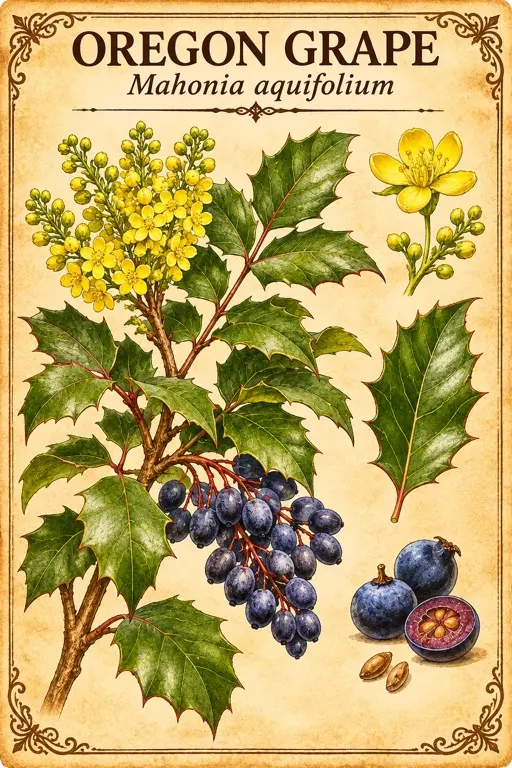
Oregon Grape
Mahonia aquifolium
An evergreen shrub from western North America with holly-like leaves, yellow flowers and dusty blue berries. Creams made from its berberine-rich bark have been tested in several small trials for psoriasis and eczema.
Safety at a glance
- PregnancyNothing recorded
- BreastfeedingNothing recorded
- MedicinesNothing recorded
- Who should avoid itNothing recorded
- AllergiesNothing recorded
- ToxicityNothing recorded
Tap a box to read the safety notes below. “Nothing recorded” means our sources don't cover it, not that it's safe.
What is Oregon Grape?
- Plant family
- Berberidaceae, the barberry family
- Parts used
- The bark of the stem and root (in creams and ointments)
- Where it grows
- Western North America
- Genus
- Mahonia
- Species
- aquifolium
Also called
Mahonia, Holly-leaved Barberry, Mountain Grape
Older scientific names
Berberis aquifolium
Traditionally used for
- Psoriasis (cream)
- Eczema (cream)
- Skin infections (traditional)
Traditionally described as
- Bark contains the yellow alkaloids berberine and jatrorrhizine
Health topics
Where Oregon Grape appears in symptom search, and why. Being listed doesn't mean it's a proven treatment.
- Acne
Lab research only: its bark extract and alkaloids slowed acne bacteria taken from patients.
- Eczema
An open 12-week trial of an Oregon grape cream improved eczema scores in 42 adults; there was no comparison group.
- Skin Irritation, Rashes and Itching
Mostly studied as a cream for psoriasis, with several small trials reporting improvement.
Natural compounds
Safety
Side effects
In a psoriasis trial with 82 people, 4 had side effects from the ointment, including itching, burning and allergic skin reactions.[1]Study
Plant-based psoriasis treatments put on the skin, including Oregon grape, most often cause:
- Skin irritation and redness
- Itching
- Burning or pain
What does the research say?
Traditional use
These are traditional uses, not proven treatments.
Oregon grape bark has traditionally been used for infections of the skin and of moist linings such as the mouth, applied directly to the affected spot.[3]Study
Technical detail: traditional use for localized skin and mucosal infections.
Laboratory & animal research
Lab and animal results show what might be worth studying in people. They don't show that the herb has these effects in humans.
In lab tests, a bark extract and its two main alkaloids, berberine and jatrorrhizine, slowed the growth of:
- Acne bacteria and skin staph bacteria taken from people with severe acne
- Candida yeast taken from women with repeated vaginal yeast infections
Technical detail: minimum inhibitory concentrations against 20 strains each of coagulase-negative staphylococci, Propionibacterium acnes and Candida sp.
Research in people
Oregon grape is native to the United States. A 2018 review found 8 trials of Oregon grape applied to the skin: 7 in psoriasis and 1 in eczema. Five of the 7 psoriasis trials, and the eczema trial, found a real improvement. Side effects were minimal. No trials have been done for other skin conditions.[4]Review or trial
Technical detail: risk of bias was unclear or low (Cochrane Risk of Bias Tool).
In a trial with 82 people with psoriasis, each person put an Oregon grape bark ointment on one side of the body and a placebo ointment on the other, for about 4 weeks. Patients rated the Oregon grape side as better, but their doctors didn't see a clear difference.[1]Study
Technical detail: randomized, placebo-controlled, within-person (left/right) design, run by 22 family physicians in Germany; significant difference for patient but not physician ratings on a three-level scale.
Three open trials tested a 10% Oregon grape cream for mild to moderate psoriasis:
- In 39 people over 12 weeks, skin scores and quality of life improved within 4 weeks, and the benefit lasted a month after stopping.
- In 32 people treating one side with the cream and the other with a standard prescription cream, 63% rated Oregon grape as good as or better than the standard cream.
- In 33 people over 1 month, the Oregon grape side did as well as or better than a cream without the extract.
In open trials, people know what they're using, which can affect the results.[5]Study
Technical detail: modified PASI and Dermatology Life Quality Index improved significantly after 4 weeks in study 1; the standard treatment in study 2 included calcipotriol (Dovonex) cream; 84% rated the Mahonia side good to excellent.
In an open trial with 42 adults with eczema, an Oregon grape cream used for 12 weeks improved eczema scores compared with the start. People also reported less itching. There was no comparison group.[6]Study
Technical detail: Reliéva cream, a homeopathic product containing a proprietary Mahonia aquifolium extract (Psorberine); Eczema Area and Severity Index improved significantly from baseline (P < 0.05).
A 2017 review of plant-based skin treatments for psoriasis found that Oregon grape was among the most studied and most effective. But overall the evidence is still limited in amount and quality.[2]Review or trial
Technical detail: 27 controlled and uncontrolled trials of topical botanicals; the others most studied were indigo naturalis, aloe vera and, to a lesser degree, capsaicin.
In short
Creams can cause itching, burning, redness or allergic skin reactions.
Sources
- [1] Mahonia aquifolium in patients with psoriasis vulgaris – an intraindividual study · DOI: 10.1016/S0944-7113(96)80058-4Peer-reviewed study
- [2] Topical Botanical Agents for the Treatment of Psoriasis: A Systematic Review · DOI: 10.1007/s40257-017-0266-0Review or clinical trial
- [3] Antimicrobial activity of Mahonia aquifolium crude extract and its major isolated alkaloids · DOI: 10.1002/ptr.1517Peer-reviewed study
- [4] Review of the Efficacy and Safety of Topical Mahonia aquifolium for the Treatment of Psoriasis and Atopic DermatitisReview or clinical trial
- [5] A report on three recent clinical trials using Mahonia aquifolium 10% topical cream and a review of the worldwide clinical experience with Mahonia aquifolium for the treatment of plaque psoriasis · DOI: 10.1097/01.mjt.0000174350.82270.daPeer-reviewed study
- [6] Reliéva, a Mahonia aquifolium extract for the treatment of adult patients with atopic dermatitis · DOI: 10.1097/MJT.0b013e31814002c1Peer-reviewed study
This information is educational and traditional in nature, and is not a substitute for professional medical advice. Unfamiliar word? See what these words mean.