
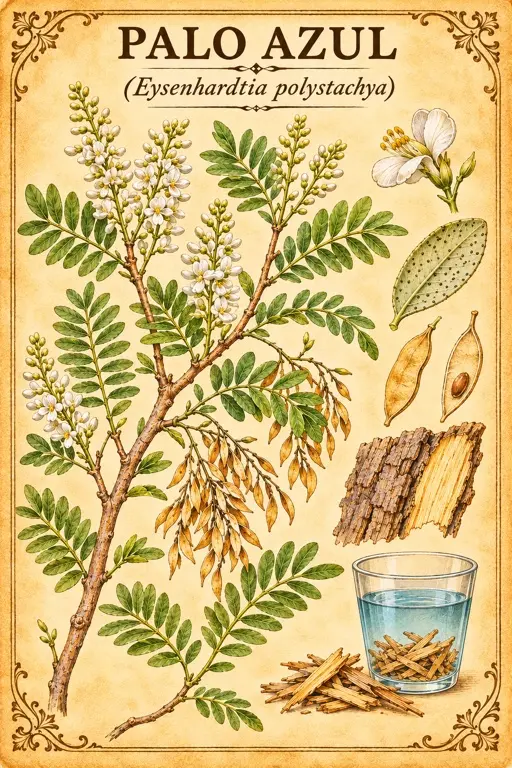
Palo Azul
Eysenhardtia polystachya
A small Mexican tree whose wood makes a tea that glows blue. It's traditionally used for kidney stones, urinary problems and diabetes, but has only been studied in the lab and in animals.
Safety at a glance
- PregnancyNothing recorded
- BreastfeedingNothing recorded
- MedicinesNothing recorded
- Who should avoid itNothing recorded
- AllergiesNothing recorded
- Toxicity1 note →
Tap a box to read the safety notes below. “Nothing recorded” means our sources don't cover it, not that it's safe.
What is Palo Azul?
- Plant family
- Fabaceae, the pea and bean family
- Parts used
- The bark and wood, soaked in water as a tea
- Where it grows
- Mexico
- Genus
- Eysenhardtia
- Species
- polystachya
Also called
Kidneywood
Regional names
Palo Dulce
Traditional names
Coatli, Lignum Nephriticum
Traditionally used for
- Kidney stones
- Urinary problems
- Diabetes
- Rheumatism (traditional)
Traditionally described as
- Rich in flavonoids; its tea glows blue
Health topics
Where Palo Azul appears in symptom search, and why. Being listed doesn't mean it's a proven treatment.
- Diarrhea
Traditionally used for diarrhea. An extract eased diarrhea in mice.
- High Blood Sugar
Traditionally used for diabetes. A bark extract lowered blood sugar in diabetic mice, but compounds from the bark didn't in another mouse study. It hasn't been tested in people.
- Joint Discomfort
Traditionally used for rheumatism. A bark extract eased arthritis in rats.
- Kidney Stones
Traditionally used in Mexico for kidney stones. Studied only in the lab and in animals.
How it's prepared
Common ways Palo Azul is prepared or sold. This isn't advice on how to take it; see Safety below.
- Tea / Infusion
The wood or bark is soaked in water to make a tea, which glows blue.[1]Study
Safety
Toxicity testing
In mice, an extract of the branches and leaves showed low toxicity: even 2,000 mg per kg of body weight didn't kill half the animals. In lab tests, it damaged the DNA of human blood cells only at high concentrations.[2]Study
Technical detail: LD50 > 2000 mg/kg (oral and intraperitoneal); comet assay showed DNA damage in human peripheral blood mononuclear cells only above 200 µg/mL.
What does the research say?
Traditional use
These are traditional uses, not proven treatments.
In Mexican traditional medicine, a tea made from the wood or bark is used for kidney stones and other stones in the urinary tract.[3]Study
It's also used for rheumatism (painful joints), and for bladder problems that come with diabetes.[4]Study
Folk healers have also used it for infections, diarrhea, swelling and pain.[2]Study
When the wood is soaked in water, the tea glows bright blue. This was first recorded in the 1500s, when the wood was known as Lignum nephriticum ("kidney wood").
The glow comes from a compound that forms in the water as one of the plant's natural chemicals breaks down. It isn't present in the plant itself.[1]Study
Technical detail: the fluorescent compound is a four-ring tetrahydromethanobenzofuro[2,3-d]oxacine, the end product of a spontaneous, repeated oxidation of at least one of the tree's flavonoids.
Laboratory & animal research
Lab and animal results show what might be worth studying in people. They don't show that the herb has these effects in humans.
A 2022 review of lab and animal studies looked at plants used in Mexico for kidney stones, including palo azul. Their natural compounds may help stop crystals forming and clumping into stones, and may increase urine flow. None of this has been tested in people.[3]Study
Technical detail: proposed actions are litholytic, antispasmodic and diuretic effects, and inhibition of crystal nucleation, growth and aggregation, possibly through antioxidant, anti-inflammatory and antimicrobial mechanisms.
In diabetic mice, a bark extract (100–400 mg per kg of body weight, by mouth) lowered blood sugar and cholesterol and raised insulin. In lab tests it also acted as an antioxidant.[5]Study
Technical detail: methanol–water bark extract in streptozotocin-induced mildly and severely diabetic mice. It also lowered triglycerides, LDL, TBARS and G6Pase, raised HDL, glycogen, glucokinase and hexokinase, and inhibited advanced glycation end products (AGEs) in vitro.
In another study in diabetic mice, five compounds taken from the bark (20 mg per kg a day for 4 weeks) did not lower blood sugar. But markers of liver damage fell, and the body's own antioxidant enzymes rose in the liver, kidneys and pancreas.
In lab tests, the same compounds acted as antioxidants and protected heart cells from oxidative stress (damage from unstable oxygen molecules).[4]Study
Technical detail: compounds 1–5 (chalcones, dihydrochalcones and a pterocarpan) in streptozotocin–nicotinamide diabetic mice lowered SGOT, SGPT, ALP and lipid peroxidation (TBARS/MDA) and raised SOD, CAT, GSH-Px and GSH; in vitro, they scavenged DPPH, hydroxyl, nitric oxide, superoxide, ABTS and hydrogen peroxide radicals and reduced reactive oxygen species in H9c2 cells. The methods describe male CD1 mice (10 per group), while the results tables mention rats (6 per group).
Two compounds from the plant, coatline B and matlaline, were given before a sudden kidney injury in animal and lab models. They reduced damage to kidney tissue and prevented a severe drop in kidney function.[6]Study
Technical detail: acute kidney injury models in vivo and in vitro; the compounds showed antioxidant activity and acted on nitric oxide (NO) and hydrogen sulfide (H2S) pathways.
In rats with arthritis, a bark extract (25–200 mg per kg a day, by mouth) eased inflammation and reduced damage to the joints. In mice, it also reduced signs of pain.[7]Study
Technical detail: complete Freund's adjuvant-induced arthritis in rats; the extract and its flavonoid-rich fractions lowered serum IL-6, TNF-α and GM-CSF. Antinociception was tested with the acetic acid writhing and hot-plate tests in mice.
In lab tests, an extract of the branches and leaves stopped the growth of E. coli and Staphylococcus aureus bacteria, but not of drug-resistant germs. In mice, it eased diarrhea and pain without causing drowsiness.[2]Study
Technical detail: ethanol extract, main compound D-pinitol (26.93%). MIC 1.56 µg/mL (E. coli) and 0.78 µg/mL (S. aureus); MIC > 100 µg/mL against multidrug-resistant strains. Antidiarrheal ED50 7.5 mg/kg; antinociceptive ED50 117 mg/kg (acetic acid test).
In short
Studied only in the lab and in animals; its safety in people hasn't been tested.
Sources
- [1] Structure and formation of the fluorescent compound of Lignum nephriticum · DOI: 10.1021/ol901022gPeer-reviewed study
- [2] Pharmacological and toxicological study of a chemical-standardized ethanol extract of the branches and leaves from Eysenhardtia polystachya (Ortega) Sarg. (Fabaceae) · DOI: 10.1016/j.jep.2018.06.016Peer-reviewed study
- [3] Plants Used in Mexican Traditional Medicine for the Management of Urolithiasis: A Review of Preclinical Evidence, Bioactive Compounds, and Molecular Mechanisms · DOI: 10.3390/molecules27062008Peer-reviewed study
- [4] Properties of Flavonoids Isolated from the Bark of Eysenhardtia polystachya and Their Effect on Oxidative Stress in Streptozotocin-Induced Diabetes Mellitus in Mice · DOI: 10.1155/2016/9156510Peer-reviewed study
- [5] Evaluation of antidiabetic, antioxidant and antiglycating activities of the Eysenhardtia polystachya · DOI: 10.4103/0973-1296.133295Peer-reviewed study
- [6] Nephroprotective activity of Eysenhardtia polystachya through antioxidant, H2S, and NO pathways · DOI: 10.1007/s00210-025-04331-4Peer-reviewed study
- [7] The Ethanolic Extract of Eysenhardtia polystachya (Ort.) Sarg. Bark and Its Fractions Delay the Progression of Rheumatoid Arthritis and Show Antinociceptive Activity in Murine ModelsPeer-reviewed study
This information is educational and traditional in nature, and is not a substitute for professional medical advice. Unfamiliar word? See what these words mean.