
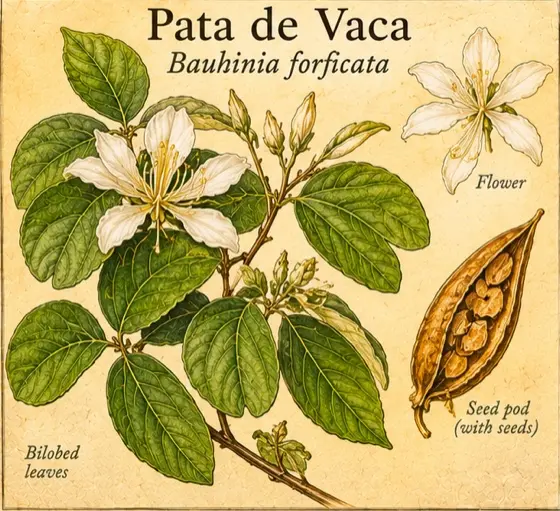
Pata de Vaca
Bauhinia forficata
A South American tree with hoof-shaped leaves, drunk as a tea for diabetes in Brazil. In one trial, a leaf extract added to diabetes medicines lowered blood sugar.
Safety at a glance
- PregnancyNothing recorded
- BreastfeedingNothing recorded
- Medicines1 note →
- Who should avoid itNothing recorded
- AllergiesNothing recorded
- ToxicityNothing recorded
Tap a box to read the safety notes below. “Nothing recorded” means our sources don't cover it, not that it's safe.
Pata de Vaca may interact with some medicines. If you take any medicine, read Interactions with medicines below and talk to your doctor or pharmacist before using it.
What is Pata de Vaca?
- Plant family
- Fabaceae, the pea and bean family
- Parts used
- The leaves
- Where it grows
- Southern Brazil, Paraguay, Uruguay and northern Argentina
- Genus
- Bauhinia
- Species
- forficata
Also called
Cow's Hoof, Cow's Foot, Brazilian Orchid Tree
Traditional names
Pata-de-vaca, Unha de boi
Traditionally used for
- Diabetes (traditional and studied)
- Blood fats (traditional)
Traditionally described as
- Leaves rich in flavonoids
Health topics
Where Pata de Vaca appears in symptom search, and why. Being listed doesn't mean it's a proven treatment.
- High Blood Sugar
In one trial, a leaf extract added to diabetes medicines lowered blood sugar and HbA1c.
Natural compounds
How it's prepared
Common ways Pata de Vaca is prepared or sold. This isn't advice on how to take it; see Safety below.
- Capsule
Capsules of 300 mg standardized leaf extract were used in a trial.[1]Study
- Tea / Infusion
The leaves are made into a tea, the traditional way of taking it.[2]Study
Safety
Interactions with medicines
In the diabetes trial, pata de vaca lowered blood sugar further when taken with diabetes tablets. Lab studies also report blood-thinning activity. Whether this matters for people taking blood thinners hasn't been studied.[2]Study
Side effects
Studies in people are limited to small trials, so its long-term safety, and its safety in pregnancy and breastfeeding, haven't been established.[1]Study
What does the research say?
Traditional use
These are traditional uses, not proven treatments.
Pata de vaca ("cow's paw") is a small tree named for its two-lobed leaves, shaped like a cloven hoof. In Brazil, tea made from the leaves is widely used to treat diabetes. Across southern South America, 10 of the 14 local Bauhinia species are drunk as leaf teas to help control blood sugar and blood fats, and for pain and inflammation.[2]Study
Laboratory & animal research
Lab and animal results show what might be worth studying in people. They don't show that the herb has these effects in humans.
In lab and animal studies, pata de vaca has lowered blood sugar and acted as an antioxidant. It has also been reported to thin the blood, lower blood pressure, increase urine flow and act against germs and tumor cells. Its flavonoids may help explain the antioxidant effects.[2]Study
Technical detail: reported activities include antioxidant, anticoagulant, antihypertensive, diuretic, antimicrobial and antitumor.
Research in people
In a 4-month trial, 92 adults with type 2 diabetes took capsules of a pata de vaca leaf extract or a placebo alongside their usual diabetes medicines. Fasting blood sugar and HbA1c (a measure of average blood sugar over 2 to 3 months) were both lower in the pata de vaca group. This is one trial, and the extract was used as an add-on, not on its own.[1]Study
Technical detail: randomized, double-blind; capsules of 300 mg standardized extract with 2% total flavonoids; primary outcomes glycated hemoglobin and fasting plasma glucose at 4 months.
In short
May lower blood sugar further when taken with diabetes medicines. Long-term safety unknown.
Sources
- [1] Clinical efficacy of capsules containing standardized extract of Bauhinia forficata Link (pata-de-vaca) as adjuvant treatment in type 2 diabetes patients: A randomized, double blind clinical trial · DOI: 10.1016/j.jep.2021.114616Peer-reviewed study
- [2] "Cow's Hoof" (Bauhinia L., Leguminosae): A Review on Pharmacological Properties of Austral South American Species · DOI: 10.3390/plants12010031Peer-reviewed study
This information is educational and traditional in nature, and is not a substitute for professional medical advice. Unfamiliar word? See what these words mean.