
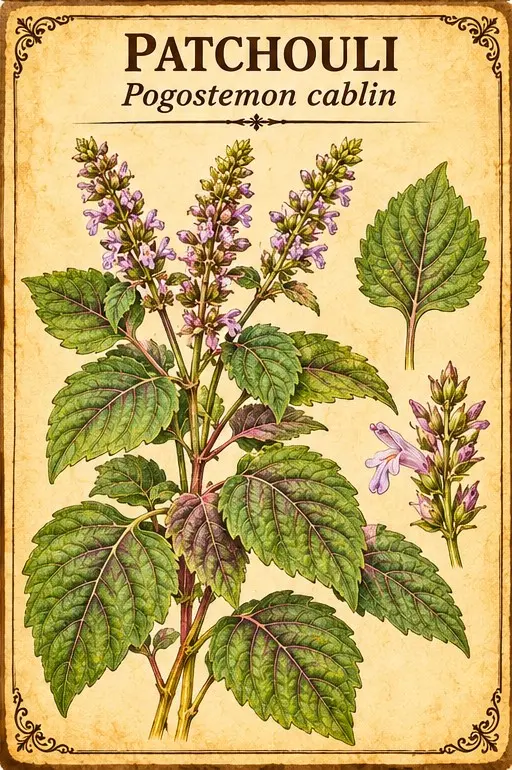
Patchouli
Pogostemon cablin
A mint-family plant whose musky leaf oil is used in perfumes, soaps and incense. It's been used in traditional Chinese medicine for about 2,000 years for colds, nausea and diarrhea.
Safety at a glance
- PregnancyNothing recorded
- BreastfeedingNothing recorded
- MedicinesNothing recorded
- Who should avoid itNothing recorded
- Allergies1 note →
- ToxicityNothing recorded
Tap a box to read the safety notes below. “Nothing recorded” means our sources don't cover it, not that it's safe.
What is Patchouli?
- Plant family
- Lamiaceae, the mint family
- Parts used
- The leaves, mainly as an essential oil
- Where it grows
- Tropical Asia
- Genus
- Pogostemon
- Species
- cablin
Also called
Patchouly
Regional names
Guang Huo Xiang
Traditionally used for
- Perfume
- Colds
- Nausea
- Diarrhea (traditional)
Traditionally described as
- Leaf oil rich in patchouli alcohol
Health topics
Where Patchouli appears in symptom search, and why. Being listed doesn't mean it's a proven treatment.
- Colds and Nasal Congestion
Used for colds in traditional Chinese medicine. Not well studied in people.
- Fungal Skin and Nail Infections (Athlete's Foot, Nail Fungus)
The oil is traditionally applied for fungal skin infections. Not tested in people.
- Occasional Nausea
A traditional Chinese remedy for nausea. Not well studied in people.
Natural compounds
Safety
Allergies
Patchouli oil can cause allergic skin rashes (contact dermatitis), including from everyday scented products.[1]Study
Depends on how it's prepared
The FDA allows patchouli as a natural flavoring in foods and drinks.[2]Health agency
What does the research say?
Traditional use
These are traditional uses, not proven treatments.
A bushy, hairy-leaved mint-family plant from tropical Asia. Its steam-distilled leaf oil has a musky scent and is widely used in perfumes, soaps, cosmetics, incense and candles. The leaves are also used to keep moths off clothing.[3]General reference
Used in traditional Chinese medicine since the Eastern Han dynasty (about 2,000 years ago) for colds, nausea, fever, headache and diarrhea.[4]Study
Traditionally also used for vomiting, stomach pain and insect and snake bites. The oil is applied to the skin for fungal infections, dandruff and eczema, and used in aromatherapy for stress and low mood.[5]Study
Laboratory & animal research
Lab and animal results show what might be worth studying in people. They don't show that the herb has these effects in humans.
In short
The oil can cause allergic skin rashes.
Sources
- [1] Allergic Contact Dermatitis to a Product Containing Patchouli Essential Oil in a Non-Occupational Setting · DOI: 10.1111/cod.70081Peer-reviewed study
- [2] 21 CFR 172.510 — Natural flavoring substances and natural substances used in conjunction with flavors — US Food and Drug Administration (Code of Federal Regulations)Government health agency
- [3] Patchouli — Encyclopaedia BritannicaGeneral reference
- [4] Pharmacological activities and mechanisms of action of Pogostemon cablin Benth: a review · DOI: 10.1186/s13020-020-00413-yPeer-reviewed study
- [5] A Comprehensive Review on the Phytochemical Constituents and Pharmacological Activities of Pogostemon cablin Benth.: An Aromatic Medicinal Plant of Industrial Importance · DOI: 10.3390/molecules20058521Peer-reviewed study
- [6] Anti-allergic and anti-inflammatory effects of aqueous extract of Pogostemon cablin · DOI: 10.3892/ijmm.2015.2401Peer-reviewed study
This information is educational and traditional in nature, and is not a substitute for professional medical advice. Unfamiliar word? See what these words mean.