
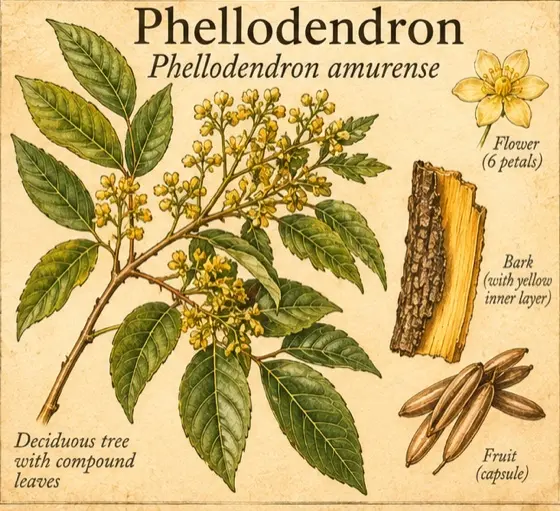
Phellodendron
Phellodendron amurense
The Amur cork tree, whose yellow inner bark, huang bai, is a Chinese medicine for diarrhea, urinary problems and skin sores. Combined with magnolia bark, it lowered stress hormone levels in small trials.
Safety at a glance
- Pregnancy1 note →
- BreastfeedingNothing recorded
- Medicines1 note →
- Who should avoid itNothing recorded
- AllergiesNothing recorded
- ToxicityNothing recorded
Tap a box to read the safety notes below. “Nothing recorded” means our sources don't cover it, not that it's safe.
Phellodendron may interact with some medicines. If you take any medicine, read Interactions with medicines below and talk to your doctor or pharmacist before using it.
What is Phellodendron?
- Plant family
- Rutaceae, the citrus family
- Parts used
- The dried bark
- Where it grows
- Northeast Asia, including northeast China, Korea and the Russian Far East
- Genus
- Phellodendron
- Species
- amurense
Also called
Amur Cork Tree
Traditional names
Huang Bai, Phellodendri Cortex
Traditionally used for
- Stress and anxiety (with magnolia
- studied)
- Diarrhea and urinary problems (traditional Chinese)
- Skin sores and eczema (traditional)
Traditionally described as
- Bark rich in berberine
- jatrorrhizine and phellodendrine
Health topics
Where Phellodendron appears in symptom search, and why. Being listed doesn't mean it's a proven treatment.
Traditions that use it
- Traditional Chinese Medicine
Known as huang bai. Used to "clear heat and dry dampness": for diarrhea and dysentery, jaundice, painful urination, vaginal discharge and itching, night sweats, sores and eczema.
Natural compounds
Safety
Interactions with medicines
Berberine-containing herbs may change how the body processes many medicines. In one study, goldenseal extract lowered levels of the diabetes drug metformin by about 25%. If you take any medicine, talk with your health care provider before using phellodendron.[1]Health agency
Pregnancy
Phellodendron bark contains berberine, which can harm newborns. The US National Institutes of Health advises that women who are pregnant or breastfeeding shouldn't use goldenseal, another berberine-rich plant, and that it shouldn't be given to infants, for this reason.[1]Health agency
What does the research say?
Traditional use
These are traditional uses, not proven treatments.
Phellodendron, or Amur cork tree, has a corky bark with a bright yellow inner layer. In Chinese medicine the dried bark (huang bai) is used for:
- Diarrhea and dysentery
- Jaundice
- Painful or difficult urination, and urinary infections
- Vaginal discharge and itching
- Night sweats and fevers
- Sores, swellings and eczema
Technical detail: traditional actions are clearing heat, drying dampness, purging fire, relieving "bone-steaming" fever and detoxifying.
Laboratory & animal research
Lab and animal results show what might be worth studying in people. They don't show that the herb has these effects in humans.
The bark's main active compounds are berberine, jatrorrhizine and phellodendrine. In lab and animal studies, it has acted as an antioxidant and against bacteria, inflammation and cancer cells, and has dampened the immune system.[2]Study
Research in people
Magnolia and phellodendron barks are both used as traditional remedies for stress and anxiety. In a 4-week trial with 56 moderately stressed adults, a combination supplement (Relora) lowered levels of the stress hormone cortisol in saliva by 18% compared with a placebo. People also reported less stress and tension, and better mood and energy.[3]Study
Technical detail: Overall Stress −11%, Global Mood State +11%, Vigor +18% (all p < 0.05); 35 men and 21 women.
In a 6-week trial with 40 overweight women who tend to eat when stressed, the same combination (250 mg three times a day) reduced short-term anxiety compared with a placebo. It didn't reduce long-standing anxiety or depression, and didn't change cortisol, appetite, weight or sleep. Only 26 women completed the study. There were no significant side effects.[4]Study
Technical detail: effective on the Spielberger STATE but not TRAIT anxiety inventory.
In short
Its berberine can harm newborns, so avoid it in pregnancy and breastfeeding. It may affect metformin and other medicines.
Sources
- [1] Goldenseal: Usefulness and Safety — National Center for Complementary and Integrative Health (NIH)Government health agency
- [2] An Updated and Comprehensive Review of Phellodendri amurensis Cortex: Ethnobotany, Geographical Distribution, Phytochemistry, Quality Control, and Pharmacology · DOI: 10.3390/molecules31081318Peer-reviewed study
- [3] Effect of Magnolia officinalis and Phellodendron amurense (Relora®) on cortisol and psychological mood state in moderately stressed subjects · DOI: 10.1186/1550-2783-10-37Peer-reviewed study
- [4] Effect of a proprietary Magnolia and Phellodendron extract on stress levels in healthy women: a pilot, double-blind, placebo-controlled clinical trial · DOI: 10.1186/1475-2891-7-11Peer-reviewed study
This information is educational and traditional in nature, and is not a substitute for professional medical advice. Unfamiliar word? See what these words mean.