
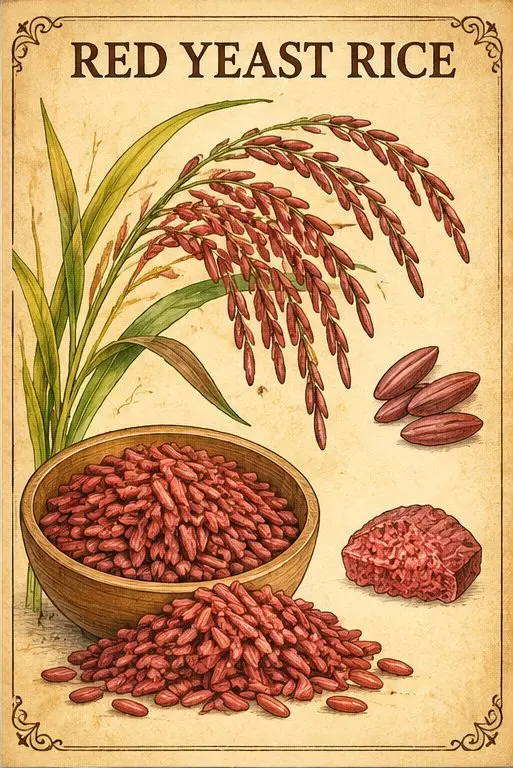
Red Yeast Rice
Monascus purpureus
Rice fermented with a mold. Some products contain the same chemical as the statin lovastatin and lower cholesterol.
Safety at a glance
- Pregnancy1 note →
- BreastfeedingNothing recorded
- Medicines1 note →
- Who should avoid itNothing recorded
- AllergiesNothing recorded
- Toxicity1 note →
Tap a box to read the safety notes below. “Nothing recorded” means our sources don't cover it, not that it's safe.
Red Yeast Rice may interact with some medicines. If you take any medicine, read Interactions with medicines below and talk to your doctor or pharmacist before using it.
What is Red Yeast Rice?
- Plant family
- Monascaceae, a family of molds
- Parts used
- Rice fermented with the mold, usually sold as a powder or capsule
- Genus
- Monascus
- Species
- purpureus
Also called
Red Mold Rice
Traditionally used for
- Food
- Chinese medicine
Traditionally described as
- Contains monacolin K (natural lovastatin)
Health topics
Where Red Yeast Rice appears in symptom search, and why. Being listed doesn't mean it's a proven treatment.
- High Cholesterol
Trials show it lowers total and LDL cholesterol, because some products contain the same chemical as the statin lovastatin.
- Liver Safety Warnings
Products high in monacolin K can cause statin-like liver, kidney and muscle damage.
Traditions that use it
- Traditional Chinese Medicine
Red yeast rice is used as a food and in traditional Chinese medicine.
Safety
Interactions with medicines
Red yeast rice can interact with other medicines in the same ways statins do, which may raise the chance of side effects. Ask your doctor or pharmacist before using it, especially if you already take a cholesterol medicine.[1]Health agency
Side effects
Products with a lot of monacolin K can cause the same side effects as statin cholesterol medicines, including muscle, kidney and liver damage. They may also cause diarrhea, nausea and stomach pain.[1]Health agency
Pregnancy
There are no studies on its safety in pregnancy or breastfeeding, and it is not recommended for people who are pregnant or breastfeeding.[1]Health agency
Toxicity testing
In 2018 the European Food Safety Authority concluded that monacolin K from red yeast rice could cause severe side effects, and it could not identify a safe daily amount.[1]Health agency
Contamination
Some products contain citrinin, a toxin that can damage the kidneys. In a 2021 test of 37 products, only 1 had citrinin below the European Union's limit, and 4 products labeled "citrinin-free" were contaminated.[1]Health agency
Depends on how it's prepared
In the United States, the FDA treats red yeast rice products with added or boosted lovastatin as unapproved drugs, not dietary supplements. You can't tell from the label how much monacolin K a product contains.[1]Health agency
What does the research say?
Traditional use
These are traditional uses, not proven treatments.
Red yeast rice is made by growing a mold on rice. It is used as a food, in traditional Chinese medicine and in dietary supplements. Despite the name, the mold is not a yeast.[1]Health agency
Research in people
Red yeast rice can contain monacolin K, which is the same chemical as the prescription cholesterol medicine lovastatin. Products with large amounts of it may lower cholesterol, blood sugar and blood pressure. But how much a product contains varies hugely, and labels usually don't say. For products with very little, it's unknown whether they work.[1]Health agency
Technical detail: a 2017 analysis of 28 US brands found monacolin K ranged more than 60-fold, from 0.09 to 5.48 mg per 1,200 mg of red yeast rice; 2 brands had none detectable.
A 2024 review of 14 double-blind trials, lasting 4 to 24 weeks, found that red yeast rice lowered total cholesterol and LDL ("bad") cholesterol compared with placebo. It did not change HDL ("good") cholesterol or triglycerides.[2]Review or trial
Technical detail: total cholesterol mean difference −37.43 mg/dL; LDL-C −35.82 mg/dL; no significant change in HDL-C or triglycerides.
A 2026 test of 14 red yeast rice supplements sold in Bulgaria found the daily amount of monacolin K ranged from almost none to more than 14 mg. Three products provided 3 mg a day or more.[3]Study
Technical detail: 0.06 to 14.11 mg/day monacolin K at the labeled dose.
In short
Statin-like side effects and interactions; may contain a kidney toxin; not in pregnancy.
Sources
- [1] Red Yeast Rice: What You Need To Know — National Center for Complementary and Integrative Health (NCCIH), NIHGovernment health agency
- [2] Safety and Efficacy of the Consumption of the Nutraceutical "Red Yeast Rice Extract" for the Reduction of Hypercholesterolemia in Humans: A Systematic Review and Meta-Analysis · DOI: 10.3390/nu16101453Review or clinical trial
- [3] Quality and Authenticity Evaluation of Red Yeast Rice Food Supplements from the Bulgarian Market · DOI: 10.3390/foods15203583Peer-reviewed study
This information is educational and traditional in nature, and is not a substitute for professional medical advice. Unfamiliar word? See what these words mean.