
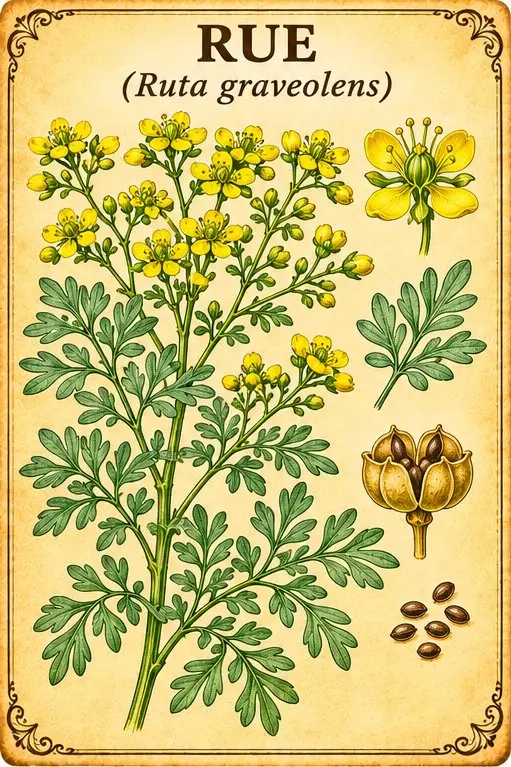
Rue
Ruta graveolens
An herb used in traditional medicine on several continents. It can harm the skin, liver and kidneys and cause miscarriage.
Safety at a glance
- Pregnancy1 note →
- BreastfeedingNothing recorded
- MedicinesNothing recorded
- Who should avoid itNothing recorded
- AllergiesNothing recorded
- Toxicity1 note →
Tap a box to read the safety notes below. “Nothing recorded” means our sources don't cover it, not that it's safe.
What is Rue?
- Plant family
- Rutaceae, the citrus family
- Parts used
- The above-ground parts
- Genus
- Ruta
- Species
- graveolens
Traditionally used for
- Traditional medicine (digestive
- nervous
- reproductive)
Traditionally described as
- Contains furanocoumarins and alkaloids
Health topics
Where Rue appears in symptom search, and why. Being listed doesn't mean it's a proven treatment.
- Cancer Research
Lab and animal studies only: listed among many effects, it slowed or killed some cancer cells. Not tested against cancer in people.
- Poisonous Plants
Can cause sun-sensitive skin reactions, liver and kidney damage, and miscarriage.
Traditions that use it
- European Folk Medicine
Used in traditional European medicine for digestive, nervous, heart, breathing and reproductive complaints.
Safety
Pregnancy
Rue extracts can cause miscarriage. Don't use rue if you are pregnant or could be pregnant.[1]Review or trial
Toxicity testing
Rue contains compounds (furanocoumarins and alkaloids) that can make the skin react badly to sunlight and can damage the liver and kidneys, especially when the dose isn't controlled.[1]Review or trial
What does the research say?
Traditional use
These are traditional uses, not proven treatments.
Rue is widely used in traditional medicine in Europe, Asia, Africa and South America for digestive, nervous, heart, breathing and reproductive problems.[1]Review or trial
Laboratory & animal research
Lab and animal results show what might be worth studying in people. They don't show that the herb has these effects in humans.
More than 160 compounds have been found in rue. In lab and animal studies it shows a wide range of effects, from fighting germs to slowing tumors. A 2026 review said turning rue into a modern herbal medicine would need careful safety testing, standardized extracts and well-designed studies.[1]Review or trial
In short
Toxic; not in pregnancy; causes sun-sensitive skin reactions.
Sources
- [1] Ruta graveolens L. in Evidence-Based Phytotherapy: Pharmacological Activities, Bioactive Compounds and Safety · DOI: 10.1002/ptr.70434Review or clinical trial
This information is educational and traditional in nature, and is not a substitute for professional medical advice. Unfamiliar word? See what these words mean.