
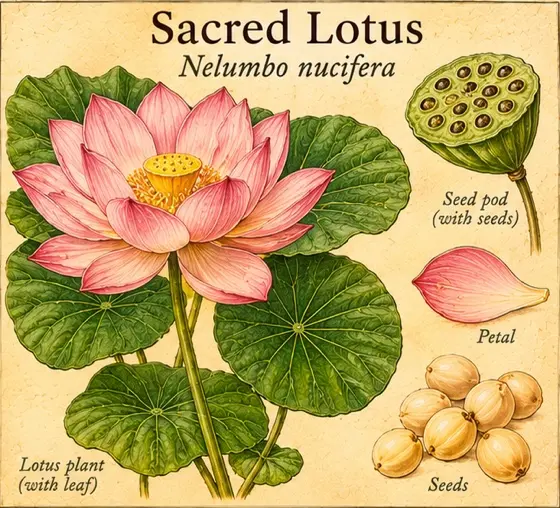
Sacred Lotus
Nelumbo nucifera
A revered Asian water plant whose seeds, root, leaves and flowers are all used as food and medicine. Lab and animal studies show many effects, but human research is lacking.
Safety at a glance
- PregnancyNothing recorded
- BreastfeedingNothing recorded
- MedicinesNothing recorded
- Who should avoid itNothing recorded
- AllergiesNothing recorded
- ToxicityNothing recorded
Tap a box to read the safety notes below. “Nothing recorded” means our sources don't cover it, not that it's safe.
What is Sacred Lotus?
- Plant family
- Nelumbonaceae, the lotus family
- Parts used
- The seeds, rhizome (root), leaves and flowers
- Where it grows
- Asia, from India to China and Japan, and northern Australia
- Genus
- Nelumbo
- Species
- nucifera
Also called
Lotus, Indian Lotus, Lotus Root, Lotus Seed
Traditional names
Lian Zi, He Ye, Kamala
Traditionally used for
- Food (root and seeds)
- Traditional medicine (seeds
- leaves
- flowers)
- Cancer research (animal)
Traditionally described as
- Contains alkaloids such as nuciferine
- and flavonoids
Health topics
Where Sacred Lotus appears in symptom search, and why. Being listed doesn't mean it's a proven treatment.
- Cancer Research
A lotus-leaf alkaloid, nuciferine, slowed bladder tumors in mice.
Traditions that use it
- Ayurveda
A well-known medicinal plant in India, where the seeds, rhizome, leaves and flowers are all used.
- Traditional Chinese Medicine
Different parts of the lotus, including the seed, leaf and flower, are used as separate medicines.
Natural compounds
How it's prepared
Common ways Sacred Lotus is prepared or sold. This isn't advice on how to take it; see Safety below.
- Culinary Preparation
The rhizome (lotus root) and seeds are widely cooked and eaten.[1]Study
Safety
Depends on how it's prepared
The root and seeds are common foods. Most medicinal claims for lotus come from lab and animal studies, and the safety of concentrated extracts hasn't been well studied in people.[2]Study
What does the research say?
Traditional use
These are traditional uses, not proven treatments.
The sacred lotus is a water plant with large round leaves and pink or white flowers, honored in Hinduism and Buddhism. Almost every part is used. The seeds, rhizome (root), leaves and flowers each have their own traditional medicinal uses.[2]Study
Lotus root and seeds are widely eaten as food. They're rich in fiber, vitamins and minerals. Lotus leaves repel water and dirt so well that the "lotus effect" is copied to make self-cleaning materials.[1]Study
Laboratory & animal research
Lab and animal results show what might be worth studying in people. They don't show that the herb has these effects in humans.
Scientists have found many plant compounds in lotus, including alkaloids, flavonoids and triterpenoids. In lab and animal studies, lotus extracts have reduced inflammation, acted as antioxidants and slowed cancer cells. These results haven't yet been confirmed in people.[1]Study
In mice with bladder cancer, nuciferine, an alkaloid from lotus leaves, slowed tumor growth and increased the death of cancer cells. This is an animal study only.[3]Study
Technical detail: STAT3 identified by molecular docking; TUNEL-positive cells increased, Ki67 decreased; Bcl-2 and STAT3 reduced, Bax increased.
In short
Root and seeds are common foods; the safety of concentrated extracts isn't well studied.
Sources
- [1] Lotus (Nelumbo nucifera): a multidisciplinary review of its cultural, ecological, and nutraceutical significance · DOI: 10.1186/s40643-024-00734-yPeer-reviewed study
- [2] The sacred lotus (Nelumbo nucifera) – phytochemical and therapeutic profile · DOI: 10.1211/jpp/61.04.0001Peer-reviewed study
- [3] Anti-bladder cancer effects of nuciferine, a bioactive compound extracted from Nelumbo nucifera leaves · DOI: 10.3389/fnut.2026.1881388Peer-reviewed study
This information is educational and traditional in nature, and is not a substitute for professional medical advice. Unfamiliar word? See what these words mean.