
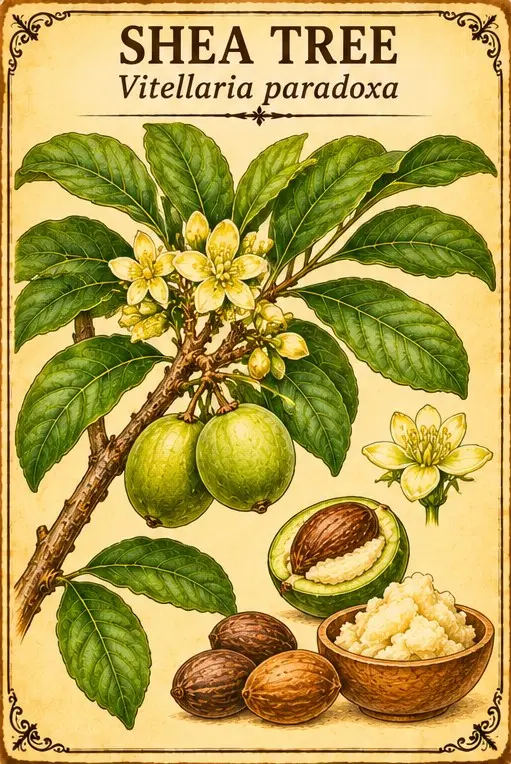
Shea Tree
Vitellaria paradoxa
The West African tree whose nuts give shea butter, long used across Africa on the skin for scabies, wounds and newborn cord care. Its bark is used for rheumatism and stomach problems.
Safety at a glance
- PregnancyNothing recorded
- BreastfeedingNothing recorded
- MedicinesNothing recorded
- Who should avoid itNothing recorded
- AllergiesNothing recorded
- ToxicityNothing recorded
Tap a box to read the safety notes below. “Nothing recorded” means our sources don't cover it, not that it's safe.
What is Shea Tree?
- Plant family
- Sapotaceae, the sapodilla family
- Parts used
- The nut fat (shea butter), and also the bark and leaves
- Where it grows
- The savanna belt of West and Central Africa
- Genus
- Vitellaria
- Species
- paradoxa
Also called
Shea Butter, Karité
Older scientific names
Butyrospermum parkii
Traditionally used for
- Skin care
- Scabies
- Wounds (traditional)
Traditionally described as
- Nut fat rich in fatty acids; bark contains betulinic acid
Health topics
Where Shea Tree appears in symptom search, and why. Being listed doesn't mean it's a proven treatment.
- Cuts, Wounds, Burns and Skin Ulcers
Traditionally applied to wounds. Not tested in trials.
- Dry Skin
Widely used as a skin butter.
- Head Lice and Scabies
Shea butter is a traditional African treatment for scabies. Not tested in trials.
Safety
Depends on how it's prepared
Shea butter is widely used on the skin, but no human safety studies of the plant as medicine were found.[1]Study
What does the research say?
Traditional use
These are traditional uses, not proven treatments.
Shea butter, the fat pressed from the tree's nuts, has long been used across Sub-Saharan Africa on the skin. A review found 24 skin uses; the most studied were scabies, wound healing and care of a newborn's umbilical cord, often mixed with palm oil.[1]Study
The bark is used in African traditional medicine for rheumatism, stomach problems, diarrhea and dysentery.[2]Study
Laboratory & animal research
Lab and animal results show what might be worth studying in people. They don't show that the herb has these effects in humans.
In short
No human safety studies of the plant as medicine were found.
Sources
- [1] A review of ethnomedicinal uses of shea butter for dermatoses in Sub-Saharan Africa · DOI: 10.1111/dth.14786Peer-reviewed study
- [2] Triterpenoids from Vitellaria paradoxa Stem Barks Reduce Nitrite Levels in LPS-Stimulated Macrophages · DOI: 10.3390/plants10051006Peer-reviewed study
- [3] In vitro trypanocidal activity of extracts and compounds isolated from Vitellaria paradoxa · DOI: 10.1186/s12906-023-04175-6Peer-reviewed study
This information is educational and traditional in nature, and is not a substitute for professional medical advice. Unfamiliar word? See what these words mean.