
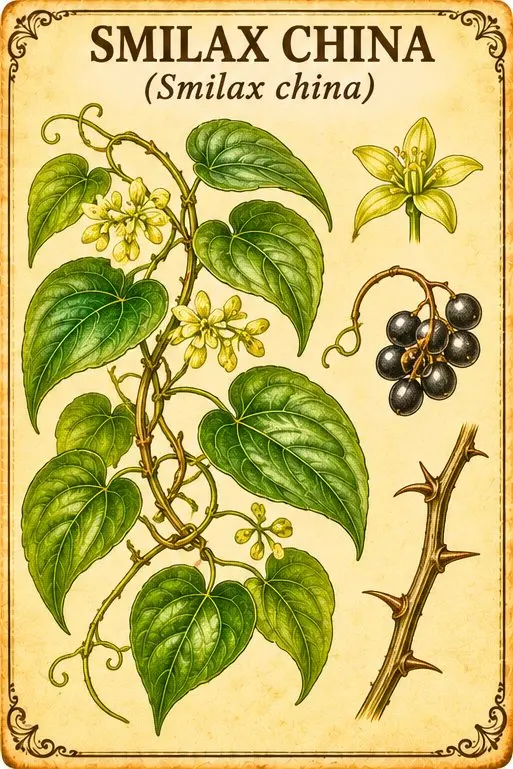
Smilax China
Smilax china
A Chinese medicinal vine (Baqia) used for inflammation, especially in the pelvis. Lab studies only.
Safety at a glance
- PregnancyNothing recorded
- BreastfeedingNothing recorded
- MedicinesNothing recorded
- Who should avoid itNothing recorded
- AllergiesNothing recorded
- ToxicityNothing recorded
Tap a box to read the safety notes below. “Nothing recorded” means our sources don't cover it, not that it's safe.
What is Smilax China?
- Plant family
- Smilacaceae, the greenbrier family
- Parts used
- The rhizome (underground stem)
- Genus
- Smilax
- Species
- china
Also called
Baqia
Traditionally used for
- Inflammation
- Pelvic inflammation (traditional)
Traditionally described as
- Steroid saponins and flavonoids
Health topics
Where Smilax China appears in symptom search, and why. Being listed doesn't mean it's a proven treatment.
- Cancer Research
Lab studies only: a flavonoid from the root killed several types of cancer cells. Not tested against cancer in people.
Traditions that use it
- Traditional Chinese Medicine
Used for inflammatory conditions, especially pelvic inflammation.
What does the research say?
Traditional use
These are traditional uses, not proven treatments.
Known in China as Baqia, it is widely used in traditional Chinese medicine for inflammatory conditions, especially pelvic inflammation.[1]Study
Laboratory & animal research
Lab and animal results show what might be worth studying in people. They don't show that the herb has these effects in humans.
Lab and animal studies report effects against inflammation, cancer, diabetes, obesity, high uric acid, high blood pressure and bacteria, and in helping skin wounds heal. A 2024 review said some traditional uses still need to be confirmed.[1]Study
A flavonoid from the rhizome killed several types of cancer cells in the lab.[2]Study
In short
No human safety data.
Sources
- [1] Smilax china L.: A review of its botany, ethnopharmacology, phytochemistry, pharmacological activities, actual and potential applications · DOI: 10.1016/j.jep.2023.116992Peer-reviewed study
- [2] Recent advances in anticancer approach of traditional medicinal plants: A novel strategy for cancer chemotherapy · DOI: 10.1016/j.ipha.2024.02.001Peer-reviewed study
This information is educational and traditional in nature, and is not a substitute for professional medical advice. Unfamiliar word? See what these words mean.