
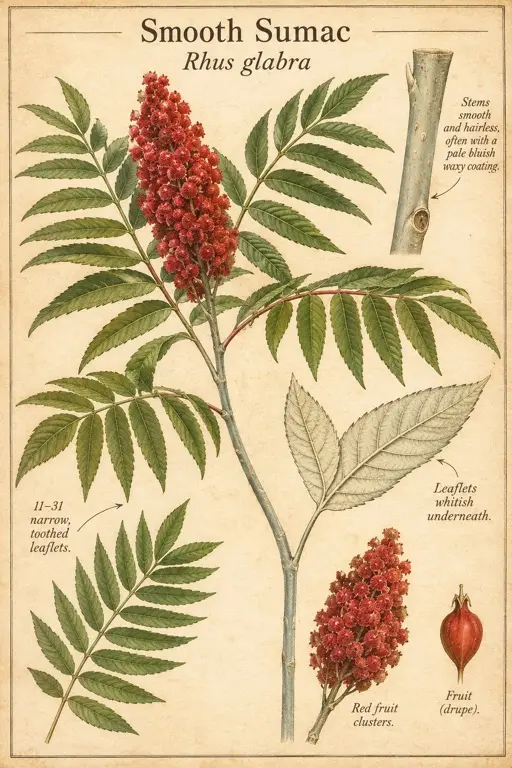
Smooth Sumac
Rhus glabra
A North American shrub used in Native American folk medicine and smoked in pipes for at least 1,400 years. Lab and animal studies show it acts against bacteria and fungi and may protect the heart; it hasn't been tested in people.
Safety at a glance
- PregnancyNothing recorded
- BreastfeedingNothing recorded
- MedicinesNothing recorded
- Who should avoid itNothing recorded
- AllergiesNothing recorded
- ToxicityNothing recorded
Tap a box to read the safety notes below. “Nothing recorded” means our sources don't cover it, not that it's safe.
What is Smooth Sumac?
- Plant family
- Anacardiaceae, the cashew and mango family
- Parts used
- The branches, leaves and red fruit clusters
- Where it grows
- North America
- Genus
- Rhus
- Species
- glabra
Also called
Scarlet Sumac, Smooth Upland Sumac
Traditionally used for
- Folk medicine (Native American)
- Smoking mixtures (historical)
- Infections and heart protection (lab and animal research only)
Traditionally described as
- Rich in tannins
- gallic acid and methyl gallate
Traditions that use it
- Native American Ethnobotany
Used in folk medicine by Native North American peoples, including those of British Columbia, and smoked in pipes for at least 1,400 years.
Natural compounds
What does the research say?
Traditional use
These are traditional uses, not proven treatments.
Smooth sumac is a North American shrub. Native North American peoples have used it in folk medicine.[1]Study
A pipe about 1,430 years old from central Washington State held residue showing that smooth sumac was smoked together with a native wild tobacco.[2]Study
Technical detail: residue metabolomics identified Nicotiana quadrivalvis and Rhus glabra in a pre-contact pipe.
Laboratory & animal research
Lab and animal results show what might be worth studying in people. They don't show that the herb has these effects in humans.
Researchers tested 100 plants used as medicine by First Nations peoples in British Columbia. Smooth sumac branches were among the extracts that worked against the widest range of bacteria. In a second study, they also slowed all 9 fungi tested.[3]Study
Technical detail: methanolic extracts screened against 11 bacterial strains and 9 fungal species; 75 of the 100 extracts were active against MRSA.
In lab tests, a tannin-rich leaf extract was a strong antioxidant. It killed cervical cancer cells while barely affecting normal cells, and slowed the growth of several bacteria, including a tooth-decay germ. These are early lab findings only.[4]Study
Technical detail: DPPH antiradical activity comparable to or exceeding vitamin C and Trolox; cytotoxic to HeLa cells with little effect on MRC-5 fibroblasts; MIC 2–125 µg/mL for Gram-positive and 125–500 µg/mL for Gram-negative bacteria, including Streptococcus mutans.
In an animal study, a polyphenol extract of smooth sumac (polyphenols are antioxidant plant compounds) protected against heart damage caused by a large dose of adrenaline. Blood markers of heart and liver damage were lower than in untreated animals, and blood fat measures linked to heart risk improved.
In liver cells taken from rats, the extract was a strong antioxidant and protected the cells' energy-producing parts (mitochondria) from damage. These results haven't been tested in people.[5]Study
Technical detail: DPPH IC50 18.4 ± 1.4 µL; inhibited lipid peroxidation (malondialdehyde) in isolated rat liver mitochondria and acted on mitochondrial K+ATP channels and the permeability transition pore. In adrenaline-induced ischemia, ALT, AST, CK and LDH fell vs the ischemic group, with improved atherogenic, cardioprotective and coronary risk indices.
Scientists isolated three bacteria-fighting compounds from smooth sumac. The strongest was methyl gallate. Gallic acid, the best known of the three, was much weaker.[1]Study
Technical detail: bioassay-guided fractionation of a methanol extract tested against 11 microorganisms, including Gram-positive and Gram-negative bacteria; isolated methyl gallate (MIC 12.5 µg/mL), 4-methoxy-3,5-dihydroxybenzoic acid (MIC 25 µg/mL) and gallic acid (MIC > 1000 µg/mL).
In short
No safety studies in people.
Sources
- [1] Antimicrobial constituents of Rhus glabra · DOI: 10.1016/0378-8741(94)90102-3Peer-reviewed study
- [2] An Ancient Residue Metabolomics-Based Method to Distinguish Use of Closely Related Plant Species in Ancient Pipes · DOI: 10.3389/fmolb.2020.00133Peer-reviewed study
- [3] Antibiotic screening of medicinal plants of the British Columbian native peoples · DOI: 10.1016/0378-8741(92)90036-qPeer-reviewed study
- [4] Rhus glabra L. and Pistacia vera L. Leaf Extracts as Rich Sources of Tannins with Antioxidant, Anticancer and Antimicrobial Activities · DOI: 10.3390/molecules31203739Peer-reviewed study
- [5] Antioxidant and cardioprotective properties of polyphenolic plant extract of Rhus glabra L. · DOI: 10.14719/pst.3442Peer-reviewed study
This information is educational and traditional in nature, and is not a substitute for professional medical advice. Unfamiliar word? See what these words mean.