
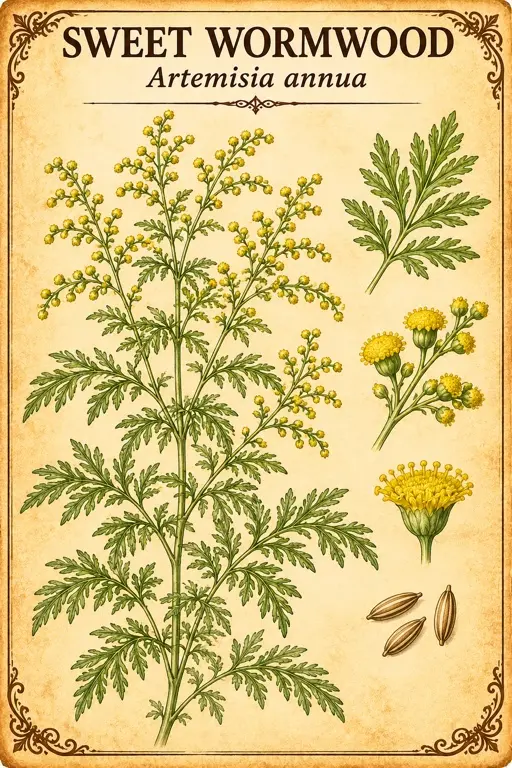
Sweet Wormwood
Artemisia annua
A feathery, fragrant annual herb known in Chinese medicine as qinghao, and the source of the malaria medicine artemisinin. Tea made from the plant clears malaria parasites at first, but the infection usually returns, and the WHO doesn't support using the plant for malaria.
Safety at a glance
- Pregnancy1 note →
- BreastfeedingNothing recorded
- MedicinesNothing recorded
- Who should avoid it1 note →
- AllergiesNothing recorded
- ToxicityNothing recorded
Tap a box to read the safety notes below. “Nothing recorded” means our sources don't cover it, not that it's safe.
What is Sweet Wormwood?
- Plant family
- Asteraceae, the daisy family
- Parts used
- The leaves and flowering tops
- Where it grows
- Temperate Asia, including China
- Genus
- Artemisia
- Species
- annua
Also called
Sweet Annie, Annual Wormwood, Artemisia
Traditional names
Qinghao
Traditionally used for
- Fever (traditional Chinese medicine)
- Source of the malaria drug artemisinin
- Cancer research (animal studies)
Traditionally described as
- Contains artemisinin and flavonoids such as luteolin; very bitter
Health topics
Where Sweet Wormwood appears in symptom search, and why. Being listed doesn't mean it's a proven treatment.
- Cancer Research
Animal studies only: extracts and artemisinin-type compounds slowed tumor growth.
- Fever
A traditional Chinese remedy for fevers; the source of artemisinin. The WHO doesn't support using the plant itself for malaria.
Traditions that use it
- Traditional Chinese Medicine
Known as qinghao. A 4th-century Chinese handbook recorded soaking it in cold water for fevers, which led to the discovery of artemisinin.
Natural compounds
Safety
Who should avoid it
Don't use sweet wormwood tea or other plant forms to prevent or treat malaria. After reviewing the evidence, the World Health Organization doesn't support using the plant in any form for malaria.
Malaria can be fatal. It needs proper testing and approved medicine.[1]Health agency
Side effects
In trials of the tea, side effects were mostly mild, such as a bitter taste and passing stomach upset. No serious side effects were recorded.[2]Review or trial
Pregnancy
There isn't enough safety information for pregnant or breastfeeding women, children under 5, or people with liver or kidney disease.[2]Review or trial
What does the research say?
Traditional use
These are traditional uses, not proven treatments.
In Chinese medicine, sweet wormwood is called qinghao. In the 1970s, Chinese scientist Tu Youyou searched old medical texts for malaria remedies. One, a handbook from around 340 CE by Ge Hong, said to soak the herb in cold water and drink the juice for fevers.
That clue led her team to extract artemisinin without heat. Artemisinin became one of the world's most important malaria medicines.[3]Study
Technical detail: Ge Hong, A Handbook of Prescriptions for Emergencies; low-temperature ether extraction preserved artemisinin's activity.
Laboratory & animal research
Lab and animal results show what might be worth studying in people. They don't show that the herb has these effects in humans.
In lab tests, the whole plant contains more than 40 compounds that act against malaria parasites in different ways. Some of them boost the effect of artemisinin. Whole-plant extracts worked at lower doses than the same amount of pure artemisinin, including against drug-resistant strains.
In mice, parasites became resistant to the whole plant more slowly than to purified artemisinin medicine. This hasn't been shown in people.[2]Review or trial
Technical detail: synergy (combination index below 1) for artemisinin with luteolin (0.36), quercetin (0.42) and casticin (0.58); whole-plant IC50 3–5 times lower than equivalent purified artemisinin on 3D7, chloroquine-resistant and multidrug-resistant strains; resistance in Pfkelch13-mutant rodent lines emerged three times more slowly than to dihydroartemisinin.
In animal studies, sweet wormwood extracts and artemisinin-type compounds slowed tumor growth. These results come from animals only and haven't been confirmed in people.[4]Study
Technical detail: systematic review of preclinical in vivo studies published 2019 to August 2025 (PRISMA 2020, PROSPERO-registered).
Research in people
A 2026 review looked at trials of sweet wormwood tea for malaria. The tea cleared parasites from the blood quickly at first. But in most people the infection came back:
- In one trial, 1 in 9 people were cured after 28 days.
- In another, none of 7 stayed cured.
- Standard combination treatment cures about 96–99%.
Side effects were mostly mild, such as a bitter taste and stomach upset. Safety in young children, pregnant or breastfeeding women, and people with liver or kidney disease hasn't been studied enough.[2]Review or trial
Technical detail: 30 studies (RCTs, quasi-experimental, in vitro and rodent). Mueller day-7 cure 74% vs 91% (quinine); Blanke day-28 cure 1/9 (11.1%) vs sulfadoxine-pyrimethamine 3/8; Magalhães 0/7 sustained cure. ACT benchmark band 95.5–98.6%.
In short
Never use the plant or its tea to prevent or treat malaria; malaria needs approved medicine.
Sources
- [1] The use of non-pharmaceutical forms of Artemisia — World Health Organization, Global Malaria Programme (WHO/CDS/GMP/2019.14)Government health agency
- [2] Phytochemical synergy in artemisia annua herbal tea against malaria: a systematic review of its efficacy and safety in the context of emerging Pfkelch13 resistance · DOI: 10.1186/s40249-026-01486-xReview or clinical trial
- [3] The discovery of artemisinin (qinghaosu) and gifts from Chinese medicine · DOI: 10.1038/nm.2471Peer-reviewed study
- [4] Anticancer power of Artemisia annua: A preclinical systematic review · DOI: 10.5455/ovj.2026.v16.i3.6Peer-reviewed study
This information is educational and traditional in nature, and is not a substitute for professional medical advice. Unfamiliar word? See what these words mean.