
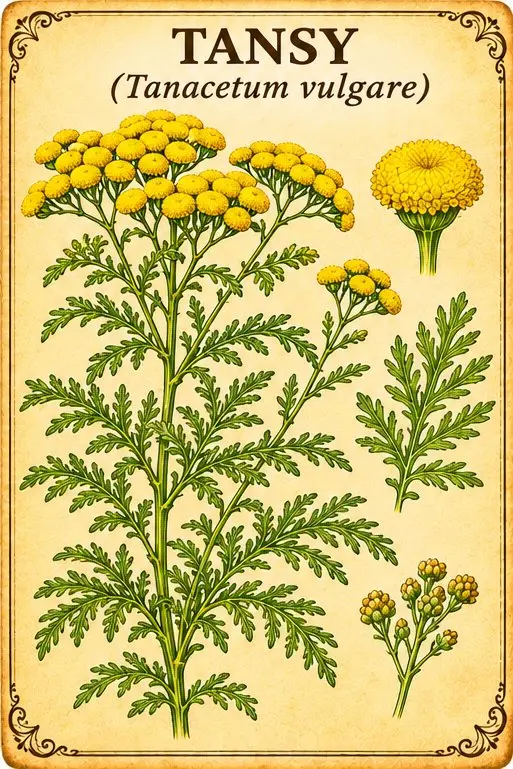
Tansy
Tanacetum vulgare
An herb traditionally used for intestinal worms. It contains thujone, which can be toxic.
Safety at a glance
- PregnancyNothing recorded
- BreastfeedingNothing recorded
- MedicinesNothing recorded
- Who should avoid itNothing recorded
- AllergiesNothing recorded
- Toxicity1 note →
Tap a box to read the safety notes below. “Nothing recorded” means our sources don't cover it, not that it's safe.
What is Tansy?
- Plant family
- Asteraceae, the daisy family
- Parts used
- The leaves and flowers
- Genus
- Tanacetum
- Species
- vulgare
Traditionally used for
- Intestinal worms (traditional)
Traditionally described as
- Contains thujone
Health topics
Where Tansy appears in symptom search, and why. Being listed doesn't mean it's a proven treatment.
- Poisonous Plants
Contains thujone, a compound that caused seizures in animal studies.
- SIBO and Intestinal Parasites
Traditionally used for intestinal worms in Lithuania; only tested on animal worm larvae in the lab. Contains thujone, which can be toxic.
Traditions that use it
- European Folk Medicine
In Lithuania, one of the plants most often used for intestinal worms.
Safety
Toxicity testing
Tansy contains thujone, in amounts that vary a lot from plant to plant. Thujone has been regarded as a serious nerve poison, and it caused seizures in animal studies. Because of this, European regulators limit how much thujone people should take from herbal medicines.[1]Health agency
What does the research say?
Traditional use
These are traditional uses, not proven treatments.
In Lithuania, tansy is one of the three plants most often used to treat intestinal worms, along with garlic and wormwood.[2]Study
Laboratory & animal research
Lab and animal results show what might be worth studying in people. They don't show that the herb has these effects in humans.
In lab studies, tansy leaves and flowers killed the larvae of worms that infect sheep. It hasn't been tested against worms in people.[3]Study
In short
Contains thujone; can be toxic.
Sources
- [1] Public statement on the use of herbal medicinal products containing thujone (EMA/HMPC/732886/2010 Rev. 1) — European Medicines Agency, Committee on Herbal Medicinal Products (HMPC)Government health agency
- [2] Medicinal Plants Traditionally Used to Treat Digestive System Disorders in Lithuania · DOI: 10.3390/plants15091390Peer-reviewed study
- [3] Anthelmintic Activity of Traditional Medicinal Plants Used in Europe · DOI: 10.3390/biology14121636Peer-reviewed study
This information is educational and traditional in nature, and is not a substitute for professional medical advice. Unfamiliar word? See what these words mean.