
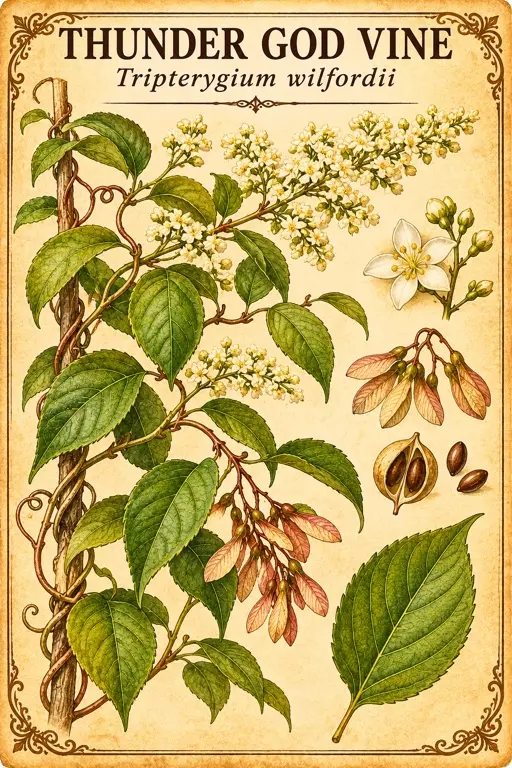
Thunder God Vine
Tripterygium wilfordii
A climbing plant from southeast China whose root extracts are used in Chinese medicine for inflammatory and autoimmune diseases. Trials suggest it may help rheumatoid arthritis, but it can cause serious side effects, including kidney and liver damage.
Safety at a glance
- Pregnancy1 note →
- Breastfeeding1 note →
- MedicinesNothing recorded
- Who should avoid it1 note →
- AllergiesNothing recorded
- Toxicity2 notes →
Tap a box to read the safety notes below. “Nothing recorded” means our sources don't cover it, not that it's safe.
What is Thunder God Vine?
- Plant family
- Celastraceae, the staff-vine family
- Parts used
- The root (as prepared extracts)
- Where it grows
- Southeast China
- Genus
- Tripterygium
- Species
- wilfordii
Also called
Tripterygium, TwHF
Traditional names
Lei Gong Teng
Traditionally used for
- Rheumatoid arthritis (studied)
- Kidney disease (studied)
- Inflammation and fever (traditional)
Traditionally described as
- Contains the potent compounds triptolide and celastrol
Health topics
Where Thunder God Vine appears in symptom search, and why. Being listed doesn't mean it's a proven treatment.
- Joint Discomfort
Trials in rheumatoid arthritis found benefit, but the herb can have serious side effects, including kidney and liver damage.
- Liver Safety Warnings
Can cause liver and kidney problems; rare deaths have been reported.
Traditions that use it
- Traditional Chinese Medicine
Extracts (lei gong teng) have been used for inflammation, fever, and inflammatory and autoimmune diseases.
Natural compounds
Safety
Who should avoid it
Don't use thunder god vine in place of standard medical care for rheumatoid arthritis. Standard treatment can delay or prevent joint damage, not just ease symptoms.
If you take any medicine, talk with your health care provider before using it.[1]Health agency
Side effects
Other side effects include:
- Stomach and digestive problems, including diarrhea
- Headache and dizziness
- A lower white blood cell count
- Changes to the menstrual cycle
- Skin redness
Adding it to standard treatment might raise the risk of side effects, though some research disagrees.[1]Health agency
Pregnancy
Using thunder god vine during pregnancy is considered unsafe, because it may increase the risk of birth defects.[1]Health agency
Breastfeeding
Little is known about whether it's safe to use while breastfeeding.[1]Health agency
Toxicity testing
Thunder god vine can have serious side effects, including kidney damage and liver problems. Rare deaths have been reported. These may be linked to certain preparations or high doses. Triptolide, one of its compounds, may be toxic in people.[1]Health agency
Its effects on the reproductive system limit its use. It can harm both male and female reproductive organs.[2]Study
Technical detail: mechanisms of tripterygium glycoside reproductive toxicity include oxidative stress, inflammation, apoptosis and metabolic imbalance.
What does the research say?
Traditional use
These are traditional uses, not proven treatments.
Thunder god vine is a climbing plant grown in southeast China. In traditional Chinese medicine, its extracts have been used for inflammation and fever, and for many diseases where the immune system attacks the body.
Today it's promoted for rheumatoid arthritis, kidney problems, Crohn's disease and eczema, taken by mouth or applied to the skin.[1]Health agency
Research in people
A 2021 review pooled 40 trials with 3,092 people with rheumatoid arthritis. Adding thunder god vine glycosides (an extract) to standard arthritis drugs reduced morning stiffness, tender and swollen joints, pain, and blood markers of inflammation. The authors call for larger, higher-quality trials.[3]Review or trial
Technical detail: outcomes included duration of morning stiffness, tender and swollen joint counts, VAS pain, CRP, ESR and rheumatoid factor (all p < .001). Only trials with a Cochrane risk-of-bias score of 4 or more were included.
The US National Institutes of Health says many low- to moderate-quality studies suggest thunder god vine might help some symptoms of rheumatoid arthritis.
Added to standard treatment, it might reduce joint swelling and tenderness more than standard treatment alone. But combining two standard medicines might work better still. It's unclear whether skin preparations do anything. Early reports suggest it might help some kidney disorders.[1]Health agency
In a US trial with 121 people with active rheumatoid arthritis, an extract (60 mg three times a day) was compared with the standard drug sulfasalazine for 24 weeks. About 65% on the extract improved by at least 20%, compared with 33% on sulfasalazine. Side effects were about as common in both groups.
Many people stopped early: only 62% kept taking the extract and 41% kept taking sulfasalazine.[4]Study
Technical detail: ACR 20 at 24 weeks 65.0% (95% CI 51.6–76.9%) vs 32.8% (95% CI 21.3–46.0%), P = 0.001, by mixed-model analysis imputing dropouts; outcome data for only 62 patients at 24 weeks. ACR 50 and ACR 70 also favoured TwHF; interleukin-6 fell.
In a Chinese trial with 207 people with active rheumatoid arthritis, people took an extract (20 mg three times a day), the standard drug methotrexate, or both, for 24 weeks. The share who improved by at least 50% was:
- 46% on methotrexate
- 55% on the extract
- 77% on both together
Irregular periods occurred in 7 women on the extract, 3 on methotrexate and 5 on both.[5]Study
Technical detail: open-label with blinded assessors (TRIFRA, NCT01613079). ACR50 46.4% (MTX) vs 55.1% (TwHF; p = 0.014) vs 76.8% (MTX+TwHF; p < 0.001 vs MTX). Methotrexate dose 12.5 mg weekly.
A 2025 review pooled 20 trials with 1,789 people with membranous nephropathy, a kidney disease that leaks protein into the urine. The extract improved remission rates, lowered protein in the urine and reduced relapses.
But 17 of the 20 trials had a high risk of bias, and side effects were poorly reported.[6]Review or trial
Technical detail: total response RR 1.27 (95% CI 1.12–1.44); complete remission RR 1.81 (1.13–2.90); 24-h urinary protein SMD −2.09; recurrence RR 0.56 (0.37–0.86). Serum albumin and reported adverse events did not differ significantly.
In short
Can cause kidney and liver damage, and rare deaths have been reported. Unsafe in pregnancy. Don't use it in place of standard arthritis treatment.
Sources
- [1] Thunder God Vine: Usefulness and Safety — National Center for Complementary and Integrative Health (NCCIH), National Institutes of HealthGovernment health agency
- [2] The mechanisms of tripterygium glycosides-induced reproductive toxicity and detoxification strategies · DOI: 10.1016/j.reprotox.2025.108830Peer-reviewed study
- [3] The effectiveness and safety of Tripterygium wilfordii glycosides combined with disease-modifying anti-rheumatic drugs in the treatment of rheumatoid arthritis: A systematic review and meta-analysis of 40 randomized controlled trials · DOI: 10.1002/ptr.6996Review or clinical trial
- [4] Comparison of Tripterygium wilfordii Hook F versus sulfasalazine in the treatment of rheumatoid arthritis: a randomized trial · DOI: 10.7326/0003-4819-151-4-200908180-00005Peer-reviewed study
- [5] Comparison of Tripterygium wilfordii Hook F with methotrexate in the treatment of active rheumatoid arthritis (TRIFRA): a randomised, controlled clinical trial · DOI: 10.1136/annrheumdis-2013-204807Peer-reviewed study
- [6] Clinical efficacy and safety of tripterygium wilfordii glycosides in the treatment of idiopathic membranous nephropathy: a systematic review and meta-analysis · DOI: 10.3389/fphar.2025.1652789Review or clinical trial
This information is educational and traditional in nature, and is not a substitute for professional medical advice. Unfamiliar word? See what these words mean.