
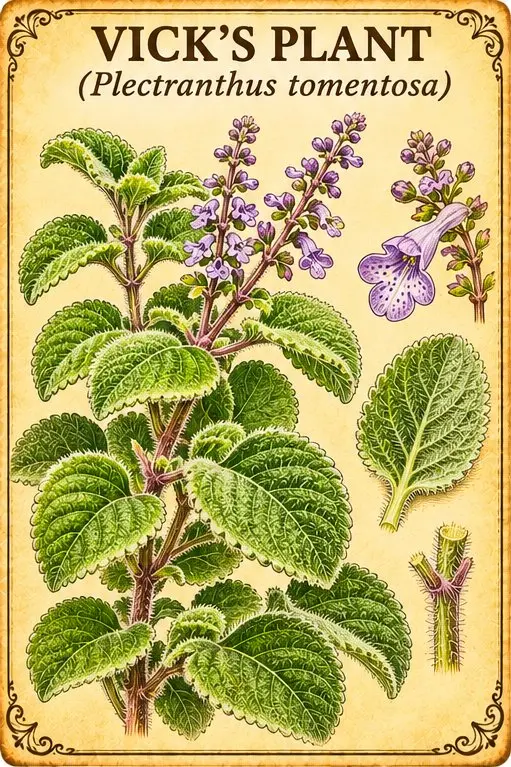
Vick's Plant
Plectranthus tomentosa
Little research exists on this plant; its well-studied relative Coleus amboinicus is used for coughs and boosted breast milk in studies.
Safety at a glance
- PregnancyNothing recorded
- BreastfeedingNothing recorded
- MedicinesNothing recorded
- Who should avoid itNothing recorded
- AllergiesNothing recorded
- ToxicityNothing recorded
Tap a box to read the safety notes below. “Nothing recorded” means our sources don't cover it, not that it's safe.
What is Vick's Plant?
- Plant family
- Lamiaceae, the mint family
- Parts used
- The leaves
- Genus
- Plectranthus
- Species
- tomentosa
Also called
Vicks Plant
Traditionally used for
- Coughs and colds (related species)
- Breast milk (related species)
Traditionally described as
- Leaves
Health topics
Where Vick's Plant appears in symptom search, and why. Being listed doesn't mean it's a proven treatment.
- Breast Milk Supply
Based on its relative Coleus amboinicus, which increased breast milk in studies; not tested on Vick's plant.
- Cancer Research
Lab and animal studies only: listed among many effects, it slowed or killed some cancer cells. Not tested against cancer in people.
- Cough
Based on its relative Coleus amboinicus, whose leaf juice is used in India for coughs and colds; not tested on Vick's plant.
What does the research say?
Traditional use
These are traditional uses, not proven treatments.
Hardly any research has been done on Vick's plant itself. The research on this page is on its most-studied relative, Coleus amboinicus (also called Plectranthus amboinicus or Cuban oregano), so it may not apply to Vick's plant.
In India, the leaf juice of Coleus amboinicus is applied for coughs, sore throats, a stuffy nose, asthma and bronchitis. In Southeast Asia it is used for skin conditions, in India and Nigeria for convulsions, epilepsy and headaches, and in tropical countries for malaria fever.[1]Review or trial
Laboratory & animal research
Lab and animal results show what might be worth studying in people. They don't show that the herb has these effects in humans.
In lab studies, Coleus amboinicus extracts and oils killed many bacteria and skin fungi, repelled mosquitoes about as well as DEET, reduced inflammation, acted as antioxidants, killed some cancer cells and helped wounds heal. A 2025 review said clinical trials are still needed.[1]Review or trial
Research in people
A 2018 analysis of studies on herbs to increase breast milk found that Coleus amboinicus and dates boosted milk production more than fenugreek and the other comparisons.[2]Review or trial
In short
Research is on a related species; no safety data for this plant.
Sources
- [1] Plectranthus amboinicus: A Systematic Review of Traditional Uses, Phytochemical Properties, and Therapeutic Applications · DOI: 10.3390/ph18050707Review or clinical trial
- [2] Effectiveness of fenugreek as a galactagogue: A network meta-analysis · DOI: 10.1002/ptr.5972Review or clinical trial
This information is educational and traditional in nature, and is not a substitute for professional medical advice. Unfamiliar word? See what these words mean.