
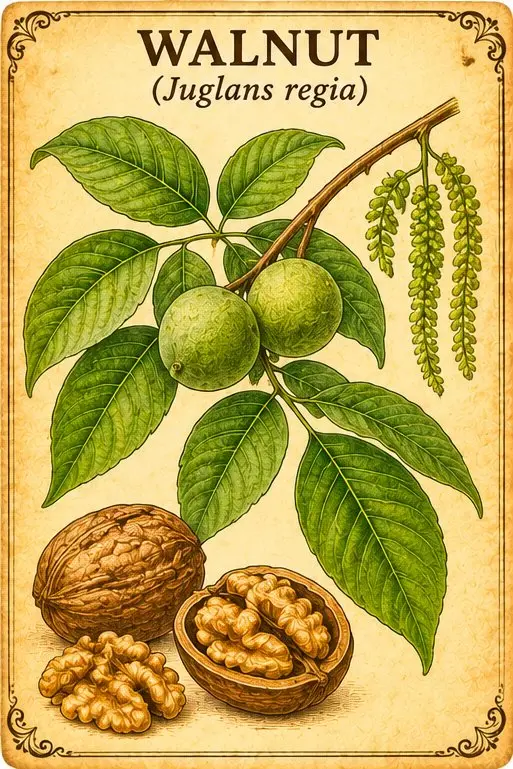
Walnut
Juglans regia
The common walnut tree. Its leaf is a traditional European skin remedy, and eating the nuts lowers cholesterol in trials.
Safety at a glance
- Pregnancy1 note →
- BreastfeedingNothing recorded
- MedicinesNothing recorded
- Who should avoid it1 note →
- Allergies1 note →
- Toxicity1 note →
Tap a box to read the safety notes below. “Nothing recorded” means our sources don't cover it, not that it's safe.
What is Walnut?
- Plant family
- Juglandaceae, the walnut family
- Parts used
- The leaf (used on the skin) and the nut (eaten as food)
- Genus
- Juglans
- Species
- regia
Also called
Walnut Leaf
Traditionally used for
- Minor skin inflammation
- Heavy sweating of hands and feet
Traditionally described as
- Leaf and nut
Health topics
Where Walnut appears in symptom search, and why. Being listed doesn't mean it's a proven treatment.
- High Cholesterol
Eating walnuts lowered total and LDL cholesterol and triglycerides in a review of 49 trials.
- Skin Irritation, Rashes and Itching
Walnut leaf is recognized in Europe as a traditional skin preparation for minor skin inflammation.
Traditions that use it
- European Folk Medicine
Walnut leaf is recognized in the European Union as a traditional herbal medicine, used on the skin for minor inflammation and to reduce heavy sweating of the hands and feet.
Safety
Who should avoid it
Don't put walnut leaf preparations on open wounds or large skin injuries, or use them if you are allergic to walnut leaf.[1]Health agency
Allergies
Walnuts are tree nuts, one of the major food allergens. Food allergy reactions can be life-threatening (anaphylaxis).[2]Health agency
Side effects
Walnut leaf preparations temporarily stain the skin. No other side effects are known, and no interactions with medicines have been reported.[1]Health agency
Pregnancy
The safety of walnut leaf preparations in pregnancy and breastfeeding has not been established, so they are not recommended during pregnancy or while breastfeeding.[1]Health agency
Toxicity testing
Walnut trees contain juglone, a toxic substance. The European Medicines Agency found that dried walnut leaf has only traces of it, which don't pose a risk to human health.[3]Health agency
How much to use
For adults only, on the skin. Boil 4 to 6 g of dried, cut leaf in 200 ml of water and apply on a soaked dressing:
- for skin inflammation, 2 to 4 times a day
- for sweating, for up to 30 minutes twice a day
Don't use it for more than 1 week. See a doctor if symptoms continue.[1]Health agency
What does the research say?
Traditional use
These are traditional uses, not proven treatments.
The European Medicines Agency recognizes walnut leaf as a traditional herbal medicine for adults, based on well-documented, very long-standing use. The dried leaves are boiled in water and the liquid is used on the skin:
- to relieve minor skin inflammation
- to reduce heavy sweating of the hands and feet
Laboratory & animal research
Lab and animal results show what might be worth studying in people. They don't show that the herb has these effects in humans.
Lab tests have shown that walnut leaf can kill or slow the growth of germs.[3]Health agency
Research in people
A 2026 review of 49 randomized trials in 4,611 adults found that eating walnuts lowered total cholesterol, LDL ("bad") cholesterol and triglycerides. Effects on HDL ("good") cholesterol were unclear. The authors concluded walnuts can be part of a heart-healthy diet.[4]Review or trial
Technical detail: triglycerides WMD −6.24 mg/dL; no significant overall change in HDL-C, Apo-A1 or Apo-B.
In short
Tree nut allergy can be severe; leaf stains the skin; not on open wounds.
Sources
- [1] Community herbal monograph on Juglans regia L., folium (EMA/HMPC/346737/2011) — European Medicines Agency, Committee on Herbal Medicinal Products (HMPC)Government health agency
- [2] Food Allergies: What You Need to Know — U.S. Food and Drug Administration (FDA)Government health agency
- [3] Walnut leaf: summary for the public (EMA/HMPC/432131/2013) — European Medicines Agency, Committee on Herbal Medicinal Products (HMPC)Government health agency
- [4] Effects of Walnut Consumption on Blood Lipid Profile and Apolipoproteins in Adults: A GRADE-Assessed Systematic Review and Dose-Response Meta-Analysis of 49 Randomized Controlled Trials · DOI: 10.1002/fsn3.71526Review or clinical trial
This information is educational and traditional in nature, and is not a substitute for professional medical advice. Unfamiliar word? See what these words mean.