
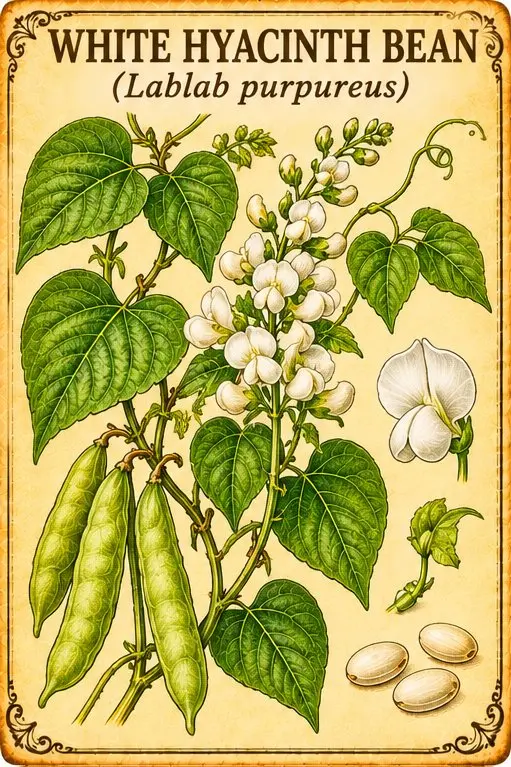
White Hyacinth Bean
Lablab purpureus
A bean used as food and in Chinese medicine for a weak stomach, poor appetite and diarrhea. Toxic if not properly prepared.
Safety at a glance
- PregnancyNothing recorded
- BreastfeedingNothing recorded
- MedicinesNothing recorded
- Who should avoid itNothing recorded
- AllergiesNothing recorded
- Toxicity1 note →
Tap a box to read the safety notes below. “Nothing recorded” means our sources don't cover it, not that it's safe.
What is White Hyacinth Bean?
- Plant family
- Fabaceae, the pea and bean family
- Parts used
- The dried white seeds
- Genus
- Lablab
- Species
- purpureus
Also called
Lablab
Older scientific names
Dolichos lablab
Traditionally used for
- Poor appetite
- Loose stools
- Diarrhea (traditional)
Traditionally described as
- Seeds rich in saponins
Health topics
Where White Hyacinth Bean appears in symptom search, and why. Being listed doesn't mean it's a proven treatment.
- Cancer Research
Lab and animal studies only: listed among many effects, it slowed or killed some cancer cells. Not tested against cancer in people.
- Diarrhea
Used in Chinese medicine for loose stools and summer diarrhea.
- Loss of Appetite
Used in Chinese medicine for poor appetite and a weak stomach.
Traditions that use it
- Traditional Chinese Medicine
Used for a weak stomach, poor appetite, loose stools and diarrhea.
Safety
Toxicity testing
The beans are toxic if not prepared properly.[1]Review or trial
What does the research say?
Traditional use
These are traditional uses, not proven treatments.
The dried white seeds, called Lablab Semen Album, are a traditional Chinese medicine with a long history. They are usually combined with other herbs for a weak stomach, poor appetite, loose stools, heavy vaginal discharge, summer diarrhea, chest tightness and a bloated belly. The beans are also widely eaten as food.[1]Review or trial
Laboratory & animal research
Lab and animal results show what might be worth studying in people. They don't show that the herb has these effects in humans.
Lab and animal studies report effects on blood fats, blood sugar, immunity, oxidation, the liver, tumors and viruses. A 2024 review said some traditional uses haven't been confirmed and that clinical studies are lacking.[1]Review or trial
Saponins (soap-like compounds) from the seeds reduced inflammation in a 2024 lab study.[2]Study
In short
Toxic if not properly prepared.
Sources
- [1] Botany, traditional uses, phytochemistry, pharmacology, edible uses, and quality control of Lablab semen Album: A systematic review · DOI: 10.1016/j.jep.2024.118507Review or clinical trial
- [2] Saponins from Dolichos lablab seeds with anti-inflammatory activity · DOI: 10.1016/j.bioorg.2024.107692Peer-reviewed study
This information is educational and traditional in nature, and is not a substitute for professional medical advice. Unfamiliar word? See what these words mean.