
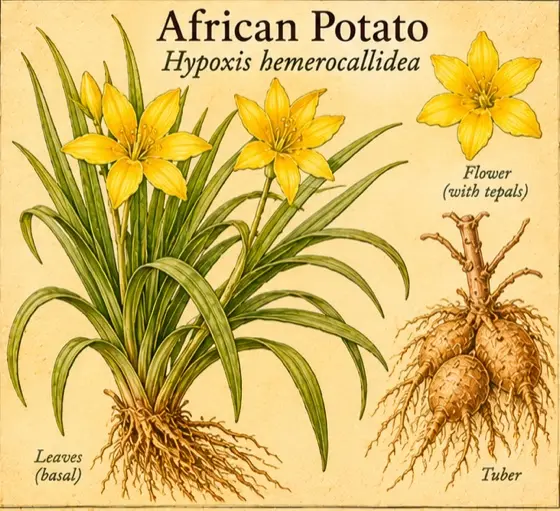
African Potato
Hypoxis hemerocallidea
A yellow-flowered southern African plant whose corm is widely used to strengthen the immune system, including by people living with HIV. Lab tests suggest it may interact with medicines.
Safety at a glance
- PregnancyNothing recorded
- BreastfeedingNothing recorded
- Medicines1 note →
- Who should avoid itNothing recorded
- AllergiesNothing recorded
- ToxicityNothing recorded
Tap a box to read the safety notes below. “Nothing recorded” means our sources don't cover it, not that it's safe.
African Potato may interact with some medicines. If you take any medicine, read Interactions with medicines below and talk to your doctor or pharmacist before using it.
What is African Potato?
- Plant family
- Hypoxidaceae, the star-grass family
- Parts used
- The corm (a swollen, potato-like underground stem)
- Where it grows
- Southern Africa
- Genus
- Hypoxis
- Species
- hemerocallidea
Also called
Hypoxis, Star Flower
Traditional names
Inkomfe
Older scientific names
Hypoxis rooperi
Traditionally used for
- Immune support (traditional)
- Impotence and infertility (traditional)
- Urinary infections (traditional)
Traditionally described as
- Corm rich in hypoxoside
- which the gut turns into rooperol
Health topics
Where African Potato appears in symptom search, and why. Being listed doesn't mean it's a proven treatment.
- Bladder and Urinary Tract Infections (UTIs)
Traditionally used for urinary infections.
- Immune Support (Colds and Flu)
Used across southern Africa to strengthen the immune system.
- Sexual Health
Traditionally used for impotence.
Traditions that use it
- African Traditional Medicine
A popular southern African remedy to strengthen the immune system, and for wasting illness, infertility, impotence and urinary infections.
Natural compounds
How it's prepared
Common ways African Potato is prepared or sold. This isn't advice on how to take it; see Safety below.
Safety
Interactions with medicines
In lab tests, African potato extract blocked several liver enzymes and transporters that the body uses to process many medicines. Normal traditional doses could reach these levels in the gut. It may therefore change how some medicines work, including HIV medicines, but this hasn't been confirmed in people.[1]Study
Technical detail: inhibited CYP1A2, 2A6, 2B6, 2C8, 2C9 and 3A4/5 (IC50 98.5–210.8 µg/mL) and OATP1B1 and OATP1B3 in human liver microsomes and transfected cells.
Side effects
The most common side effects are nausea and vomiting, which settle down over time.[2]Review or trial
What does the research say?
Traditional use
These are traditional uses, not proven treatments.
African potato is a grass-like plant with yellow star-shaped flowers. It isn't related to the true potato. Its corm (a potato-like underground stem) is used across southern Africa to strengthen the immune system. Traditional uses also include:
- Wasting illness
- Infertility and impotence
- Testicular tumors
- Mental illness and bad dreams
- Gut worms and urinary infections
- Heart disease
A water decoction of the corm is widely taken in southern Africa by people living with HIV, some of whom also take antiretroviral and other medicines.[1]Study
Laboratory & animal research
Lab and animal results show what might be worth studying in people. They don't show that the herb has these effects in humans.
The corm contains hypoxoside, which the gut quickly turns into rooperol, a strong antioxidant. In lab and animal studies, African potato has affected the immune system and reduced pain, inflammation, blood sugar, seizures, gut spasms and bacteria.[2]Review or trial
Technical detail: also contains sterols, sterol glycosides, stanols, terpenoids, saponins, cardiac glycosides and tannins; 15 mg/kg/day of hypoxoside is reported to be therapeutic.
A review of the Hypoxis genus found promising results in lab and animal studies and a couple of clinical trials. It also found gaps in knowledge, especially about toxicity. The authors call for more safety research and for protecting wild plants.[3]Study
In short
May interfere with how the body processes many medicines, including HIV medicines. Can cause nausea and vomiting.
Sources
- [1] The potential of Hypoxis hemerocallidea for herb-drug interaction · DOI: 10.3109/13880209.2013.796393Peer-reviewed study
- [2] African potato (Hypoxis hemerocallidea): a systematic review of its chemistry, pharmacology and ethno medicinal properties · DOI: 10.1186/s12906-020-02956-xReview or clinical trial
- [3] Hypoxis (Hypoxidaceae) in African traditional medicine · DOI: 10.1016/j.jep.2013.10.032Peer-reviewed study
This information is educational and traditional in nature, and is not a substitute for professional medical advice. Unfamiliar word? See what these words mean.