
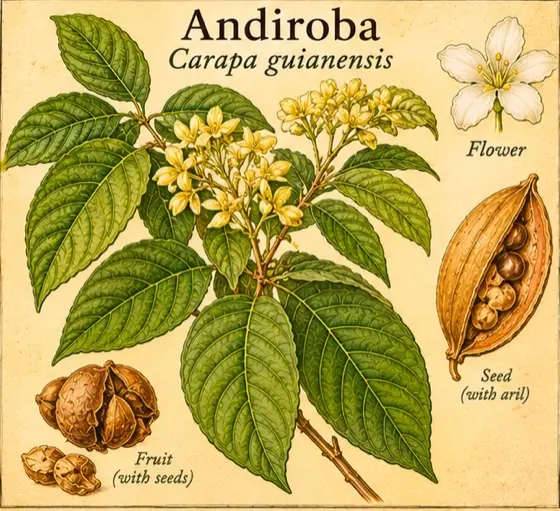
Andiroba
Carapa guianensis
An Amazon rainforest tree whose seed oil is a traditional remedy for wounds, skin problems, inflammation and rheumatism. Animal studies support its wound-healing effects.
Safety at a glance
- PregnancyNothing recorded
- BreastfeedingNothing recorded
- MedicinesNothing recorded
- Who should avoid itNothing recorded
- AllergiesNothing recorded
- ToxicityNothing recorded
Tap a box to read the safety notes below. “Nothing recorded” means our sources don't cover it, not that it's safe.
What is Andiroba?
- Plant family
- Meliaceae, the mahogany family
- Parts used
- The oil pressed from the seeds (also the bark and leaves)
- Where it grows
- The Amazon rainforest, Central America and the Caribbean
- Genus
- Carapa
- Species
- guianensis
Also called
Andiroba Oil, Carapa Oil
Traditional names
Andirobeira
Traditionally used for
- Wounds and skin problems (traditional and animal research)
- Inflammation and rheumatism (traditional)
Traditionally described as
- Seed oil rich in limonoids such as gedunin
Health topics
Where Andiroba appears in symptom search, and why. Being listed doesn't mean it's a proven treatment.
- Cuts, Wounds, Burns and Skin Ulcers
Traditionally applied to wounds; the oil helped wounds heal in animal studies.
- Joint Discomfort
Traditionally used in the Amazon for rheumatism.
- Skin Irritation, Rashes and Itching
Traditionally used for skin problems; reduced inflammation in animals.
Natural compounds
How it's prepared
Common ways Andiroba is prepared or sold. This isn't advice on how to take it; see Safety below.
Safety
Side effects
Most andiroba research has been done in animals and cells. There are few studies in people, so its safety on the skin or taken by mouth hasn't been well established.[1]Study
Depends on how it's prepared
The makeup of andiroba oil varies between products, because there are no standard ways of extracting and testing it.[2]Study
What does the research say?
Traditional use
These are traditional uses, not proven treatments.
Andiroba is a tall rainforest tree of the mahogany family. Almost every part of it is used in folk medicine in Brazil and other Amazon countries. Its seed oil is the most important. Traditional peoples, especially in the Brazilian Amazon, use the oil for:
- Wounds and skin problems
- Inflammation and rheumatism (joint and muscle pain)
- Infections
- Fever
Laboratory & animal research
Lab and animal results show what might be worth studying in people. They don't show that the herb has these effects in humans.
A 2024 review of 22 studies, mostly in animals, found that andiroba oil reduced inflammation and helped wounds of many kinds heal. It reduced swelling, helped new skin and blood vessels form, and helped repair cells called fibroblasts recover. Some newer forms of the oil, such as gels, films and nanoemulsions, worked better than the plain oil.[1]Study
Technical detail: reduced leukocyte infiltration and apoptotic cells; increased phagocytic activity and growth factors; stimulated glucocorticoid production; studies published 2005–2021.
Andiroba's effects are thought to come from compounds called limonoids, such as gedunin. In rodents, the oil and these compounds reduced swelling and allergic reactions. They also calmed the immune cells that drive inflammation and allergy.[3]Study
Technical detail: tetranortriterpenoids (6α-acetoxygedunin, 7-deacetoxy-7-oxogedunin, andirobin, gedunin, methyl angolensate) inhibited histamine-, bradykinin- and PAF-induced edema, IL-5, CCL11/eotaxin, TNF-α and IL-1β, via NF-κB.
Andiroba oil doesn't mix with water, which limits how well the body can use it. Packaging it in tiny particles (nanoencapsulation) improved its effects on inflammation, germs and wound healing in lab studies. Reported makeup of the oil varies between studies, because there are no standard methods to extract or test it.[2]Study
In short
Few studies in people; product quality varies.
Sources
- [1] Effects of andiroba oil (Carapa guianensis Aublet) on the immune system in inflammation and wound healing: A scoping review · DOI: 10.1016/j.jep.2024.118004Peer-reviewed study
- [2] Exploring Copaiba and Andiroba Oils: A Comprehensive Review of Composition, Physicochemical Properties and Pharmacological Activities in Advanced Delivery Systems · DOI: 10.3390/pharmaceutics18060642Peer-reviewed study
- [3] The therapeutic properties of Carapa guianensis · DOI: 10.2174/13816128113199990048Peer-reviewed study
This information is educational and traditional in nature, and is not a substitute for professional medical advice. Unfamiliar word? See what these words mean.