
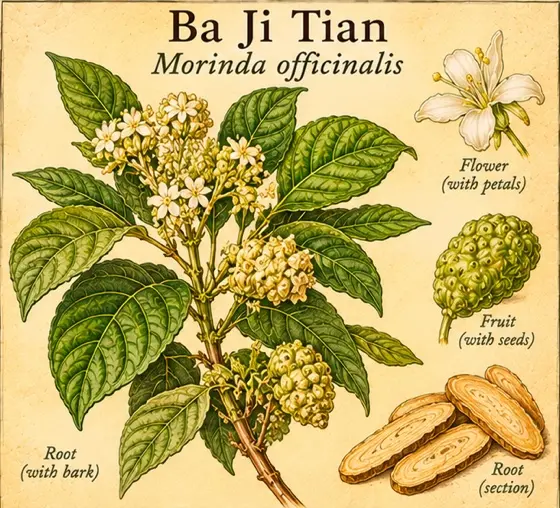
Ba Ji Tian
Morinda officinalis
A Chinese medicinal root used to strengthen the kidneys and bones. Capsules of its sugars worked about as well as antidepressants in trials of mild to moderate depression.
Safety at a glance
- PregnancyNothing recorded
- BreastfeedingNothing recorded
- MedicinesNothing recorded
- Who should avoid itNothing recorded
- AllergiesNothing recorded
- ToxicityNothing recorded
Tap a box to read the safety notes below. “Nothing recorded” means our sources don't cover it, not that it's safe.
What is Ba Ji Tian?
- Plant family
- Rubiaceae, the coffee family
- Parts used
- The root
- Where it grows
- Southern China
- Genus
- Morinda
- Species
- officinalis
Also called
Morinda Root
Traditional names
Bajitian, Morindae Officinalis Radix
Traditionally used for
- Depression (studied)
- Osteoporosis (traditional and studied in mixtures)
Traditionally described as
- Root rich in oligosaccharides
Traditions that use it
- Traditional Chinese Medicine
Ba ji tian root is used as both food and medicine to strengthen ("tonify") the kidneys, and is believed to help bones by supporting the kidneys and liver.
Natural compounds
How it's prepared
Common ways Ba Ji Tian is prepared or sold. This isn't advice on how to take it; see Safety below.
- Capsule
Capsules of sugars from the root (oligosaccharides) were tested in depression trials.[1]Review or trial
- Decoction
The root is used in traditional Chinese herbal formulas.[2]Study
Safety
Side effects
In a review of 7 trials, side effects of ba ji tian capsules were no more common than with standard antidepressants. The quality of this evidence was low.[1]Review or trial
In an 8-week trial, side effects were mild, mainly stomach and gut upsets such as diarrhea or constipation.[3]Study
What does the research say?
Traditional use
These are traditional uses, not proven treatments.
Ba ji tian is the root of a climbing vine in the coffee family, a relative of noni. In traditional Chinese medicine, it's used as both food and medicine to strengthen ("tonify") the kidneys. It's believed to help bones by supporting the kidneys and liver, and is used for osteoporosis (thinning bones).[2]Study
Research in people
A 2021 review of 7 trials with 1,384 people with mild to moderate depression compared capsules of sugars from ba ji tian root with standard antidepressants. The capsules worked about as well as the antidepressants, with no difference in side effects. The quality of the evidence on side effects was low.[1]Review or trial
Technical detail: Morinda officinalis oligosaccharide (MOO) capsules; response RR 0.99 (95% CI 0.92–1.06); adverse events RR 0.84 (0.65–1.07); GRADE assessed.
In an 8-week trial, 108 people with major depression and gut symptoms all took ba ji tian capsules, plus either probiotics or a placebo. Adding probiotics didn't improve depression overall, but it eased sleep problems more at week 2. Side effects were mild, mainly diarrhea or constipation.[3]Study
Technical detail: randomized, double-blind; MOO 2 capsules twice daily; primary outcome HAMD-17 change (p = 0.983); insomnia sub-score p = 0.028.
A 2026 review of 215 publications found 11 clinical trials in osteoporosis, mostly of herbal mixtures containing ba ji tian. They reported benefits in people with osteoporosis, but the effect of ba ji tian on its own is unclear.[2]Study
In short
Mild stomach and gut side effects reported. Evidence quality is low.
Sources
- [1] Efficacy and safety of Morinda officinalis oligosaccharide capsules for depressive disorder: a systematic review and meta-analysis · DOI: 10.1590/1516-4446-2020-0945Review or clinical trial
- [2] Morinda officinalis in the prevention and treatment of osteoporosis: A comprehensive review · DOI: 10.1016/j.jep.2026.122296Peer-reviewed study
- [3] Efficacy and Safety of Morinda Officinalis Oligosaccharides Combined with Probiotics as a Therapeutic Strategy for Major Depressive Disorder with Gastrointestinal Symptoms: A Randomized, Double-Blind, Controlled Clinical Trial · DOI: 10.2147/NDT.S534858Peer-reviewed study
This information is educational and traditional in nature, and is not a substitute for professional medical advice. Unfamiliar word? See what these words mean.