
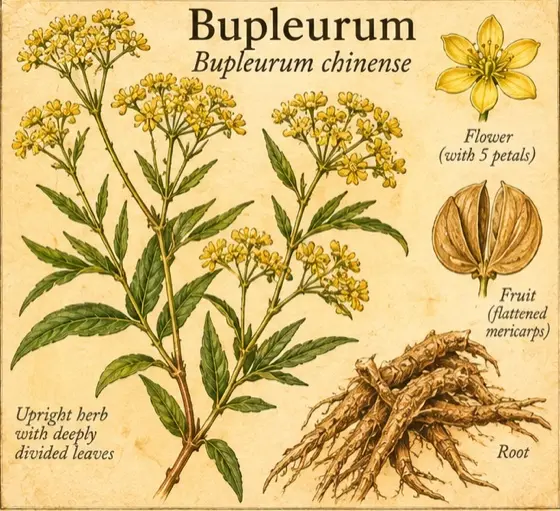
Bupleurum
Bupleurum chinense
A Chinese herb whose root, chai hu, has been used for over 2,000 years for colds with fever, liver problems and menstrual disorders. Its saikosaponins are active in the lab, but it can damage the liver.
Safety at a glance
- PregnancyNothing recorded
- BreastfeedingNothing recorded
- MedicinesNothing recorded
- Who should avoid itNothing recorded
- AllergiesNothing recorded
- Toxicity2 notes →
Tap a box to read the safety notes below. “Nothing recorded” means our sources don't cover it, not that it's safe.
What is Bupleurum?
- Plant family
- Apiaceae, the carrot and parsley family
- Parts used
- The dried root
- Where it grows
- China, Korea and Japan
- Genus
- Bupleurum
- Species
- chinense
Also called
Thorowax
Regional names
Saiko
Traditional names
Chai Hu, Radix Bupleuri
Traditionally used for
- Colds
- flu and fever (traditional)
- Liver problems (traditional)
- Menstrual disorders (traditional)
Traditionally described as
- Root rich in saikosaponins
Health topics
Where Bupleurum appears in symptom search, and why. Being listed doesn't mean it's a proven treatment.
- Colds and Nasal Congestion
Traditionally used for the common cold and influenza.
- Fever
A traditional remedy for colds with fever and influenza in China, Japan and Korea.
- Liver Safety Warnings
Can damage the liver, especially at high doses or with long-term use.
- Menstrual Discomfort
Traditionally used in Chinese medicine for menstrual disorders.
Traditions that use it
- Traditional Chinese Medicine
Known as chai hu, first recorded about 200 AD. Used for colds with fever, influenza, malaria, hepatitis and menstrual disorders.
Natural compounds
Safety
Toxicity testing
Bupleurum can damage the liver, especially at high doses and with long-term use. Signs of liver injury from it have included raised liver enzymes, hepatitis and jaundice (yellowing of the skin and eyes).[1]Study
Both sudden liver damage from overdose and slowly building liver damage from long-term use have been reported with saikosaponins and bupleurum root.[2]Study
What does the research say?
Traditional use
These are traditional uses, not proven treatments.
Bupleurum root (chai hu) has been used as medicine for more than 2,000 years in China, Japan and Korea. It was first recorded in the Shennong Bencao Jing around 200 AD. Traditional uses include:
- Colds with fever, and influenza
- Inflammation and pain
- Malaria
- Hepatitis
- Menstrual disorders
Laboratory & animal research
Lab and animal results show what might be worth studying in people. They don't show that the herb has these effects in humans.
The root contains saponins (called saikosaponins), essential oils, flavonoids and other compounds. In lab and animal studies, its extracts and compounds reduced inflammation and fever, acted against cancer cells, germs and viruses, and protected the liver and nerves.[1]Study
Technical detail: in mice, raw and vinegar-baked root (5 g/kg/day for 14 days) protected against CCl4 liver injury, with the processed root more effective.
Saikosaponins, the main active compounds, have shown effects against inflammation, viruses and cancer in lab and animal studies, and both protective and harmful effects on liver scarring. Bupleurum is sold in China in tablets such as Chai Hu Shu Gan and Xiao Yao Wan.[2]Study
Technical detail: mainly saikosaponins a, c and d; contradictory roles in apoptosis, oxidative stress and liver fibrosis.
In short
Can damage the liver, especially at high doses or with long-term use.
Sources
- [1] Radix Bupleuri: A Review of Traditional Uses, Botany, Phytochemistry, Pharmacology, and Toxicology · DOI: 10.1155/2017/7597596Peer-reviewed study
- [2] A comprehensive review and perspectives on pharmacology and toxicology of saikosaponins · DOI: 10.1016/j.phymed.2018.09.174Peer-reviewed study
This information is educational and traditional in nature, and is not a substitute for professional medical advice. Unfamiliar word? See what these words mean.