
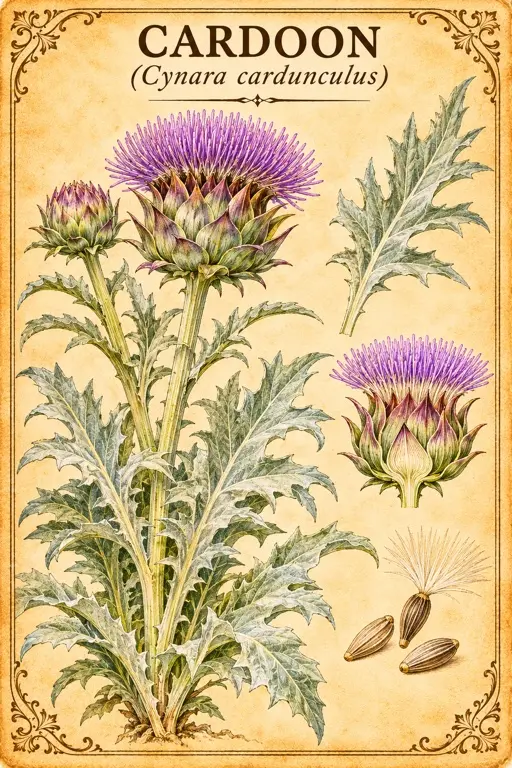
Cardoon
Cynara cardunculus var. altilis
A thistle-like Mediterranean relative of the artichoke, grown for its fleshy leaf stalks. Its flowers curdle milk for traditional sheep and goat cheeses, and supplements made from it have been studied for fatty liver and cholesterol.
Safety at a glance
- Pregnancy1 note →
- BreastfeedingNothing recorded
- MedicinesNothing recorded
- Who should avoid it1 note →
- AllergiesNothing recorded
- ToxicityNothing recorded
Tap a box to read the safety notes below. “Nothing recorded” means our sources don't cover it, not that it's safe.
What is Cardoon?
- Plant family
- Asteraceae, the daisy family
- Parts used
- The leaf stalks (as a vegetable), the flowers (to curdle milk) and the leaves (in extracts)
- Where it grows
- The Mediterranean
- Genus
- Cynara
- Species
- cardunculus
Also called
Artichoke Thistle
Regional names
Cardone, Cardo
Traditionally used for
- Vegetable (leaf stalks)
- Cheese-making (flowers)
- Fatty liver
- High cholesterol
Traditionally described as
- Rich in polyphenols
- inulin and fiber
Health topics
Where Cardoon appears in symptom search, and why. Being listed doesn't mean it's a proven treatment.
- Fatty Liver (NAFLD)
In a 12-week trial, a supplement combining wild cardoon and bergamot reduced liver fat more than placebo.
- High Cholesterol
Cholesterol fell in people taking a cardoon-based supplement in a 6-month trial reanalysis; leaves are also studied in the lab.
Traditions that use it
- Mediterranean Folk Medicine
Part of Mediterranean diets and folk medicine since ancient times; its flowers curdle milk for traditional cheeses.
Safety
Who should avoid it
European guidance on medicines made from the leaves of this species (sold as artichoke leaf) says not to use them if you have:
- A blocked or inflamed bile duct (cholangitis)
- Gallstones or any other bile problem that needs medical care
- Liver disease
- An allergy to daisy-family plants
Side effects
With these leaf medicines, side effects include mild diarrhea with belly cramps, nausea, heartburn and allergic reactions. How often they happen isn't known.[2]Health agency
Pregnancy
The safety of these leaf medicines during pregnancy and breastfeeding hasn't been established, so European guidance doesn't recommend them at these times.[1]Health agency
What does the research say?
Traditional use
These are traditional uses, not proven treatments.
Cardoon has been part of Mediterranean diets and folk medicine since ancient times. It's the same species as the globe artichoke and the wild cardoon, but it's grown for its leaf stalks rather than its flower buds.[3]Study
Technical detail: Cynara cardunculus has three botanical forms: wild cardoon (var. sylvestris), globe artichoke (var. scolymus) and cultivated cardoon (var. altilis).
The fleshy leaf stalks are eaten in salads and soups.[4]Study
Since ancient times, a water extract of the flowers has been used instead of animal rennet to curdle milk. This is how several Portuguese and Spanish sheep and goat cheeses with protected status are made.[5]Study
Technical detail: the milk-clotting enzymes in the flowers are aspartic proteases called cardosins and cyprosins.
Laboratory & animal research
Lab and animal results show what might be worth studying in people. They don't show that the herb has these effects in humans.
Some studies suggest the leaves could increase urine and bile flow, protect the liver, lower cholesterol, and act against bacteria and cancer cells. These effects are linked mainly to the leaves' polyphenols (antioxidant plant compounds).[4]Study
Technical detail: reported properties are diuretic, hepatoprotective, choleretic, hypocholesterolemic, anticarcinogenic and antibacterial.
A 2022 review describes the plant's natural compounds and the effects reported for them, especially on the liver, blood fats and blood sugar.[3]Study
Technical detail: compounds include phenolics, minerals, inulin, fiber and sesquiterpene lactones. Reported activities include antimicrobial, anti-inflammatory, anticancer, antioxidant, lipid-lowering, cytotoxic, antidiabetic, antihemorrhoidal, cardiotonic and choleretic effects; the review focuses on hepatoprotective, hypolipidemic and antidiabetic activity.
In lab tests, extracts of the leaf stalks were tested for whether they could act as antioxidants, reduce inflammation and fight germs. How strong these effects were depended on how mature the stalks were when picked.[6]Study
Technical detail: hydroethanolic extracts of petioles from 16 growth stages; the main phenolics were 5-O-caffeoylquinic (chlorogenic) acid and 1,5-di-O-caffeoylquinic acid. Antifungal activity varied with maturity stage and fungal strain.
Research in people
In a trial with 102 people with fatty liver, a supplement combining wild cardoon and bergamot extracts (300 mg a day for 12 weeks) reduced liver fat more than a placebo. After allowing for weight loss, the benefit held only in people over 50. Because the supplement had two ingredients, the effect of cardoon on its own isn't known.[7]Study
Technical detail: double-blind, placebo-controlled; liver fat measured as CAP score by transient elastography (−48.2 ± 39 vs −26.9 ± 43 dB/m, p = 0.02). After adjusting for weight change, the percentage CAP reduction was significant only in those over 50 (78% vs 44%, p = 0.007).
A reanalysis of a 6-month trial looked at 50 people who were overweight but not obese. In those taking a cardoon-based supplement (150 mg a day), body weight, blood sugar and cholesterol fell, and liver and blood-vessel measures improved.[8]Study
Technical detail: post-hoc subgroup analysis (BMI 25–29.9) of a 100-person randomized, double-blind, placebo-controlled study of Altilix (Bionap, Italy), a Cynara cardunculus-based supplement containing chlorogenic acid and luteolin. Outcomes included HbA1c, HOMA-IR, total cholesterol, triglycerides, LDL, fatty liver index, AST/ALT, carotid intima-media thickness and flow-mediated dilation.
In short
Don't use leaf extracts if you have gallstones, a blocked bile duct or liver disease, or are allergic to daisy-family plants.
Sources
- [1] European Union herbal monograph on Cynara cardunculus L. (syn. Cynara scolymus L.), folium (EMA/HMPC/194014/2017) — European Medicines Agency, Committee on Herbal Medicinal Products (HMPC)Government health agency
- [2] Artichoke leaf (Cynara cardunculus L. (syn. Cynara scolymus L.), folium): summary of the HMPC conclusions (EMA/268161/2018) — European Medicines Agency, Committee on Herbal Medicinal Products (HMPC)Government health agency
- [3] Bioactive Compounds from Cardoon as Health Promoters in Metabolic Disorders · DOI: 10.3390/foods11030336Peer-reviewed study
- [4] A New Insight on Cardoon: Exploring New Uses besides Cheese Making with a View to Zero Waste · DOI: 10.3390/foods9050564Peer-reviewed study
- [5] Cardoon-based rennets for cheese production · DOI: 10.1007/s00253-018-9032-3Peer-reviewed study
- [6] Phenolic Composition and Biological Properties of Cynara cardunculus L. var. altilis Petioles: Influence of the Maturity Stage · DOI: 10.3390/antiox10121907Peer-reviewed study
- [7] Randomized Clinical Trial: Bergamot Citrus and Wild Cardoon Reduce Liver Steatosis and Body Weight in Non-diabetic Individuals Aged Over 50 Years · DOI: 10.3389/fendo.2020.00494Peer-reviewed study
- [8] A Nutraceutical Containing Chlorogenic Acid and Luteolin Improves Cardiometabolic Parameters in Subjects with Pre-Obesity: A 6-Month Randomized, Double-Blind, Placebo-Controlled Study · DOI: 10.3390/nu15020462Peer-reviewed study
This information is educational and traditional in nature, and is not a substitute for professional medical advice. Unfamiliar word? See what these words mean.