
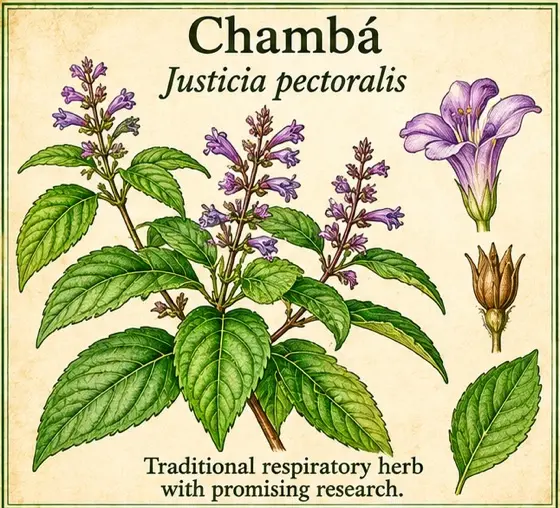
Chambá
Justicia pectoralis
A small Latin American and Caribbean herb used for coughs, asthma, anxiety and menopause. Animal studies support its effects on coughing, airway inflammation and anxiety, but it hasn't been tested in people.
Safety at a glance
- Pregnancy1 note →
- BreastfeedingNothing recorded
- Medicines1 note →
- Who should avoid itNothing recorded
- AllergiesNothing recorded
- Toxicity1 note →
Tap a box to read the safety notes below. “Nothing recorded” means our sources don't cover it, not that it's safe.
Chambá may interact with some medicines. If you take any medicine, read Interactions with medicines below and talk to your doctor or pharmacist before using it.
What is Chambá?
- Plant family
- Acanthaceae, the acanthus family
- Parts used
- The leaves and stems (aerial parts)
- Where it grows
- Central America, the Caribbean and tropical South America
- Genus
- Justicia
- Species
- pectoralis
Also called
Chamba, Fresh Cut
Traditional names
Tilo, Anador
Traditionally used for
- Cough and asthma (traditional and animal research)
- Anxiety (traditional and animal research)
- Menopause symptoms (traditional)
Traditionally described as
- Leaves rich in coumarin; estrogen-like activity in lab tests
Health topics
Where Chambá appears in symptom search, and why. Being listed doesn't mean it's a proven treatment.
- Anxiety
Traditionally used as a calming herb; reduced anxious behavior in mice.
- Asthma and Wheezing
A Jamaican folk remedy for wheezing; reduced airway inflammation in animal studies.
- Cough
Traditionally used for coughs; calmed coughing and helped clear mucus in rats.
- Menopause Symptoms
Used in Costa Rica for menopause; has estrogen-like activity in lab tests.
Traditions that use it
- Caribbean Folk Medicine
In Jamaica, a leaf extract of "fresh cut" is used to ease breathing difficulty and wheezing in people with asthma.
Natural compounds
How it's prepared
Common ways Chambá is prepared or sold. This isn't advice on how to take it; see Safety below.
- Extract
A standardized extract is being developed for respiratory use.[1]Study
- Tea / Infusion
The leaves are made into tea in Latin American folk medicine.[2]Study
Safety
Interactions with medicines
Chambá has estrogen-like activity in lab tests. Whether it affects hormone treatments or hormone-sensitive conditions hasn't been studied.[3]Study
Pregnancy
In pregnant rats, a dry chambá extract didn't harm the mothers or cause birth defects. There are no studies in pregnant women.[2]Study
Technical detail: 300, 600 or 1,200 mg/kg from gestational day 0 to 20.
Toxicity testing
In formal animal safety tests, a standardized extract didn't damage DNA and had acceptable toxicity at normal doses. It hasn't been tested for safety in people.[1]Study
What does the research say?
Traditional use
These are traditional uses, not proven treatments.
Chambá is a small herb of the acanthus family, with lilac-pink flowers, used widely in Latin American folk medicine. It's known there as tilo, chambá and anador. Traditional uses include:
- Coughs and other breathing problems, to loosen mucus and open the airways
- Calming nerves and anxiety, and to help with sleep
- Menopause symptoms
In Costa Rica, chambá is used for menopause symptoms and painful periods. In lab tests, its extract acted on the body's estrogen and progesterone receptors and reduced inflammation. This may explain its traditional use, but it hasn't been tested in women.[3]Study
Technical detail: methanol extract bound ERα, ERβ and the progesterone receptor and inhibited COX-2 (IC50 4.8 µg/mL); weakly enhanced MCF-7 cell growth, not statistically significant.
Laboratory & animal research
Lab and animal results show what might be worth studying in people. They don't show that the herb has these effects in humans.
In mice, a chambá extract reduced anxious behavior in a similar way to the anti-anxiety drug diazepam, without making them sleepy or less active.[4]Study
Technical detail: 50–200 mg/kg; effect reversed by flumazenil, suggesting GABA-A/benzodiazepine receptor involvement.
In rats, a standardized chambá extract was absorbed quickly. It helped clear mucus, calmed coughing, and reduced airway inflammation and damage in an asthma model.[1]Study
Technical detail: extract TI-138; peak plasma coumarin about 1.5 µg/mL and o-coumaric acid 2.0 µg/mL at 0.25 h; suppressed Il4, Il13, Il17a, Tnf and other immune genes.
In guinea pigs, a leaf extract reduced skin reactions to histamine (the chemical behind allergic reactions). In lab tests, it also relaxed airway muscle tightened by histamine. This supports its folk use for asthma and allergies.[5]Study
In short
No human studies. Has estrogen-like activity in lab tests.
Sources
- [1] Preclinical safety and anti-inflammatory activity of a standardized Justicia pectoralis Jacq. extract in experimental models of respiratory inflammation · DOI: 10.1016/j.jep.2026.121411Peer-reviewed study
- [2] Assessing the safety of using the dry extract of Justicia pectoralis Jacq. (Acanthaceae) during pregnancy of Wistar rats · DOI: 10.1016/j.jep.2020.113618Peer-reviewed study
- [3] Estrogenic and progestagenic effects of extracts of Justicia pectoralis Jacq., an herbal medicine from Costa Rica used for the treatment of menopause and PMS · DOI: 10.1016/j.maturitas.2010.04.001Peer-reviewed study
- [4] Anxiolytic-like effects of standardized extract of Justicia pectoralis (SEJP) in mice: Involvement of GABA/benzodiazepine in receptor · DOI: 10.1002/ptr.3274Peer-reviewed study
- [5] Preliminary Investigations of the Anti-asthmatic Properties of the Aqueous Extract of Justicia pectoralis (Fresh Cut) · DOI: 10.7727/wimj.2014.149Peer-reviewed study
This information is educational and traditional in nature, and is not a substitute for professional medical advice. Unfamiliar word? See what these words mean.