
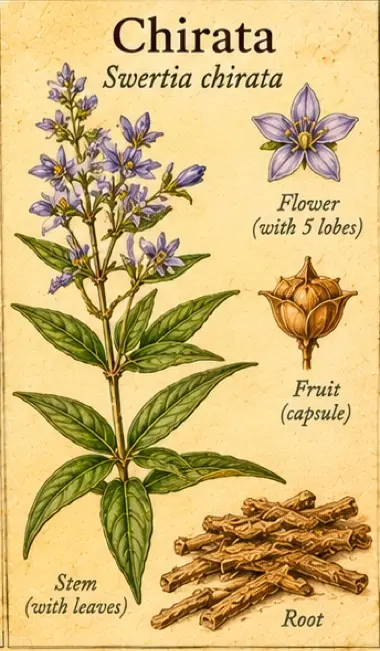
Chirata
Swertia chirayita
An intensely bitter Himalayan herb traditionally used for fever, malaria, liver and digestive problems and diabetes. Lab and animal studies support some uses, but there are no human trials.
Safety at a glance
- PregnancyNothing recorded
- BreastfeedingNothing recorded
- MedicinesNothing recorded
- Who should avoid itNothing recorded
- AllergiesNothing recorded
- ToxicityNothing recorded
Tap a box to read the safety notes below. “Nothing recorded” means our sources don't cover it, not that it's safe.
What is Chirata?
- Plant family
- Gentianaceae, the gentian family
- Parts used
- The whole dried plant
- Where it grows
- The temperate Himalayas of India, Nepal and Bhutan
- Genus
- Swertia
- Species
- chirayita
Also called
Chiretta
Traditional names
Chirayita, Kiratatikta
Older scientific names
Swertia chirata
Traditionally used for
- Fever and malaria (traditional)
- Liver problems (traditional and animal research)
- Digestion (traditional)
Traditionally described as
- Bitter herb rich in xanthones
Health topics
Where Chirata appears in symptom search, and why. Being listed doesn't mean it's a proven treatment.
- Fatty Liver (NAFLD)
Reduced liver fat and inflammation in rats on a high-fat diet.
- Fever
Traditionally used for fever and malaria.
- High Blood Sugar
Traditionally used for diabetes; improved insulin resistance in rats.
- Indigestion
Traditionally used as a bitter for digestive problems and vomiting.
Traditions that use it
- Ayurveda
A famous bitter herb of India and Nepal, traditionally used for fever, malaria, liver problems, digestive upsets, diabetes and skin diseases.
Natural compounds
Safety
Side effects
One review says the available data suggest chirata is safe, but its effects still need to be confirmed in clinical studies and human trials.[1]Study
Contamination
Chirata is often adulterated (mixed or replaced) with other similar-looking Swertia species.[1]Study
What does the research say?
Traditional use
These are traditional uses, not proven treatments.
Chirata is an intensely bitter herb of the gentian family from the Himalayas. It has traditionally been used for:
- Fever and malaria
- Vomiting, jaundice and digestive problems
- Diabetes
- Heart disease
- Skin diseases
- Scorpion stings
Chirata is famous in China, India and Nepal. In traditional Tibetan medicine, it has long been used for liver disorders.[3]Study
Laboratory & animal research
Lab and animal results show what might be worth studying in people. They don't show that the herb has these effects in humans.
About 123 plant compounds have been found in chirata, mainly xanthones and other bitter compounds. In lab and animal studies, extracts and compounds reduced inflammation, acted as antioxidants and protected the liver. They also acted against tumors, viruses, bacteria and the malaria parasite. These effects haven't been tested in clinical trials.[2]Study
Technical detail: xanthones, seco-iridoids, terpenoids, alkaloids and flavonoids.
In rats with fatty liver from an 8-week high-fat diet, chirata reduced body fat, liver fat and insulin resistance. It also improved liver enzymes, blood fats and inflammation, and restored a healthier balance of gut microbes. This is an animal study only.[3]Study
Technical detail: metabolic-associated fatty liver disease (MAFLD) model; lowered AST, ALT, TG, TC and LDL-C; raised fecal short-chain fatty acids and gut-barrier proteins ZO-1, occludin and claudin-1.
In short
Often adulterated with other Swertia species. No human trials.
Sources
- [1] Swertia chirata: A Comprehensive Review with Recent Advances · DOI: 10.2174/1389201018666171026153515Peer-reviewed study
- [2] Swertia chirayita: A comprehensive review on traditional uses, phytochemistry, quality assessment and pharmacology · DOI: 10.1016/j.jep.2022.115714Peer-reviewed study
- [3] Swertia chirayita ameliorates MAFLD by improving intestinal microenvironment and hepatic lipogenesis · DOI: 10.1016/j.jep.2026.121471Peer-reviewed study
This information is educational and traditional in nature, and is not a substitute for professional medical advice. Unfamiliar word? See what these words mean.