
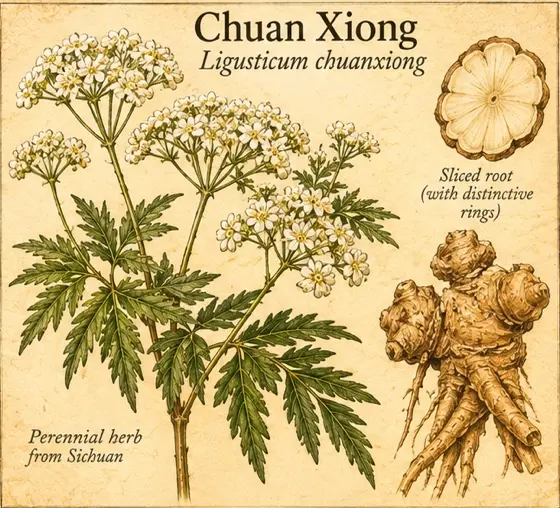
Chuan Xiong
Ligusticum chuanxiong
A Chinese herb from the carrot family whose knobby rhizome is a classic remedy for headache and for heart and brain circulation. A formula built around it reduced headaches in many small, mostly poor-quality trials.
Safety at a glance
- PregnancyNothing recorded
- BreastfeedingNothing recorded
- MedicinesNothing recorded
- Who should avoid itNothing recorded
- AllergiesNothing recorded
- ToxicityNothing recorded
Tap a box to read the safety notes below. “Nothing recorded” means our sources don't cover it, not that it's safe.
What is Chuan Xiong?
- Plant family
- Apiaceae, the carrot and parsley family
- Parts used
- The dried, knobby rhizome (underground stem)
- Where it grows
- Sichuan, China
- Genus
- Ligusticum
- Species
- chuanxiong
Also called
Szechuan Lovage
Traditional names
Chuanxiong Rhizoma
Older scientific names
Ligusticum wallichii, Conioselinum anthriscoides
Traditionally used for
- Headache (traditional and studied)
- Circulation problems (traditional Chinese)
Traditionally described as
- Aromatic; contains ligustilide and tetramethylpyrazine
Health topics
Where Chuan Xiong appears in symptom search, and why. Being listed doesn't mean it's a proven treatment.
- Headache
A classic formula built around chuan xiong reduced headache frequency in pooled trials, though most were poor quality.
- Poor Circulation
Widely used in China for heart and brain circulation problems.
Traditions that use it
- Traditional Chinese Medicine
A classic Chinese herb for heart and brain circulation problems, and the main herb in Chuanxiong Chadiao Powder, used for headache for over 1,000 years.
Natural compounds
Safety
Side effects
Side effects are poorly documented: in a review of 37 headache trials of a chuan xiong formula, 15 trials didn't report on side effects at all.[1]Review or trial
What does the research say?
Traditional use
These are traditional uses, not proven treatments.
Chuan xiong is a traditional Chinese herb from the carrot family. It's widely used for many conditions, especially diseases of the heart and blood vessels in the heart and brain. It can be used alone or with other herbs or medicines.[2]Study
Chuanxiong Chadiao Powder, a classic Chinese formula built around chuan xiong, has been used for headache for more than 1,000 years.[1]Review or trial
Laboratory & animal research
Lab and animal results show what might be worth studying in people. They don't show that the herb has these effects in humans.
More than 100 compounds have been found in chuan xiong. Key ones include ligustilide, senkyunolide A and tetramethylpyrazine. In lab and animal studies, it reduced clumping of blood-clotting cells, protected blood vessel linings, reduced inflammation and acted as an antioxidant. It's been studied for artery hardening, heart and brain damage from blocked blood flow, and high blood pressure.[2]Study
Technical detail: mechanisms include antiplatelet, endothelial-protective, anti-inflammatory, antioxidant and anti-apoptotic activity.
Research in people
A 2015 review pooled 37 trials with 3,680 people with headache. Chuanxiong Chadiao Powder reduced how often headaches happened and how long they lasted, compared with standard medicine or a placebo. But most trials were of poor quality, with only one rated high quality. The authors call the evidence limited.[1]Review or trial
Technical detail: primary outcomes were headache frequency and duration, pain intensity and global assessment; 15 of the 37 studies didn't report adverse events.
In short
Side effects are poorly reported in trials.
Sources
- [1] Chuanxiong chadiao powder, a famous Chinese herbal prescription, for headache: A systematic review and meta-analysis · DOI: 10.1016/j.ctim.2015.06.012Review or clinical trial
- [2] Ligusticum chuanxiong: a chemical, pharmacological and clinical review · DOI: 10.3389/fphar.2025.1523176Peer-reviewed study
This information is educational and traditional in nature, and is not a substitute for professional medical advice. Unfamiliar word? See what these words mean.