
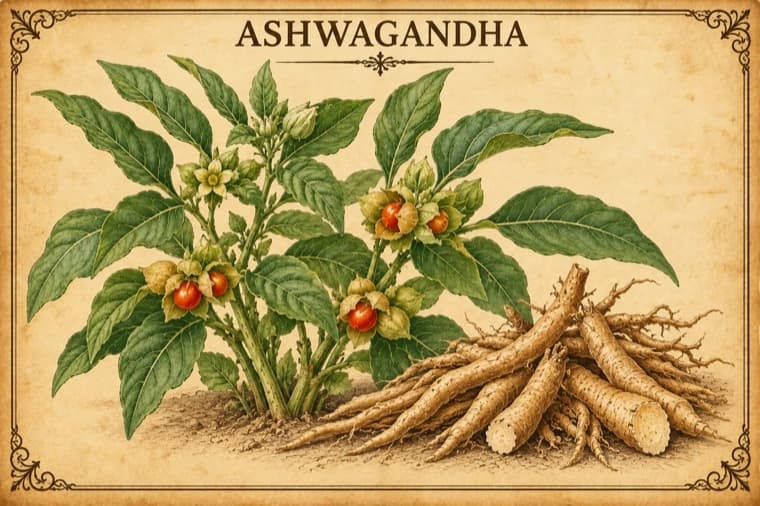
Ashwagandha
Withania somnifera
A root from Ayurvedic medicine, traditionally used to help the body cope with stress.
Safety at a glance
- Pregnancy1 note →
- BreastfeedingNothing recorded
- Medicines1 note →
- Who should avoid it1 note →
- Allergies1 note →
- Toxicity1 note →
Tap a box to read the safety notes below. “Nothing recorded” means our sources don't cover it, not that it's safe.
Ashwagandha may interact with some medicines. If you take any medicine, read Interactions with medicines below and talk to your doctor or pharmacist before using it.
What is Ashwagandha?
- Plant family
- Solanaceae, the nightshade family
- Parts used
- Mainly the root, which is traditionally preferred. Powders and extracts of the root and leaf are also used.
- Where it grows
- The Middle East, North Africa, southern Europe, the Indian subcontinent and Southeast Asia
- Genus
- Withania
- Species
- somnifera
Also called
Indian Ginseng, Winter Cherry
Traditional names
Ashwagandha
Older scientific names
Physalis somnifera L.
Traditionally used for
- Stress
- Sleep
- Energy
Traditionally described as
- Adaptogen
- Calming
- May help reduce inflammation
Health topics
Where Ashwagandha appears in symptom search, and why. Being listed doesn't mean it's a proven treatment.
- Anxiety
A review of trials found less anxiety than with placebo, though NCCIH says its effect on anxiety specifically is unclear.
- Fertility
Limited evidence suggests taking it for 2 to 4 months may improve testosterone levels and sperm quality in men. There isn't enough evidence for female infertility.
- Liver Safety Warnings
Rarely, ashwagandha products have caused liver damage, usually 2 to 12 weeks after starting.
- Menopausal Weight Gain
Helped stressed adults with overweight lose a little weight in one trial. It hasn't been tested for weight gain in menopause.
- Menopause Symptoms
In one trial, ashwagandha combined with shatavari eased menopause symptoms more than placebo. There isn't enough evidence for ashwagandha alone.
- Sexual Health
Traditionally used in Ayurveda to boost sex drive.
- Sleep Problems (Insomnia)
Traditionally used to bring on sleep; research suggests some products may help insomnia.
- Stress
A review of 9 trials found it lowered stress, anxiety and the stress hormone cortisol more than placebo.
Traditions that use it
- Ayurveda
One of the main rasayana (rejuvenating) herbs in Ayurveda, used for nearly 3,000 years to strengthen the nervous system, boost sex drive and build general strength. Its Sanskrit name means "smell of horse", referring to the root's distinctive smell and to the vigor it was traditionally believed to give.
Technical detail: nervine tonic, aphrodisiac.
Natural compounds
How it's prepared
Common ways Ashwagandha is prepared or sold. This isn't advice on how to take it; see Safety below.
- Decoction
Herbalists simmer the root in water as a tea (decoction), and in Ayurveda it's traditionally cooked in milk or ghee (clarified butter).[1]General reference
- Extract
Supplements usually contain extracts of the root, the leaf, or both.[2]Health agency
- Powder
The powdered root is taken by mouth, often in capsules.[1]General reference
- Tincture
Tinctures (alcohol extracts) of the dried root are taken by mouth.[1]General reference
Safety
Interactions with medicines
Ashwagandha may interact with medicines for diabetes, high blood pressure and thyroid conditions, as well as medicines that suppress the immune system, sedatives and seizure medicines. It has a calming, sleep-inducing effect, and early evidence suggests it may strengthen the effects of benzodiazepines and other sedative or anti-anxiety medicines.[2]Health agency
Who should avoid it
The US National Center for Complementary and Integrative Health (NCCIH) advises avoiding ashwagandha if you are pregnant or breastfeeding, before or after surgery, or if you have an autoimmune disease, a thyroid condition, or hormone-sensitive prostate cancer.[2]Health agency
Allergies
Ashwagandha is in the nightshade family, with tomatoes, potatoes and peppers. People who react to nightshades might react to ashwagandha too.[1]General reference
Side effects
Ashwagandha can cause drowsiness, stomach upset, diarrhea and vomiting. It appears safe for most people for up to 3 months, but there isn't enough data on longer use.[2]Health agency
Pregnancy
NCCIH lists pregnancy and breastfeeding as reasons to avoid ashwagandha. Older herbal and official sources, including the WHO, also advise against it in pregnancy, partly because the plant was historically recorded as being used to cause miscarriage. A 2025 review traced that claim mainly to a single 1869 anecdote (Stewart's Punjab Plants) and found no miscarriage or fertility effects in modern animal studies at high doses. It also noted that most historical reports were about the above-ground parts, not the root used in Ayurveda and most modern products. Because there is no controlled safety data in pregnant people either way, avoiding it during pregnancy is still the standard advice.[3]Study
Technical detail: modern animal studies used doses up to 3000 mg/kg body weight; abortifacient and antifertility effects.
Toxicity testing
Rarely, ashwagandha products have caused liver damage. It usually appeared 2 to 12 weeks after starting (in some cases as early as about 30 hours), often with yellowing of the skin or eyes (jaundice) and itching. Most cases were mild to moderate and cleared up within 1 to 5 months of stopping. A few cases in people who already had long-term liver disease were severe. Because products are sometimes mixed with other herbs or mislabeled, it isn't always certain that ashwagandha itself caused the damage.[4]Health agency
Technical detail: clinically apparent liver injury, usually cholestatic or mixed pattern, with pruritus; self-limited.
What does the research say?
Traditional use
These are traditional uses, not proven treatments.
Ashwagandha has been used in Ayurvedic medicine for nearly 3,000 years as a rasayana, a rejuvenating herb believed to strengthen the nervous system. The root has traditionally been used to boost sex drive, bring on sleep, restore strength, increase urination, expel intestinal worms and stimulate the body.[5]Study
Technical detail: aphrodisiac, narcotic, tonic, diuretic, anthelmintic, stimulant.
Ashwagandha's name means "essence of the horse". It's used in Ayurveda, Siddha and Unani medicine and Indian folk healing, traditionally cooked in milk or ghee (clarified butter). Herbalists give it daily over weeks for stress, poor sleep and tiredness, and alongside cancer treatment to help rebuild strength. Only the root is used; the leaves, stems and berries aren't taken by mouth. These uses come from herbal practice and haven't been tested in clinical trials.[1]General reference
Laboratory & animal research
Lab and animal results show what might be worth studying in people. They don't show that the herb has these effects in humans.
In lab and animal studies, withaferin A and related compounds (withanolides) protected nerve cells. This included reducing the buildup of proteins linked to Alzheimer's disease, and switching on the cell's protective stress response in models of Huntington's disease. They also acted against bacteria, including the antibiotic-resistant "superbug" MRSA, and caused breast, colon, lung and prostate cancer cells to die in the lab.[5]Study
Technical detail: reduced beta-amyloid aggregation; inhibited tau accumulation; heat shock response activation; methicillin-resistant Staphylococcus aureus; pro-apoptotic activity against cancer cell lines.
Research in people
A review that combined 9 trials with 558 people found ashwagandha products lowered stress, anxiety and levels of the stress hormone cortisol more than placebo (a dummy pill), with few reported side effects. The authors noted that more data is needed on long-term safety.[6]Review or trial
Technical detail: systematic review and meta-analysis of randomized controlled trials; Hamilton Anxiety Rating Scale; serum cortisol.
Research suggests some ashwagandha products may help with insomnia and stress, but it's unclear whether they help anxiety specifically. Limited evidence suggests taking ashwagandha for 2 to 4 months may improve testosterone levels and sperm quality in men, but more research is needed. There isn't enough reliable evidence to know whether it helps asthma, athletic performance, memory and thinking, diabetes, menopause symptoms, female infertility or COVID-19.[2]Health agency
In an 8-week trial of 135 women aged 45–65 with menopausal symptoms, a combination of ashwagandha and shatavari root extracts improved menopause symptom scores significantly more than placebo or shatavari alone. Side effects were mild (loose stools and dizziness in the combination group).[7]Study
Technical detail: randomized, double-blind, three-arm, placebo-controlled; Menopause Rating Scale; NCT06716554.
A 2026 review of ashwagandha and body composition found mixed results, with the most benefit in people who are overweight. In one 8-week trial of stressed adults with overweight or obesity, those taking ashwagandha root extract lost about 2.3 kg compared with 1.1 kg on placebo.[8]Study
In short
Avoid during pregnancy and with certain thyroid or autoimmune conditions.
Sources
- [1] The Medicinal Benefits of Ashwagandha — Chestnut School of Herbal MedicineGeneral reference
- [2] Ashwagandha: Science, Safety, and Cautions — National Center for Complementary and Integrative Health (NIH)Government health agency
- [3] Is Ashwagandha an Abortifacient? — Phytotherapy Research · DOI: 10.1002/ptr.70150Peer-reviewed study
- [4] Ashwagandha — LiverTox: Clinical and Research Information on Drug-Induced Liver Injury, National Institute of Diabetes and Digestive and Kidney Diseases (NIH)Government health agency
- [5] Ashwagandha (Withania somnifera)—Current Research on the Health-Promoting Activities: A Narrative Review — Pharmaceutics · DOI: 10.3390/pharmaceutics15041057Peer-reviewed study
- [6] Effects of Ashwagandha (Withania Somnifera) on stress and anxiety: A systematic review and meta-analysis — Explore (NY) · DOI: 10.1016/j.explore.2024.103062Review or clinical trial
- [7] Efficacy and safety of Shatavari root extract (Asparagus racemosus) for menopausal symptoms: a randomized, double-blind, three-arm, placebo-controlled study — Frontiers in Reproductive Health · DOI: 10.3389/frph.2025.1654503Peer-reviewed study
- [8] Effects of Ashwagandha (Withania somnifera) on Body Composition: A Narrative Review · DOI: 10.3390/sports14100442Peer-reviewed study
This information is educational and traditional in nature, and is not a substitute for professional medical advice. Unfamiliar word? See what these words mean.