
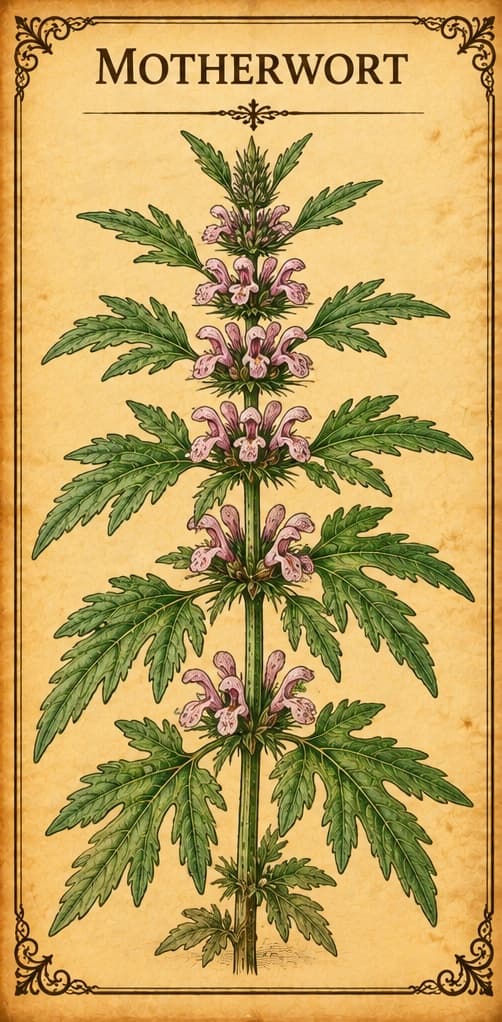
Motherwort
Leonurus cardiaca
A plant from the mint family, traditionally used as a heart tonic and for women's health. Recognized in Europe for nervous heart complaints such as palpitations.
Safety at a glance
- Pregnancy2 notes →
- BreastfeedingNothing recorded
- Medicines1 note →
- Who should avoid it1 note →
- AllergiesNothing recorded
- ToxicityNothing recorded
Tap a box to read the safety notes below. “Nothing recorded” means our sources don't cover it, not that it's safe.
Motherwort may interact with some medicines. If you take any medicine, read Interactions with medicines below and talk to your doctor or pharmacist before using it.
What is Motherwort?
- Plant family
- Lamiaceae, the mint family
- Parts used
- The flowering parts
- Where it grows
- Native to Asia and southeastern Europe; now found around the world
- Genus
- Leonurus
- Species
- cardiaca
Traditionally used for
- Palpitations
- Nervous tension
- Women's health
Traditionally described as
- Calming
- Heart tonic
Health topics
Where Motherwort appears in symptom search, and why. Being listed doesn't mean it's a proven treatment.
- Heart Palpitations
Traditionally used in Europe for nervous heart complaints such as palpitations, once a doctor has ruled out serious conditions.
- High Blood Pressure
One small, short study suggested it may lower blood pressure in people with anxiety, but firm conclusions can't be drawn.
Traditions that use it
- European Folk Medicine
Recognized by the European Medicines Agency as a traditional herbal medicine for nervous tension and nervous heart complaints such as palpitations.
Natural compounds
How it's prepared
Common ways Motherwort is prepared or sold. This isn't advice on how to take it; see Safety below.
- Extract
Liquid extracts of the plant are taken by mouth.[1]Health agency
- Powder
The powdered flowering parts are taken by mouth.[1]Health agency
- Tea / Infusion
The dried flowering parts are made into an herbal tea.[1]Health agency
- Tincture
Herbalists use it as a tincture.[2]General reference
Safety
Interactions with medicines
Motherwort may increase the risk of bleeding with blood thinners and anti-platelet medicines, and has been reported to strengthen the effect of warfarin. Taken with benzodiazepines (anti-anxiety and sleep medicines), it may add to their sleep-inducing effect; this has been reported to result in coma.[3]Study
Who should avoid it
Motherwort medicines should only be used by adults. See a doctor if symptoms last longer than 4 weeks or get worse.[1]Health agency
Side effects
At the time of the European assessment, no side effects had been reported with motherwort medicines.[1]Health agency
Taking 3 g of powdered extract a day has been linked to diarrhea, bleeding from the womb and stomach irritation.[3]Study
Pregnancy
Motherwort medicines must not be taken during pregnancy.[1]Health agency
Motherwort is listed as an herb to avoid in pregnancy, mainly because it may stimulate the womb and bring on menstruation.[3]Study
Before surgery
Motherwort has been listed as an herb linked to bleeding problems, which matters for anesthesia and surgery.[3]Study
What does the research say?
Traditional use
These are traditional uses, not proven treatments.
Motherwort has been used since ancient times as a heart tonic and for women's health problems such as missing or painful periods, anxiety around menopause and depression after childbirth.[3]Study
Technical detail: cardiotonic; amenorrhea, dysmenorrhea, menopausal anxiety, postpartum depression.
Based on at least 30 years of safe use, the European Medicines Agency recognizes motherwort as a traditional herbal medicine to relieve nervous tension and nervous heart complaints such as palpitations (more noticeable heartbeats), once a doctor has ruled out serious conditions.[1]Health agency
Laboratory & animal research
Lab and animal results show what might be worth studying in people. They don't show that the herb has these effects in humans.
In lab studies on rat heart cells, motherwort extracts reduced the production of harmful free radicals. In mice, leonurine, a compound found in motherwort, reduced inflammation.[3]Study
Research in people
In one study, 50 people with stage 1 or 2 high blood pressure took 1,200 mg of motherwort oil extract a day for 28 days. Their blood pressure and heart rate changed significantly, and anxiety, headaches and sleep problems improved, especially in people with stage 1 high blood pressure.[3]Study
Technical detail: Shikov et al. 2011, Phytotherapy Research; changes in systolic and diastolic blood pressure, heart rate and ECG.
The European Medicines Agency considered that study. A possible blood-pressure-lowering effect was seen, but the study was short and didn't compare motherwort with any other treatment, so firm conclusions couldn't be drawn.[1]Health agency
In short
Must not be taken during pregnancy; may increase bleeding risk with blood thinners.
Sources
- [1] Motherwort (Leonurus cardiaca L., herba): summary of the HMPC conclusions (EMA/165476/2019) — European Medicines Agency, Committee on Herbal Medicinal Products (HMPC)Government health agency
- [2] Motherwort — Herban Herbalist materia medica — Herban Herbalist (herb shop)General reference
- [3] Leonurus cardiaca L. as a Source of Bioactive Compounds: An Update of the European Medicines Agency Assessment Report (2010) — BioMed Research International · DOI: 10.1155/2019/4303215Peer-reviewed study
This information is educational and traditional in nature, and is not a substitute for professional medical advice. Unfamiliar word? See what these words mean.