
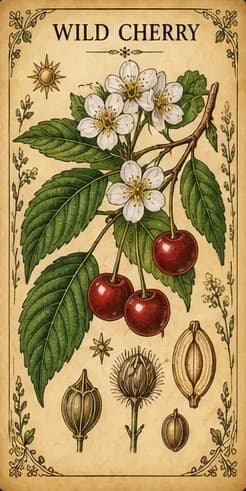
Wild Cherry
Prunus serotina
Black cherry (capulín), a North American tree whose bark was a Native American remedy for breathing infections and is now used in cough syrups. Its seeds and leaves contain compounds that can release cyanide.
Safety at a glance
- PregnancyNothing recorded
- BreastfeedingNothing recorded
- Medicines1 note →
- Who should avoid it1 note →
- AllergiesNothing recorded
- Toxicity2 notes →
Tap a box to read the safety notes below. “Nothing recorded” means our sources don't cover it, not that it's safe.
Wild Cherry may interact with some medicines. If you take any medicine, read Interactions with medicines below and talk to your doctor or pharmacist before using it.
What is Wild Cherry?
- Plant family
- Rosaceae, the rose family
- Parts used
- The bark, leaves and seeds
- Where it grows
- Native to North America; introduced into Europe, where it has become invasive
- Genus
- Prunus
- Species
- serotina
Also called
Black Cherry, Wild Black Cherry
Regional names
Capulín, Capulin
Traditionally used for
- Cough (traditional)
- Colds (traditional)
- Digestion (traditional)
- Cough syrups
Traditionally described as
- Traditionally used for cough
Health topics
Where Wild Cherry appears in symptom search, and why. Being listed doesn't mean it's a proven treatment.
- Cough
Traditionally used for cough by Native Americans and in Mexico, and now an ingredient in cough syrups. It hasn't been properly tested in people, and its seeds and leaves can release cyanide.
How it's prepared
Common ways Wild Cherry is prepared or sold. This isn't advice on how to take it; see Safety below.
- Culinary Preparation
The seeds are eaten as snacks in Mexico.[1]Study
- Tea / Infusion
In Mexico, capulín is most often used as a tea of the leaves.[2]Study
Safety
Interactions with medicines
Wild cherry may change how the liver breaks down some medicines. Use caution if you take medicines processed by the liver, such as lovastatin (for cholesterol), fexofenadine (for allergies) or triazolam (for sleep).[3]General reference
Who should avoid it
Wild cherry isn't recommended for:
- Young children
- Pregnant or breastfeeding women
- People with severe liver or kidney disease
Toxicity testing
How much to use
Wild cherry is generally regarded as safe at recommended doses, but it contains small amounts of cyanide, so don't take more than recommended. Take syrups that contain it as directed on the label.[3]General reference
What does the research say?
Traditional use
These are traditional uses, not proven treatments.
In Mexican traditional medicine, black cherry (capulín) is used for heart, breathing and digestive problems. Its seeds, eaten as snacks in Mexico, are used for cough.[1]Study
Capulín is sold and used in folk medicine for high blood pressure, digestive illnesses and cough, most often as an infusion (tea) of the leaves.[2]Study
Wild cherry bark was a traditional Native American remedy for breathing infections and anxiety, and European settlers adopted it for the same purposes. Today it's mainly used as an ingredient in cough syrups. Herbal references also list it for:
- Whooping cough, bronchitis and colds
- Digestive problems and diarrhea
- Gout
- Relaxation and sleep, as a mild calming aid
Research in people
No double-blind, placebo-controlled trials have tested wild cherry in people. That doesn't mean it doesn't work, only that it needs more study.[3]General reference
In short
Contains small amounts of cyanide; not recommended for young children, during pregnancy or breastfeeding, or with severe liver or kidney disease.
Sources
- [1] Nutritional value and volatile compounds of black cherry (Prunus serotina) seeds — Molecules · DOI: 10.3390/molecules20023479Peer-reviewed study
- [2] Simultaneous quantification by HPLC of the phenolic compounds for the crude drug of Prunus serotina subsp. capuli — Pharmaceutical Biology · DOI: 10.3109/13880209.2013.876054Peer-reviewed study
- [3] Wild cherry's therapeutic uses — EBSCO Research StartersGeneral reference
- [4] Quantitative analysis of amygdalin and prunasin in Prunus serotina Ehrh. using 1H-NMR spectroscopy — Phytochemical Analysis · DOI: 10.1002/pca.2476Peer-reviewed study
- [5] Development of the Potential for Cyanogenesis in Maturing Black Cherry (Prunus serotina Ehrh.) Fruits — Plant Physiology · DOI: 10.1104/pp.98.4.1423Peer-reviewed study
This information is educational and traditional in nature, and is not a substitute for professional medical advice. Unfamiliar word? See what these words mean.