
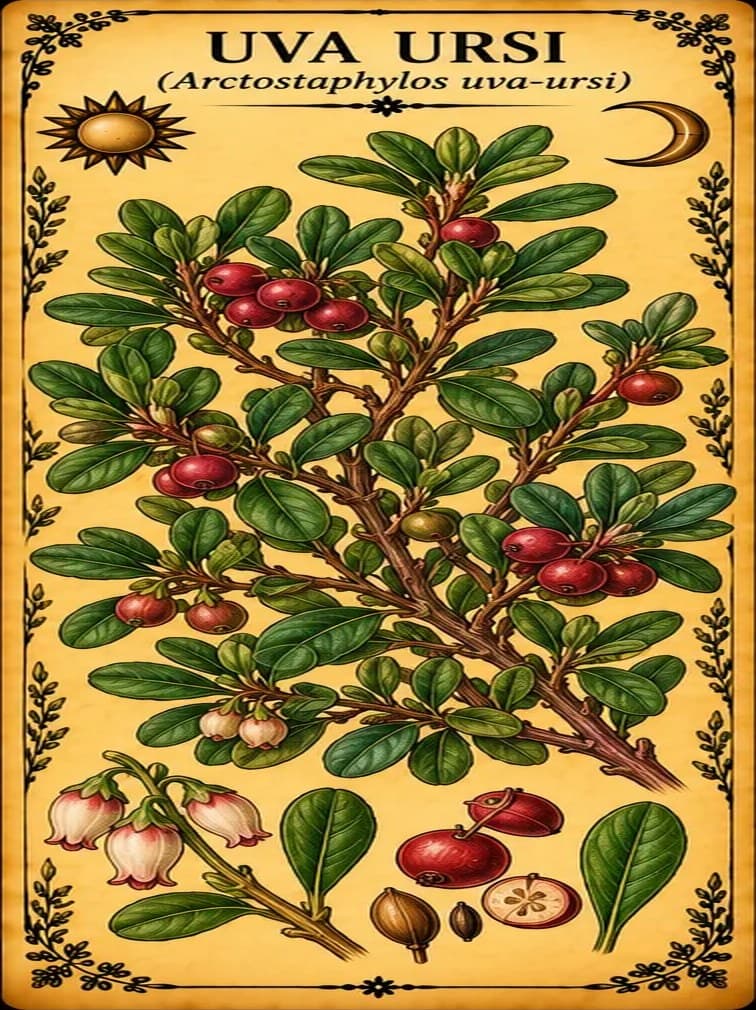
Uva Ursi
Arctostaphylos uva-ursi
Bearberry leaf, recognised in Europe as a traditional remedy for mild, repeated bladder infections in adult women. Use it for no more than a week.
Safety at a glance
- Pregnancy1 note →
- BreastfeedingNothing recorded
- MedicinesNothing recorded
- Who should avoid it1 note →
- AllergiesNothing recorded
- ToxicityNothing recorded
Tap a box to read the safety notes below. “Nothing recorded” means our sources don't cover it, not that it's safe.
What is Uva Ursi?
- Plant family
- Ericaceae, the heather family
- Parts used
- The leaves, taken as a tea or in tablets or capsules
- Genus
- Arctostaphylos
- Species
- uva-ursi
Also called
Bearberry, Bearberry Leaf, Uva-ursi
Traditionally used for
- Bladder infections
- Urinary tract
Traditionally described as
- Kills bacteria (in lab tests)
Health topics
Where Uva Ursi appears in symptom search, and why. Being listed doesn't mean it's a proven treatment.
- Bladder and Urinary Tract Infections (UTIs)
Recognised in Europe as a traditional remedy for mild, repeated bladder infections in adult women, for no more than 1 week.
Traditions that use it
- European Folk Medicine
Bearberry leaf has been used in Europe for at least 30 years for mild bladder infections.
How it's prepared
Common ways Uva Ursi is prepared or sold. This isn't advice on how to take it; see Safety below.
- Capsule
It's also taken as capsules or a standardized extract.[1]General reference
- Extract
Dry and liquid extracts of the leaves, standardized for arbutin, are taken by mouth.[2]Health agency
- Powder
The powdered leaves are taken by mouth in tablets or capsules.[2]Health agency
- Tea / Infusion
The dried, cut leaves are made into an herbal tea.[2]Health agency
- Tincture
Herbalists use it as a tincture.[1]General reference
Safety
Who should avoid it
Only for adult women. Don't use it if you have kidney problems. A doctor should first rule out more serious urinary conditions.[3]Health agency
Side effects
It can cause nausea, vomiting and stomach discomfort.[3]Health agency
Pregnancy
Its safety during pregnancy and breastfeeding hasn't been established, so the European Medicines Agency doesn't recommend bearberry leaf medicines at these times.[2]Health agency
How much to use
Don't take it for more than 1 week. See a doctor if your symptoms last more than 4 days or get worse while you're taking it.[3]Health agency
What does the research say?
Traditional use
These are traditional uses, not proven treatments.
The European Medicines Agency recognises bearberry leaf as a traditional herbal medicine for symptoms of mild, repeated infections of the lower urinary tract, such as burning when urinating or needing to urinate often, in adult women. This is based on its long use: at least 30 years, including 15 years in the European Union.[3]Health agency
Laboratory & animal research
Lab and animal results show what might be worth studying in people. They don't show that the herb has these effects in humans.
In lab studies, bearberry leaf preparations killed bacteria.[3]Health agency
Research in people
There are no clinical studies of products containing only bearberry leaf. Its effect is considered plausible, but it hasn't been proven in trials.[3]Health agency
In short
Only for adult women; don't use with kidney problems or for more than 1 week.
Sources
- [1] Uva Ursi (Bearberry) — Herban Herbalist materia medica — Herban Herbalist (herb shop)General reference
- [2] European Union herbal monograph on Arctostaphylos uva-ursi (L.) Spreng., folium (Revision 2) — European Medicines Agency, Committee on Herbal Medicinal Products (HMPC)Government health agency
- [3] Uvae ursi folium (bearberry leaf): herbal medicinal product summary — European Medicines Agency (EMA), Committee on Herbal Medicinal ProductsGovernment health agency
This information is educational and traditional in nature, and is not a substitute for professional medical advice. Unfamiliar word? See what these words mean.