
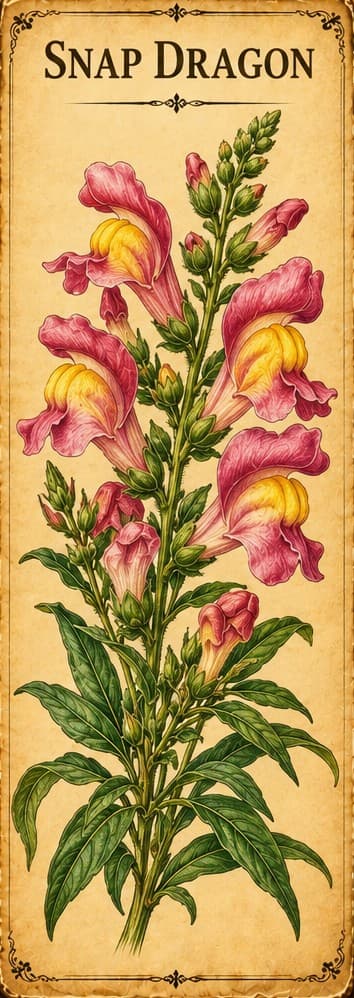
Snapdragon
Antirrhinum majus
A Mediterranean garden flower. In Iraqi folk medicine the whole plant is boiled for liver problems and as a wash, and in lab tests its flower extract slowed some bacteria and fungi.
Safety at a glance
- PregnancyNothing recorded
- BreastfeedingNothing recorded
- MedicinesNothing recorded
- Who should avoid itNothing recorded
- AllergiesNothing recorded
- ToxicityNothing recorded
Tap a box to read the safety notes below. “Nothing recorded” means our sources don't cover it, not that it's safe.
What is Snapdragon?
- Plant family
- Plantaginaceae, the plantain family
- Parts used
- The leaves, flowers and whole plant; the seeds give a cooking oil
- Where it grows
- The Mediterranean region
- Genus
- Antirrhinum
- Species
- majus
Also called
Snap Dragon, Common Snapdragon
Traditionally used for
- Liver problems (traditional)
- Watery eyes (traditional)
- Ornamental
Traditionally described as
- Kills bacteria and fungi (in lab tests)
How it's prepared
Common ways Snapdragon is prepared or sold. This isn't advice on how to take it; see Safety below.
What does the research say?
Traditional use
These are traditional uses, not proven treatments.
Few sources describe snapdragon as a medicine. In Iraqi tradition, the whole plant is boiled and used as a wash and an astringent, to increase urination, and for liver problems. A boiled preparation of the whole plant, including the root, has been used for watery eyes. The seeds give an oil used in cooking.[1]Study
Laboratory & animal research
Lab and animal results show what might be worth studying in people. They don't show that the herb has these effects in humans.
In lab tests, extracts of fresh snapdragon flowers slowed or killed several bacteria, including Staphylococcus aureus and E. coli, and the yeast Candida. Drying the plant before extraction made the extracts much weaker. It hasn't been tested in animals or people.[1]Study
In short
Not studied in people.
Sources
- [1] Antimicrobial activity and molecular docking screening of bioactive components of Antirrhinum majus (snapdragon) aerial parts · DOI: 10.1016/j.heliyon.2022.e10391Peer-reviewed study
This information is educational and traditional in nature, and is not a substitute for professional medical advice. Unfamiliar word? See what these words mean.