
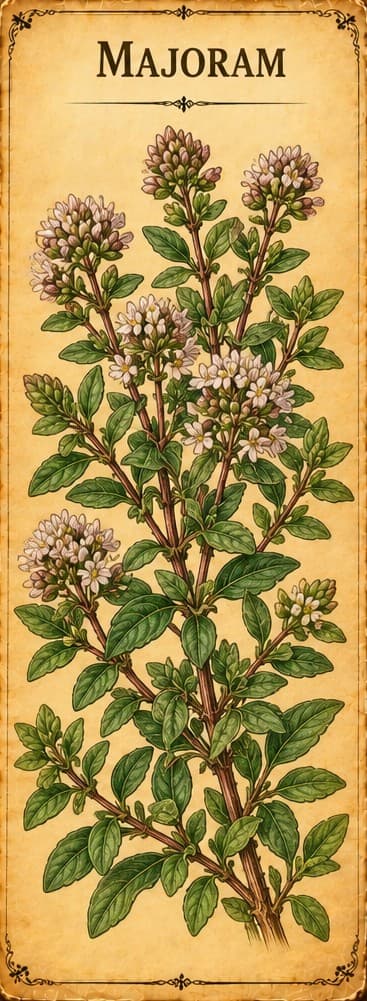
Marjoram
Origanum majorana
Sweet marjoram, a culinary herb of the mint family, used in traditional medicine for digestive, breathing, heart, joint and nerve complaints. Research so far is in the lab and in animals.
Safety at a glance
- PregnancyNothing recorded
- BreastfeedingNothing recorded
- MedicinesNothing recorded
- Who should avoid itNothing recorded
- AllergiesNothing recorded
- ToxicityNothing recorded
Tap a box to read the safety notes below. “Nothing recorded” means our sources don't cover it, not that it's safe.
What is Marjoram?
- Plant family
- Lamiaceae, the mint family
- Parts used
- The leaves and flowering tops, fresh or dried, and the essential oil
- Genus
- Origanum
- Species
- majorana
Also called
Sweet Marjoram
Older scientific names
Majorana hortensis
Traditionally used for
- Cooking
- Digestion (traditional)
- Coughs and colds (traditional)
- Joint pain (traditional)
Traditionally described as
- Antioxidant (in lab studies)
- Kills bacteria and fungi (in lab studies)
Health topics
Where Marjoram appears in symptom search, and why. Being listed doesn't mean it's a proven treatment.
- Indigestion
Traditionally used for digestive problems. Not tested in trials.
How it's prepared
Common ways Marjoram is prepared or sold. This isn't advice on how to take it; see Safety below.
- Tea / Infusion
In one small trial, people drank marjoram tea.[1]Study
What does the research say?
Traditional use
These are traditional uses, not proven treatments.
Sweet marjoram has been used in traditional and folk medicine for many complaints, including:
- Digestive problems
- Eye, nose and throat problems
- Breathing problems
- Heart complaints
- Joint and muscle pain
- Nervous complaints
It's widely used in cooking and perfumes.[2]Study
Laboratory & animal research
Lab and animal results show what might be worth studying in people. They don't show that the herb has these effects in humans.
Research in people
In a small Tunisian pilot trial, 60 people with Parkinson's disease drank marjoram tea or a dummy drink for 30 days alongside their medicine. Non-movement symptoms and depression improved with marjoram, but movement symptoms didn't change clearly.[1]Study
In a 2023 Korean trial, 57 nurses in a COVID-19 intensive care unit breathed in 3% marjoram oil or almond oil for 2 hours at work. Anxiety and stress fell in the marjoram group, but the difference compared with almond oil wasn't clear.[4]Study
In short
Not well studied in people.
Sources
- [1] The effect of Origanum majorana tea on motor and non-motor symptoms in patients with idiopathic Parkinson's disease: A randomized controlled pilot study · DOI: 10.1016/j.parkreldis.2021.08.013Peer-reviewed study
- [2] Sweet Marjoram: A Review of Ethnopharmacology, Phytochemistry, and Biological Activities · DOI: 10.1177/2156587216650793Peer-reviewed study
- [3] Origanum majorana Essential Oil: A Review of Its Chemical Profile and Pesticide Activity · DOI: 10.3390/life12121982Peer-reviewed study
- [4] Inhalation of Origanum majorana L. essential oil while working reduces perceived stress and anxiety levels of nurses in a COVID-19 intensive care unit: a randomized controlled trial · DOI: 10.3389/fpsyt.2023.1287282Peer-reviewed study
This information is educational and traditional in nature, and is not a substitute for professional medical advice. Unfamiliar word? See what these words mean.