
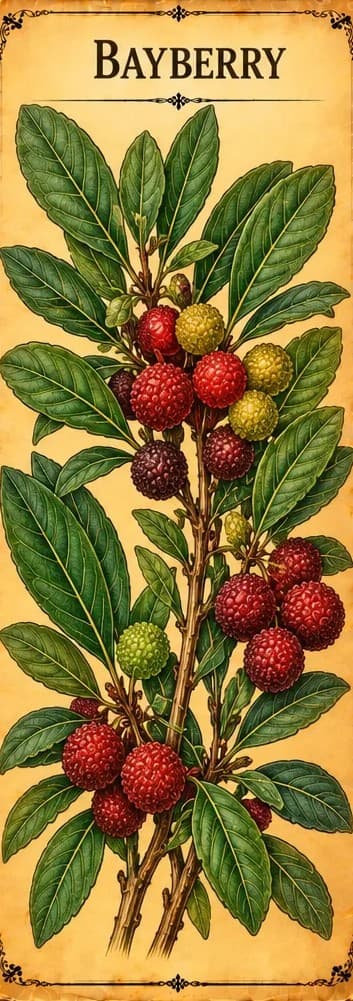
Bayberry
Myrica rubra
Chinese bayberry (yangmei), a red fruit grown in China for over 2,000 years. Parts of the tree have been used as folk medicine, but research is limited to the lab and animals.
Safety at a glance
- PregnancyNothing recorded
- BreastfeedingNothing recorded
- MedicinesNothing recorded
- Who should avoid itNothing recorded
- AllergiesNothing recorded
- ToxicityNothing recorded
Tap a box to read the safety notes below. “Nothing recorded” means our sources don't cover it, not that it's safe.
What is Bayberry?
- Plant family
- Myricaceae, the bayberry family
- Parts used
- The fruit; other parts of the tree are used in folk medicine
- Where it grows
- China and other Asian countries
- Genus
- Myrica
- Species
- rubra
Also called
Chinese Bayberry, Red Bayberry
Traditional names
Yangmei
Traditionally used for
- Fruit
- Folk medicine (traditional)
Traditionally described as
- Antioxidant (in lab studies)
Health topics
Where Bayberry appears in symptom search, and why. Being listed doesn't mean it's a proven treatment.
- Fatty Liver (NAFLD)
Bayberry juice lowered inflammation markers in young adults with signs of fatty liver in one small trial.
Traditions that use it
- Traditional Chinese Medicine
Grown in China for more than 2,000 years; different parts of the tree have been used as folk medicines.
How it's prepared
Common ways Bayberry is prepared or sold. This isn't advice on how to take it; see Safety below.
- Culinary Preparation
The fruit is made into juice, which has been tested in a trial in China.[1]Study
What does the research say?
Traditional use
These are traditional uses, not proven treatments.
Chinese bayberry is a fruit tree from China and other Asian countries that has been grown in China for more than 2,000 years. Its fruit is prized for its colour and flavour, and different parts of the tree have been used as folk medicines.[2]Study
Plants in the bayberry group have been used as food, as medicine and to make natural dyes.[3]Review or trial
Laboratory & animal research
Lab and animal results show what might be worth studying in people. They don't show that the herb has these effects in humans.
The fruit is rich in a red pigment called cyanidin-3-glucoside, an antioxidant. In lab and animal studies, bayberry extracts showed effects against inflammation, allergy, diabetes, cancer, bacterial infection and diarrhea. These haven't been confirmed in people.[2]Study
A 2026 review found that only a few studies have measured the nutrients and plant compounds in bayberry fruits and leaves, and that results vary a lot between species and even within one species.[3]Review or trial
Research in people
In a Chinese trial, 44 young adults with signs of fatty liver disease drank 250 ml of Chinese bayberry juice or a dummy drink twice a day for 4 weeks each. The juice lowered blood markers of oxidative damage and inflammation, but didn't change weight or insulin resistance.[1]Study
Sources
- [1] Effects of bayberry juice on inflammatory and apoptotic markers in young adults with features of non-alcoholic fatty liver disease · DOI: 10.1016/j.nut.2013.07.023Peer-reviewed study
- [2] Biological activities of extracts from Chinese bayberry (Myrica rubra Sieb. et Zucc.): a review · DOI: 10.1007/s11130-013-0349-xPeer-reviewed study
- [3] Phytochemical, Nutritional and Physicochemical Characteristics of Fruits and Leaves from the Myrica L. Genus: A Systematic Review · DOI: 10.3390/ijms27188237Review or clinical trial
This information is educational and traditional in nature, and is not a substitute for professional medical advice. Unfamiliar word? See what these words mean.