
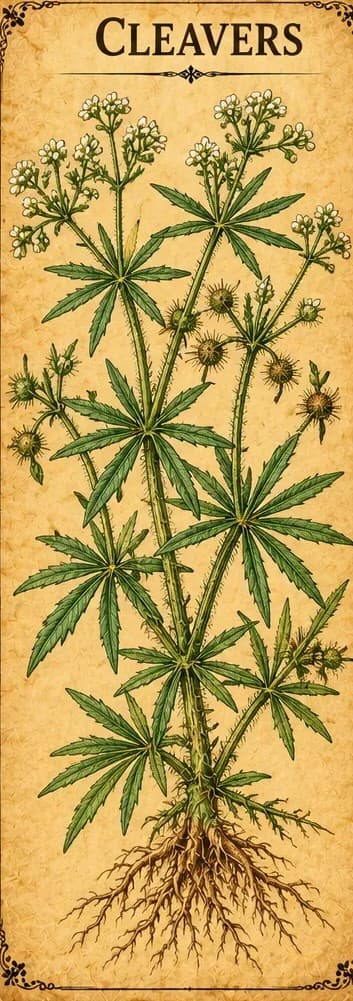
Cleavers
Galium aparine
A sticky, fast-growing plant traditionally used to increase urination and relieve bloating, and for swollen glands, fever and wounds. In the lab, an extract helped skin cells heal a scratch.
Safety at a glance
- PregnancyNothing recorded
- BreastfeedingNothing recorded
- MedicinesNothing recorded
- Who should avoid itNothing recorded
- AllergiesNothing recorded
- ToxicityNothing recorded
Tap a box to read the safety notes below. “Nothing recorded” means our sources don't cover it, not that it's safe.
What is Cleavers?
- Plant family
- Rubiaceae, the coffee family
- Parts used
- The whole above-ground plant, fresh juice or as an extract
- Genus
- Galium
- Species
- aparine
Also called
Catchweed Bedstraw, Goosegrass, Galium
Traditionally used for
- Bloating (traditional)
- Swollen lymph glands (traditional)
- Wounds and burns (traditional)
- Fever (traditional)
Traditionally described as
- Antioxidant (in lab studies)
- Helped wound healing (in lab studies)
Health topics
Where Cleavers appears in symptom search, and why. Being listed doesn't mean it's a proven treatment.
- Bloating
Traditionally used to increase urination and relieve bloating. Not tested in trials.
- Cuts, Wounds, Burns and Skin Ulcers
A traditional wound and burn remedy; an extract helped skin cells close a wound in the lab. Not tested in people.
- High Blood Pressure
A traditional folk use. Not tested in trials.
How it's prepared
Common ways Cleavers is prepared or sold. This isn't advice on how to take it; see Safety below.
What does the research say?
Traditional use
These are traditional uses, not proven treatments.
Cleavers is a fast-growing plant of the coffee family. Traditionally it's used to increase urination and relieve bloating, and also for:
- Swollen lymph glands
- Jaundice
- Fever
- High blood pressure
- Wounds and skin injuries
In one folk recipe, the fresh juice is mixed with butter into an ointment for scalds, burns and swelling.[1]Study
Laboratory & animal research
Lab and animal results show what might be worth studying in people. They don't show that the herb has these effects in humans.
In a 2024 lab study, a cleavers extract acted as an antioxidant, slowed the growth of the bacterium Staphylococcus aureus, and helped skin cells close a scratch "wound" faster, without harming the cells. This hasn't been tested on wounds in people.[1]Study
Sources
- [1] Bringing back Galium aparine L. from forgotten corners of traditional wound treatment procedures: an antimicrobial, antioxidant, and in-vitro wound healing assay along with HPTLC fingerprinting study · DOI: 10.1186/s12906-024-04355-yPeer-reviewed study
This information is educational and traditional in nature, and is not a substitute for professional medical advice. Unfamiliar word? See what these words mean.