
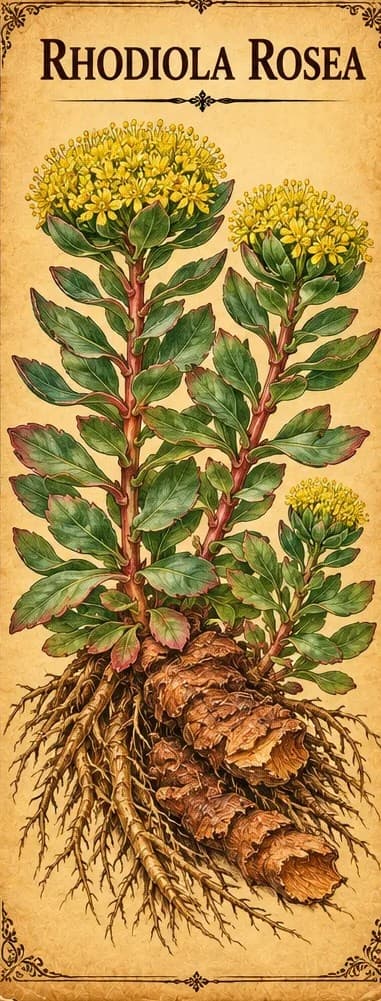
Rhodiola Rosea
Rhodiola rosea
Golden root, recognised in the EU as a traditional herbal medicine for stress symptoms such as tiredness and exhaustion. Small trials suggest it may help exercise performance.
Safety at a glance
- Pregnancy1 note →
- BreastfeedingNothing recorded
- MedicinesNothing recorded
- Who should avoid itNothing recorded
- AllergiesNothing recorded
- ToxicityNothing recorded
Tap a box to read the safety notes below. “Nothing recorded” means our sources don't cover it, not that it's safe.
What is Rhodiola Rosea?
- Plant family
- Crassulaceae, the stonecrop and jade plant family
- Parts used
- The underground stem (rhizome) and root, usually as a dry extract
- Genus
- Rhodiola
- Species
- rosea
Also called
Rhodiola, Golden Root, Roseroot, Arctic Root
Traditionally used for
- Stress and fatigue (traditional)
- Exercise performance (studied)
Traditionally described as
Health topics
Where Rhodiola Rosea appears in symptom search, and why. Being listed doesn't mean it's a proven treatment.
Traditions that use it
- European Folk Medicine
A traditional EU herbal medicine for relief of stress symptoms such as fatigue and exhaustion.
How it's prepared
Common ways Rhodiola Rosea is prepared or sold. This isn't advice on how to take it; see Safety below.
- Decoction
Herbalists simmer 1 to 2 teaspoons of the root in a cup of water.[1]General reference
- Extract
A dry extract of the root is taken by mouth in tablets or capsules.[2]Health agency
- Tincture
Herbalists use it as a tincture.[1]General reference
Safety
Side effects
Reported side effects include headache, nausea, stomach pain, diarrhea, and skin rash or itching. No clinically relevant drug interactions have been seen.[2]Health agency
Pregnancy
Its safety in pregnancy and breastfeeding hasn't been established, so it isn't recommended then. It isn't recommended for under-18s.[2]Health agency
What does the research say?
Traditional use
These are traditional uses, not proven treatments.
The European Medicines Agency recognises rhodiola root as a traditional herbal medicine, based on long use rather than trials, for relief of stress symptoms such as tiredness and exhaustion.
- The usual dose is 144 to 400 mg of extract a day, in 1 or 2 doses
- See a doctor if symptoms last more than 2 weeks
It's for adults only.[2]Health agency
Research in people
A 2022 review of 10 small trials, with 10 to 48 healthy adults each, looked at rhodiola and exercise. Most reported better athletic performance and endurance, and no obvious side effects. The trials were short (1 hour to 37 days), and the reviewers say larger, more rigorous trials are needed.[3]Review or trial
In short
Not for under-18s or in pregnancy or breastfeeding. May cause headache or stomach upset.
Sources
- [1] Rhodiola — Herban Herbalist materia medica — Herban Herbalist (herb shop)General reference
- [2] European Union herbal monograph on Rhodiola rosea L., rhizoma et radix, Final – Revision 1 (EMA/HMPC/24177/2023) — European Medicines Agency, Committee on Herbal Medicinal Products (HMPC)Government health agency
- [3] Effects of Rhodiola Rosea Supplementation on Exercise and Sport: A Systematic Review · DOI: 10.3389/fnut.2022.856287Review or clinical trial
This information is educational and traditional in nature, and is not a substitute for professional medical advice. Unfamiliar word? See what these words mean.