
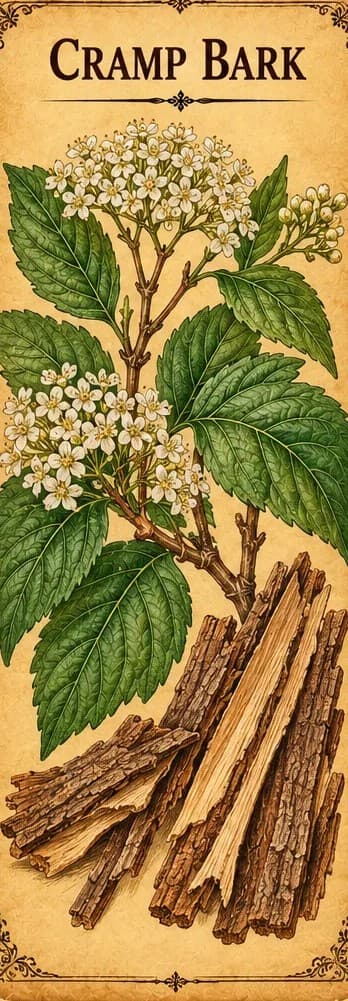
Cramp Bark
Viburnum opulus
The bark of the guelder rose, traditionally used for bleeding from the stomach or uterus and for haemorrhoids; the plant is used for coughs, colds and kidney problems. Research is in the lab and in animals.
Safety at a glance
- PregnancyNothing recorded
- BreastfeedingNothing recorded
- MedicinesNothing recorded
- Who should avoid itNothing recorded
- AllergiesNothing recorded
- ToxicityNothing recorded
Tap a box to read the safety notes below. “Nothing recorded” means our sources don't cover it, not that it's safe.
What is Cramp Bark?
- Plant family
- Viburnaceae, the viburnum and elder family
- Parts used
- The bark; the red berries are also eaten and made into juice
- Genus
- Viburnum
- Species
- opulus
Also called
Crampbark, Guelder Rose, European Cranberrybush, Snowball Tree, Water Elder
Regional names
Gilaburu
Traditionally used for
- Stomach or uterine bleeding (traditional)
- Haemorrhoids (traditional)
- Coughs and colds (traditional)
- Kidney problems (traditional)
Traditionally described as
Health topics
Where Cramp Bark appears in symptom search, and why. Being listed doesn't mean it's a proven treatment.
- Cough
A traditional remedy for coughs and colds. Not tested in trials.
- Kidney Stones
In one study, cramp bark extract helped small ureter stones pass about as well as tamsulosin, with less pain medicine needed.
Traditions that use it
- European Folk Medicine
Used for coughs, colds, rheumatic aches, ulcers, and stomach and kidney problems; the bark for stomach or uterine bleeding and haemorrhoids.
How it's prepared
Common ways Cramp Bark is prepared or sold. This isn't advice on how to take it; see Safety below.
- Culinary Preparation
The sour red berries are cooked into jams, cordials and pies, and in Turkey the fermented juice (gilaburu) is a traditional drink.[1]Study
What does the research say?
Traditional use
These are traditional uses, not proven treatments.
Cramp bark, also called guelder rose, is traditionally used for coughs, colds, tuberculosis, rheumatic aches, ulcers, and stomach and kidney problems. The bark is used for bleeding from the stomach or uterus and for haemorrhoids.[1]Study
Its sour red berries are cooked into jams, cordials and pies in Russia and Ukraine. In Turkey, the fermented juice (gilaburu) is a traditional drink, also used for liver disease, diabetes and high blood pressure.[1]Study
Laboratory & animal research
Lab and animal results show what might be worth studying in people. They don't show that the herb has these effects in humans.
In rats, an extract of the berries increased urination and lowered oxalate, the main substance in kidney stones. A berry extract also relaxed blood vessels in lab tests. Lab studies of different parts of the plant report effects against microbes, inflammation, diabetes and cancer cells. These haven't been tested in people.[1]Study
A 2014 lab analysis found cramp bark (gilaburu) fruit juice has as much citrate as lemon juice, more potassium and less calcium and sodium. Citrate helps prevent some kidney stones, so the authors suggest it may be an alternative for people with low urine citrate; this needs clinical testing.[2]Study
Research in people
In a 2021 Turkish study, 86 people with a kidney stone of 10 mm or less in the lower ureter took either cramp bark (gilaburu) extract or tamsulosin, a standard medicine that helps stones pass. Stones passed at similar rates and speed, and the cramp bark group needed less extra pain relief and fewer emergency visits.[3]Study
Technical detail: prospective two-group comparison (not described as randomized); on-demand diclofenac in both groups; extra analgesia 37.2% vs 65.1% (p = 0.017).
Sources
- [1] Viburnum opulus L.—A Review of Phytochemistry and Biological Effects · DOI: 10.3390/nu12113398Peer-reviewed study
- [2] Viburnum opulus: could it be a new alternative, such as lemon juice, to pharmacological therapy in hypocitraturic stone patients? · DOI: 10.4081/aiua.2014.4.297Peer-reviewed study
- [3] Gilaburu extract (Viburnum opulus Linnaeus) is as effective as Tamsulosin in medical expulsive therapy of distal ureteral calculi · DOI: 10.1111/ijcp.14950Peer-reviewed study
This information is educational and traditional in nature, and is not a substitute for professional medical advice. Unfamiliar word? See what these words mean.