
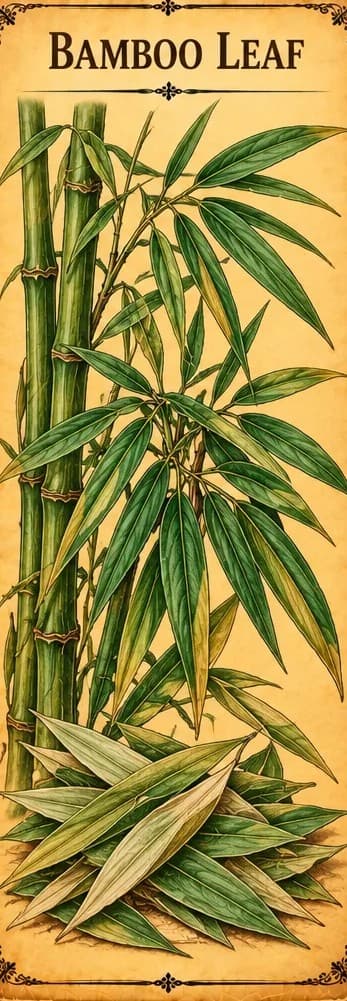
Bamboo Leaf
Lophatherum gracile
Dan zhu ye, the Chinese "bamboo leaf" herb from a bamboo-like grass, used as tea and medicine for feverish thirst, painful urination and tongue sores.
Safety at a glance
- PregnancyNothing recorded
- BreastfeedingNothing recorded
- MedicinesNothing recorded
- Who should avoid itNothing recorded
- AllergiesNothing recorded
- ToxicityNothing recorded
Tap a box to read the safety notes below. “Nothing recorded” means our sources don't cover it, not that it's safe.
What is Bamboo Leaf?
- Plant family
- Poaceae, the grass family
- Parts used
- The dried stems and leaves, usually as tea
- Genus
- Lophatherum
- Species
- gracile
Also called
Lophatheri Herba, Lophatherum
Traditional names
Dan Zhu Ye, Danzhuye
Traditionally used for
- Feverish thirst (traditional)
- Painful urination (traditional)
- Tongue sores (traditional)
- Tea
Traditionally described as
- Killed bacteria (in lab studies)
Health topics
Where Bamboo Leaf appears in symptom search, and why. Being listed doesn't mean it's a proven treatment.
- Bladder and Urinary Tract Infections (UTIs)
Traditionally used for painful urination. Not tested in trials.
Traditions that use it
- Traditional Chinese Medicine
Called dan zhu ye; used for feverish heartburn and thirst, painful urination and tongue sores, and drunk as tea in southern China.
How it's prepared
Common ways Bamboo Leaf is prepared or sold. This isn't advice on how to take it; see Safety below.
- Tea / Infusion
Bamboo leaf is a popular tea in southern China, and it's added to drinks and other foods.[1]Study
What does the research say?
Traditional use
These are traditional uses, not proven treatments.
The Chinese herb sold as "bamboo leaf" (dan zhu ye) is the dried stems and leaves of Lophatherum gracile, a bamboo-like grass. It's used as both food and medicine, mainly for:
- Feverish heartburn and thirst
- Painful urination
- Sores on the tongue
In southern China it's a popular tea, and it's added to drinks and other foods.[1]Study
Laboratory & animal research
Lab and animal results show what might be worth studying in people. They don't show that the herb has these effects in humans.
In lab and animal studies, its extracts and flavonoids slowed bacteria and viruses, may help reduce inflammation, protected the liver and heart, lowered blood sugar and slowed some cancer cells. Research on it is limited, and its clinical use hasn't been well studied.[1]Study
Sources
- [1] Research and utilization status of Lophatherum gracile: A medicinal and food homologous plant · DOI: 10.1016/j.chmed.2024.07.006Peer-reviewed study
This information is educational and traditional in nature, and is not a substitute for professional medical advice. Unfamiliar word? See what these words mean.