
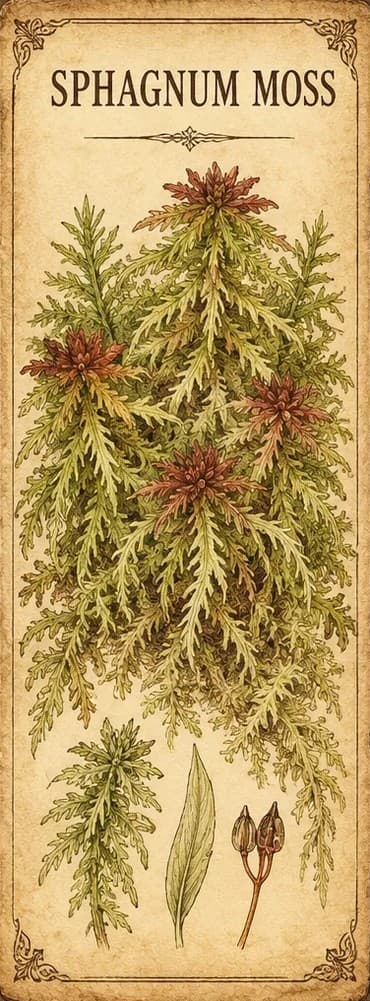
Sphagnum Moss
Sphagnum spp.
Peat moss, a very absorbent bog moss used in Europe for centuries as a wound dressing and as nappies and bedding for babies.
Safety at a glance
- PregnancyNothing recorded
- BreastfeedingNothing recorded
- MedicinesNothing recorded
- Who should avoid itNothing recorded
- AllergiesNothing recorded
- ToxicityNothing recorded
Tap a box to read the safety notes below. “Nothing recorded” means our sources don't cover it, not that it's safe.
What is Sphagnum Moss?
- Plant family
- Sphagnaceae, the peat moss family
- Parts used
- The whole dried moss
- Genus
- Sphagnum
- Species
- spp.
Also called
Peat Moss, Bog Moss, Sphagnum palustre
Traditionally used for
- Wound dressing (traditional)
- Baby nappies and bedding (traditional)
Traditionally described as
- Very absorbent
Health topics
Where Sphagnum Moss appears in symptom search, and why. Being listed doesn't mean it's a proven treatment.
- Cuts, Wounds, Burns and Skin Ulcers
Historically used as a wound dressing; not tested in modern trials.
Traditions that use it
- European Folk Medicine
Used in Europe as a wound dressing, and as nappies and bedding for babies.
How it's prepared
Common ways Sphagnum Moss is prepared or sold. This isn't advice on how to take it; see Safety below.
What does the research say?
Traditional use
These are traditional uses, not proven treatments.
Old European medical books record sphagnum moss being used:
- As nappies and bedding for babies, because it soaks up urine well
- As a dressing for wounds
- Boiled with beer and applied as a poultice to swollen feet in older people
When interest in medicinal mosses faded in the 1880s, sphagnum stayed in use as a source of wound dressings.[1]Study
Laboratory & animal research
Lab and animal results show what might be worth studying in people. They don't show that the herb has these effects in humans.
Sphagnum dressings can soak up 3 to 4 times as much as cotton ones. Lab research suggests a sugar-like substance in the moss (sphagnan) binds to proteins, which may trap bacteria and switch off the harmful substances they release. This is a proposed explanation for its use on wounds, not proof from studies in people.[2]Study
Technical detail: inactivation of enzymes by a Maillard reaction; the moss's complex pectin resembles immune-stimulating pectins from other wound-healing plants.
Sources
- [1] Four Centuries of Medicinal Mosses and Liverworts in European Ethnopharmacy and Scientific Pharmacy: A Review · DOI: 10.3390/plants10071296Peer-reviewed study
- [2] Concerning the wound-healing properties of Sphagnum holocellulose: the Maillard reaction in pharmacology · DOI: 10.1016/S0378-8741(03)00189-2Peer-reviewed study
This information is educational and traditional in nature, and is not a substitute for professional medical advice. Unfamiliar word? See what these words mean.