
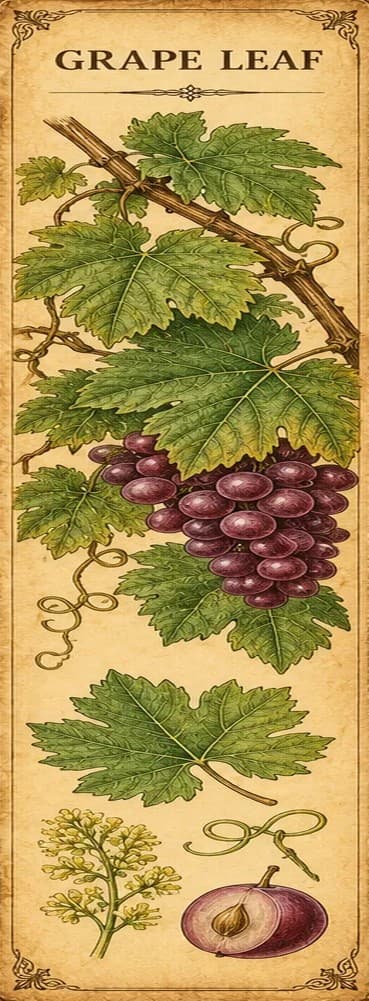
Grape Leaf
Vitis vinifera
Grapevine leaf, recognized in Europe as a medicine for long-term poor circulation in the leg veins, with swollen, heavy legs and varicose veins.
Safety at a glance
- PregnancyNothing recorded
- BreastfeedingNothing recorded
- MedicinesNothing recorded
- Who should avoid it1 note →
- AllergiesNothing recorded
- ToxicityNothing recorded
Tap a box to read the safety notes below. “Nothing recorded” means our sources don't cover it, not that it's safe.
What is Grape Leaf?
- Plant family
- Vitaceae, the grape family
- Parts used
- The dried leaves, as a tea, tablets or capsules, or in creams and gels for the skin
- Genus
- Vitis
- Species
- vinifera
Also called
Grapevine Leaf, Red Vine Leaf, Vitis vinifera
Traditionally used for
- Poor leg vein circulation
- Heavy legs (traditional)
- Piles (traditional)
Traditionally described as
Health topics
Where Grape Leaf appears in symptom search, and why. Being listed doesn't mean it's a proven treatment.
- Poor Circulation
Recognized in Europe as a well-established medicine for long-term poor circulation in the leg veins.
Traditions that use it
- European Folk Medicine
Recognized in Europe for long-term poor circulation in the leg veins, and traditionally for heavy legs, piles and fragile skin capillaries.
How it's prepared
Common ways Grape Leaf is prepared or sold. This isn't advice on how to take it; see Safety below.
- Extract
A dry extract of grapevine leaves is taken by mouth in tablets or capsules.[1]Health agency
- Powder
The powdered dried leaves are taken by mouth.[1]Health agency
- Salve
Creams and gels made with grapevine leaf extract are applied to the skin.[1]Health agency
- Tea / Infusion
The dried, cut leaves are made into an herbal tea.[1]Health agency
Safety
Who should avoid it
Grapevine leaf medicines are for adults only. See a doctor if symptoms last more than 2 weeks for leg circulation problems, or more than 1 week for piles or fragile skin capillaries.[2]Health agency
Side effects
Reported side effects include allergic skin reactions (itching and redness), nausea, stomach and gut complaints, and headache. How often these happen isn't known.[2]Health agency
What does the research say?
Traditional use
These are traditional uses, not proven treatments.
Based on long-standing use, the European Medicines Agency also recognizes grapevine leaf as a traditional herbal medicine for adults:
- To relieve discomfort and heaviness of the legs from minor vein circulation problems
- To relieve itching and burning from piles (haemorrhoids), after a doctor has ruled out anything serious
- For symptoms of fragile small blood vessels in the skin
This rests on at least 30 years of safe use, not on proof from clinical trials.[2]Health agency
Research in people
The European Medicines Agency accepts grapevine leaf as a well-established medicine for long-term poor circulation in the leg veins (chronic venous insufficiency). This causes swollen legs, varicose veins, and heavy, painful, tired, itchy or cramping calves. Some clinical studies found it improved symptoms, including leg swelling. Treatment is usually for 12 weeks.[2]Health agency
In short
For adults only.
Sources
- [1] European Union herbal monograph on Vitis vinifera L., folium — European Medicines Agency, Committee on Herbal Medicinal Products (HMPC)Government health agency
- [2] Grapevine leaf (Vitis vinifera L., folium): summary for the public (EMA/381757/2017) — European Medicines Agency, Committee on Herbal Medicinal Products (HMPC)Government health agency
This information is educational and traditional in nature, and is not a substitute for professional medical advice. Unfamiliar word? See what these words mean.