
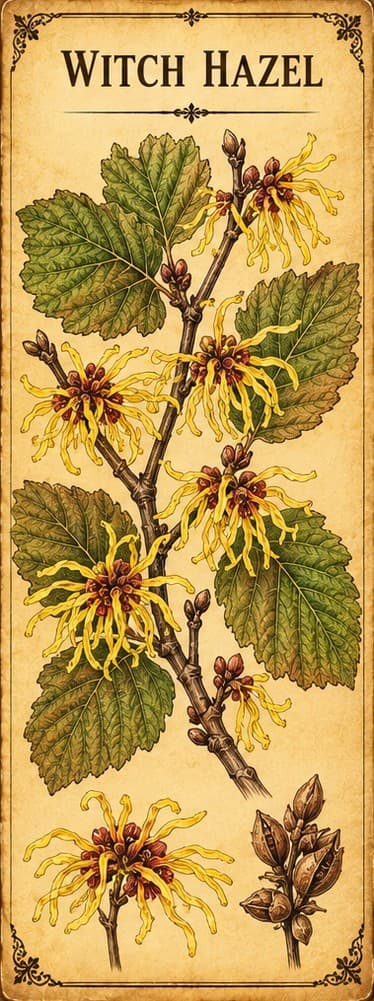
Witch Hazel
Hamamelis virginiana
A North American shrub whose leaves are recognized in Europe as a traditional medicine for minor skin inflammation, itchy piles and mouth inflammation.
Safety at a glance
- Pregnancy1 note →
- BreastfeedingNothing recorded
- MedicinesNothing recorded
- Who should avoid it1 note →
- Allergies1 note →
- ToxicityNothing recorded
Tap a box to read the safety notes below. “Nothing recorded” means our sources don't cover it, not that it's safe.
What is Witch Hazel?
- Plant family
- Hamamelidaceae, the witch hazel family
- Parts used
- The leaves, as creams, liquids, dressings, suppositories and gargles
- Genus
- Hamamelis
- Species
- virginiana
Also called
Hamamelis, Hamamelis virginiana
Traditionally used for
- Minor skin inflammation (traditional)
- Piles (traditional)
- Mouth gargle (traditional)
Traditionally described as
Health topics
Where Witch Hazel appears in symptom search, and why. Being listed doesn't mean it's a proven treatment.
- Eczema
Witch hazel creams helped atopic eczema in some trials, but a mild hydrocortisone cream worked better in another.
- Skin Irritation, Rashes and Itching
Recognized in Europe as a traditional medicine for minor skin inflammation and dry skin.
- Sore Throat
Recognized in Europe as a traditional mouthwash and gargle for minor inflammation in the mouth.
Traditions that use it
- European Folk Medicine
Recognized in Europe as a traditional herbal medicine for minor skin inflammation, itchy piles and mouth inflammation.
How it's prepared
Common ways Witch Hazel is prepared or sold. This isn't advice on how to take it; see Safety below.
- Decoction
The dried, cut leaves are simmered in water to make a liquid for the skin or for rinsing the mouth.[1]Health agency
- Salve
Creams, ointments and gels made with witch hazel leaf are used on the skin and around the anus, for example for hemorrhoids.[1]Health agency
Safety
Who should avoid it
If you have bleeding from the back passage, see a doctor. See a doctor too if symptoms get worse or don't go away. Some witch hazel liquids contain alcohol.[1]Health agency
Allergies
Allergic skin rashes (contact dermatitis) have been reported. How often isn't known. Don't use it if you're allergic to witch hazel.[1]Health agency
Pregnancy
Its safety in pregnancy and breastfeeding hasn't been established.[1]Health agency
What does the research say?
Traditional use
These are traditional uses, not proven treatments.
Based on long-standing use, the European Medicines Agency recognizes witch hazel leaf as a traditional herbal medicine:
- On the skin, for minor skin inflammation and dry skin (age 6 and up)
- For itching and burning from piles (haemorrhoids), as creams, dressings or suppositories (adults only)
- As a mouthwash or gargle for minor inflammation inside the mouth (age 12 and up)
This rests on long-standing use, not on proof from clinical trials.[1]Health agency
Native American nations have used witch hazel in several ways:
- The Iroquois drink a tea of the dried leaves for sore throats, colds and diarrhea
- The Osage make medicine from the bark for skin sores and ulcers (probably from the related Ozark witch hazel)
- The Potawatomi use it in sweat lodges
The Mohegan are believed to have shown European settlers how to use forked witch hazel branches for dowsing (searching for underground water).[2]General reference
In Appalachian folk medicine, witch hazel is one of the most widely used remedies. It's put on the skin for poison ivy rash, burns, sunburn, acne, eczema, sore gums, tired muscles, bruises, sprains, insect bites, varicose veins and hemorrhoids. Herbalists also use it in shallow sitz baths for hemorrhoids and soreness after childbirth. These uses come from herbal practice and haven't been tested in clinical trials.[2]General reference
Drugstore witch hazel is made by steam-distilling the twigs and adding alcohol. According to the Chestnut School, it's much weaker than a homemade tea or tincture of the bark, twigs, leaves and buds. Most uses are on the skin, and the authors keep witch hazel tea for use on the outside of the body.[3]General reference
Research in people
A 2013 review describes clinical studies of witch hazel creams for eczema, with mixed results:
- Creams with witch hazel leaf extract were reported effective for atopic eczema in children and other eczemas
- In 72 people with severe atopic eczema, a cream with witch hazel distillate worked about as well as a non-steroid anti-itch cream (bufexamac)
- But a mild steroid cream (0.5% hydrocortisone) worked better than a witch hazel distillate cream for moderately severe atopic eczema
In people, a lotion with 10% witch hazel water also reduced sunburn redness.[4]Study
In short
Can cause allergic skin rashes. See a doctor about any rectal bleeding.
Sources
- [1] Community herbal monograph on Hamamelis virginiana L., folium (EMA/HMPC/114586/2008) — European Medicines Agency, Committee on Herbal Medicinal Products (HMPC)Government health agency
- [2] The Folklore and Medicine of Witch Hazel — Chestnut School of Herbal MedicineGeneral reference
- [3] Witch Hazel Wonders: Cultivation and Herbal Uses — Chestnut School of Herbal MedicineGeneral reference
- [4] Medicinal plants used in treatment of inflammatory skin diseases — Postępy Dermatologii i Alergologii · DOI: 10.5114/pdia.2013.35620Peer-reviewed study
This information is educational and traditional in nature, and is not a substitute for professional medical advice. Unfamiliar word? See what these words mean.