
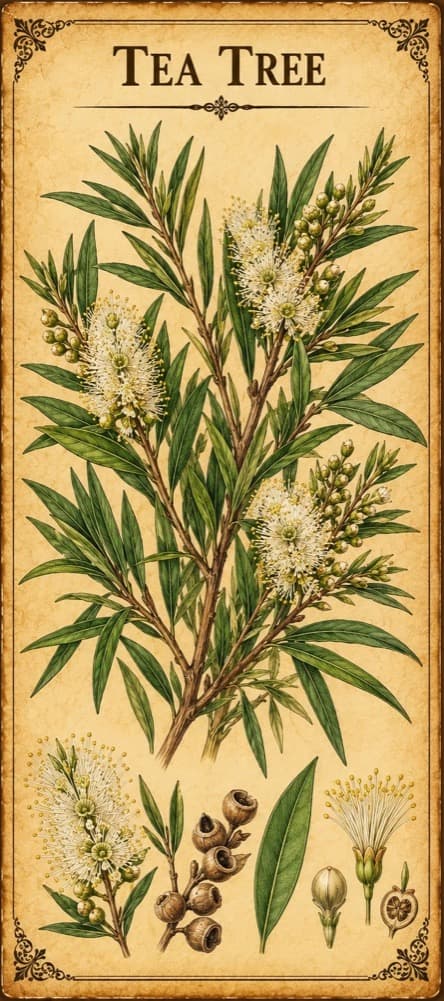
Tea Tree
Melaleuca alternifolia
An Australian tree whose leaves Aboriginal Australians used for wounds, burns and insect bites. Its oil, used on the skin, may modestly help acne. Never swallow it.
Safety at a glance
- Pregnancy1 note →
- BreastfeedingNothing recorded
- MedicinesNothing recorded
- Who should avoid itNothing recorded
- AllergiesNothing recorded
- Toxicity1 note →
Tap a box to read the safety notes below. “Nothing recorded” means our sources don't cover it, not that it's safe.
What is Tea Tree?
- Plant family
- Myrtaceae, the myrtle family
- Parts used
- The leaves, steam-distilled to make tea tree oil
- Where it grows
- Native to eastern Australia, where most tea tree oil is made
- Genus
- Melaleuca
- Species
- alternifolia
Also called
Tea Tree Oil, Melaleuca
Traditionally used for
- Acne
- Athlete's foot
- Wounds and burns (traditional)
- Insect bites (traditional)
Traditionally described as
- May modestly reduce acne
- Kills some germs (in lab studies)
Health topics
Where Tea Tree appears in symptom search, and why. Being listed doesn't mean it's a proven treatment.
- Acne
Several small trials and a 2026 review suggest a 5% tea tree oil gel on the skin may modestly reduce acne, with mostly mild side effects. NCCIH says more evidence is needed.
- Fungal Skin and Nail Infections (Athlete's Foot, Nail Fungus)
May help athlete's foot, but may not work as well as standard treatments. There isn't enough good research for toenail fungus.
- Head Lice and Scabies
Only tested mixed with other ingredients for lice, so its own effect is unclear.
How it's prepared
Common ways Tea Tree is prepared or sold. This isn't advice on how to take it; see Safety below.
- Essential Oil
Tea tree oil is used in liquids, creams and gels for the skin, or in liquids for the mouth.[1]Health agency
Safety
Side effects
Most people have no problems using it on the skin, but some get redness or irritation. This may be more likely if the oil is old or has been exposed to heat, light or air.[2]Health agency
Three young boys grew breast tissue while using skin products containing lavender and tea tree oils. It went away soon after they stopped. In lab tests, the oils acted a little like estrogen and blocked male hormones.[3]Study
Technical detail: prepubertal gynecomastia; estrogenic and antiandrogenic activity in human cell lines.
Pregnancy
Tea tree products used on the skin may be safe during pregnancy and while breastfeeding.[2]Health agency
Toxicity testing
Don't swallow tea tree oil, including mouthwashes that contain it. Swallowing it has caused confusion, unsteadiness, being unable to walk, and coma.[2]Health agency
What does the research say?
Traditional use
These are traditional uses, not proven treatments.
Aboriginal Australians used tea tree leaves for wounds, burns and insect bites. Today the oil is promoted for use on the skin for acne, athlete's foot, toenail fungus, lice and other conditions.[2]Health agency
Research in people
What research says about tea tree oil on the skin:
- Acne: limited research suggests it might help, but more evidence is needed.
- Athlete's foot: it may help, but may not work as well as standard treatments.
- Toenail fungus: there isn't enough good research to say.
- Lice: it has only been tested mixed with other ingredients, so its own effect is unclear.
- Eyelid inflammation from tiny mites, and gum problems or bad breath (in mouthwashes): results are uncertain.
A 2026 review combined 7 studies with 445 people with acne. Tea tree oil on the skin was linked with a modest drop in acne severity compared with other treatments or a placebo. Side effects were mostly mild and on the skin, such as itching, dryness and burning. The authors say larger, better trials are needed.[4]Review or trial
Technical detail: pooled odds ratio 0.74 (95% CI 0.63 to 0.88); mild itching less common than with comparison treatments (pOR 0.09, 95% CI 0.03 to 0.23); overall risk of bias low.
A Cochrane review of complementary treatments for acne found low-quality evidence, from a single trial of 60 people, that tea tree oil gel may reduce the number of spots. Some people had mild side effects from the gel.[5]Review or trial
Technical detail: total skin lesion counts MD −7.53 (95% CI −10.40 to −4.66); acne severity score MD −5.75 (−9.51 to −1.99); searched to January 2014.
In an Iranian trial, 60 people with mild to moderate acne used a 5% tea tree oil gel or a placebo gel for 45 days. Tea tree oil reduced the number of spots and how severe the acne was much more than placebo. Side effects were similar in both groups.[6]Review or trial
Technical detail: randomized, double-blind; total lesion count improvement 3.55 times and acne severity index 5.75 times that of placebo.
In an Australian trial, 124 people with mild to moderate acne used a 5% tea tree oil gel or a 5% benzoyl peroxide lotion, a standard acne treatment. Both reduced red, swollen spots as well as blackheads and whiteheads. Tea tree oil worked more slowly but caused fewer side effects.[7]Review or trial
Technical detail: single-blind, randomized; reduced inflamed and non-inflamed lesions (open and closed comedones).
In short
Never swallow tea tree oil; it can cause confusion and coma. It can irritate the skin.
Sources
- [1] European Union herbal monograph on Melaleuca alternifolia (Maiden and Betch) Cheel, M. linariifolia Smith, M. dissitiflora F. Mueller and/or other species of Melaleuca, aetheroleum — European Medicines Agency, Committee on Herbal Medicinal Products (HMPC)Government health agency
- [2] Tea Tree Oil: Usefulness and Safety — National Center for Complementary and Integrative Health (NIH)Government health agency
- [3] Prepubertal gynecomastia linked to lavender and tea tree oils — New England Journal of Medicine · DOI: 10.1056/NEJMoa064725Peer-reviewed study
- [4] Efficacy and Safety of Melaleuca alternifolia (Tea Tree) Oil for Acne-A Systematic Review and Meta-Analysis — Phytotherapy Research · DOI: 10.1002/ptr.70344Review or clinical trial
- [5] Complementary therapies for acne vulgaris — Cochrane · DOI: 10.1002/14651858.CD009436.pub2Review or clinical trial
- [6] The efficacy of 5% topical tea tree oil gel in mild to moderate acne vulgaris: a randomized, double-blind placebo-controlled study — Indian Journal of Dermatology, Venereology and Leprology · DOI: 10.4103/0378-6323.30646Review or clinical trial
- [7] A comparative study of tea-tree oil versus benzoylperoxide in the treatment of acne — Medical Journal of Australia · DOI: 10.5694/j.1326-5377.1990.tb126150.xReview or clinical trial
This information is educational and traditional in nature, and is not a substitute for professional medical advice. Unfamiliar word? See what these words mean.